










Torrent Power Q2 revenue rose 24% as gas PLF fell sharply
Key highlights
- Torrent Power's Q2 26-27 revenue from operations rose 24% to Rs 9,802 crore.
- Torrent Power's reported GAS PLF fell to 16.6% in Q2-27 from 25.2% in Q2-26.
- Torrent Power's Q2-27 wind PLF rose to 39.2% from 30.1%, while solar PLF increased to 17.1%.
- Torrent Power reported Q2 26-27 profit after tax of Rs 838 crore, up 13% year on year.
powered by IRIS
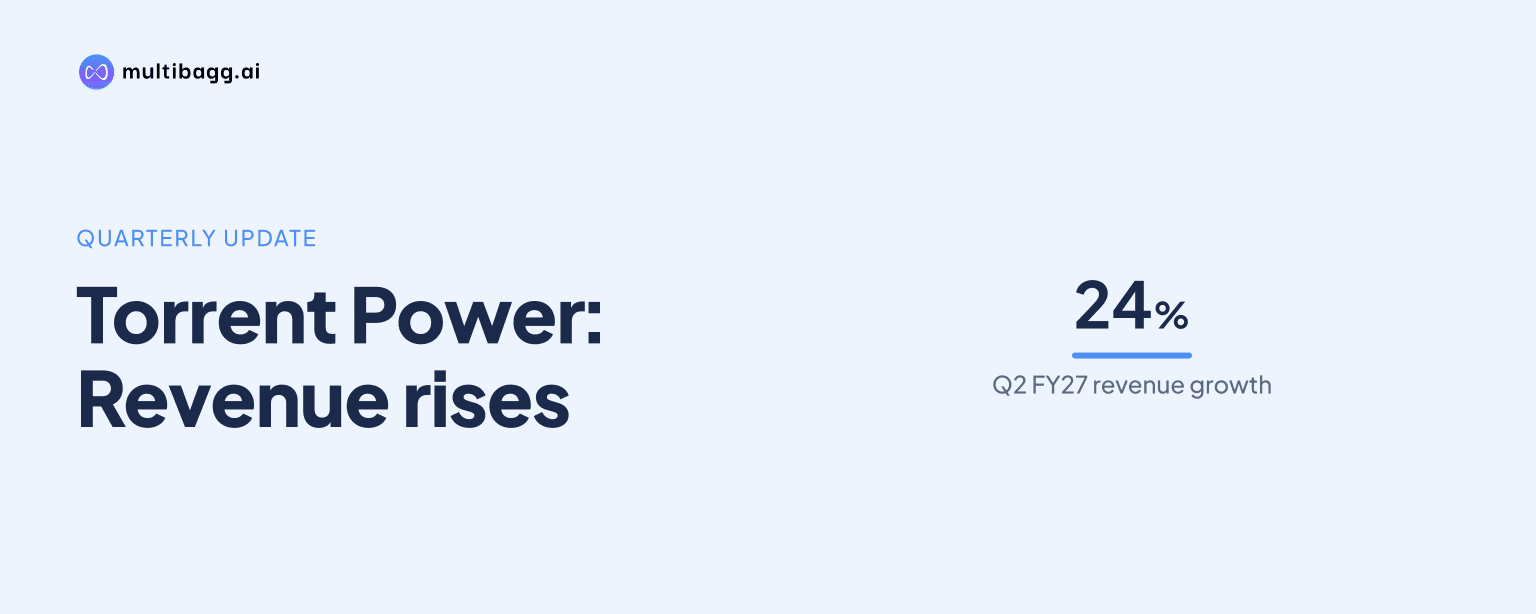
Torrent Power reported revenue from operations of Rs 9,802 crore in Q2 26-27, up 24% from Rs 7,876 crore a year earlier, while the GAS plant-load factor, or PLF, fell to 16.6% from 25.2%. Profit after tax increased 13% to Rs 838 crore as renewable utilisation improved and distribution losses were broadly stable.
Know Torrent Power inside out
Results, valuation, peers and who's buying, in one view.
How did Torrent Power's Q2 26-27 financial results change?
Torrent Power's Q2 26-27 revenue, contribution, profit before depreciation, interest and tax, or PBDIT, and profit after tax all increased from Q2 25-26. Revenue rose by Rs 1,926 crore, contribution increased by Rs 377 crore and PBDIT rose by Rs 404 crore, while profit after tax increased by Rs 96 crore.
Torrent Power's power purchase cost increased by Rs 2,006 crore, exceeding the Rs 1,926 crore increase in revenue, while other income rose to Rs 249 crore from Rs 78 crore. Finance cost increased to Rs 439 crore from Rs 216 crore, and depreciation and amortisation expense rose to Rs 418 crore from Rs 389 crore.
For H1 26-27, Torrent Power reported revenue of Rs 17,926 crore, up 14% from Rs 15,782 crore in H1 25-26. PBDIT also grew 14% to Rs 3,606 crore, but profit after tax rose by Rs 17 crore to Rs 1,500 crore as finance cost increased to Rs 732 crore from Rs 428 crore.
Why did Torrent Power's gas-plant utilisation decline?
Torrent Power's reported GAS PLF declined by 8.6 percentage points to 16.6% in Q2-27 from 25.2% in Q2-26. PLF measures generation as a proportion of plant capacity over a stated period, and the presentation shows lower Q2 utilisation at SUGEN, UNOSUGEN and DGEN as well.
SUGEN recorded the largest disclosed Q2 decline, with PLF falling to 18.9% from 33.9%, a 15.0-percentage-point reduction. UNOSUGEN fell to 6.9% from 11.0%, while DGEN declined to 17.4% from 21.4%; in H1-27, the reported GAS PLF was 17.9%, compared with 28.4% in H1-26.
The movement was not shared across all thermal assets. AMGEN's Q2-27 PLF was 86.8%, compared with 88.5% a year earlier, while NABHA recorded 87.9% after its acquisition became effective on 25 June 2026. The presentation does not state the reason for the lower GAS PLF, so it does not establish a cause for the change.
Got a follow-up? Ask IRIS
How did Torrent Power's renewable PLFs perform in Q2-27?
Torrent Power's wind PLF increased to 39.2% in Q2-27 from 30.1% in Q2-26, and solar PLF increased to 17.1% from 16.0%. The wind comparison covers 921 megawatts in both periods, whereas solar capacity increased to 1,137 megawatts from 949 megawatts.
Torrent Power's 254-megawatt hybrid portfolio recorded a Q2-27 PLF of 38.5%, with no Q2-26 comparator presented. The company calculates renewable PLF using contracted capacity, except for merchant projects, meaning the reported percentages follow that specified measurement basis.
The H1 comparison also improved for the established renewable categories. Wind PLF rose to 36.2% in H1-27 from 30.8% in H1-26, while solar increased to 21.4% from 18.9%; hybrid PLF was 38.5% in H1-27.
Torrent Power listed about 4.5 gigawatt-peak of renewable capacity under installation against about 2.5 gigawatts of contracted capacity as of 30 September 2026. The projects have expected aggregate costs of about Rs 30,638 crore and are scheduled for progressive commissioning from FY27 through FY29, making them planned additions rather than current operating capacity.
What changed in Torrent Power's distribution volumes and losses?
Torrent Power's Q2 FY27 units sold or purchased increased in six of seven disclosed distribution areas, with Dahej rising to 250 million units from 205 million units. Ahmedabad increased to 2,591 million units from 2,508 million units, while DDDNH was the only disclosed area to decline, to 2,824 million units from 2,830 million units.
Surat's units increased to 1,112 million from 1,102 million, Bhiwandi rose to 1,084 million from 1,063 million, Agra increased to 813 million from 797 million and SMK reached 250 million from 225 million. The presentation labels these Q2 figures as USO/Purchase in million units.
Transmission and distribution, or T&D, losses in Torrent Power's licensed areas were mostly stable in H1 27. Ahmedabad remained at 5.0%, Surat declined to 3.5% from 3.6%, DDDNH fell to 1.5% from 1.7%, and Dahej increased to 0.5% from 0.4%.
In franchised distribution, Agra's H1 27 T&D loss declined to 10.2% from 11.4%, and SMK's fell to 22.1% from 24.0%. Bhiwandi increased marginally to 10.4% from 10.3%, combining with higher Q2 units in all three franchised locations.
Conclusion
Torrent Power's Q2 26-27 operating picture combined 24% revenue growth and 13% profit-after-tax growth with a lower reported GAS PLF. Wind PLF increased by 9.1 percentage points, solar PLF rose by 1.1 percentage points, and distribution losses improved in Agra and SMK while remaining close to prior-period levels in most licensed areas.
The next disclosed milestones are progressive renewable commissioning from FY27 to FY29 and the 3,000-megawatt pumped-storage hydro project in Raigad district, Maharashtra. Torrent Power has an executed agreement for 2,000 megawatts and 16,000 megawatt-hours with MSEDCL, with a scheduled commercial operation date of March 2030, while its 300-megawatt SECI award is due within 36 months of the power purchase agreement's effective date.