










Total Transport H1 Revenue Rose 53.6% Despite Volume Falls
Key highlights
- Total Transport reported H1 FY27 revenue of Rs 477.5 crore, up 53.6% year on year.
- H1 FY27 LCL volume fell to 199,484 cubic metres from 207,901 cubic metres.
- H1 FY27 FCL volume declined to 8,460 TEUs from 9,555 TEUs.
- H1 FY27 air-freight volume increased to 983 tonnes from 807 tonnes.
powered by IRIS
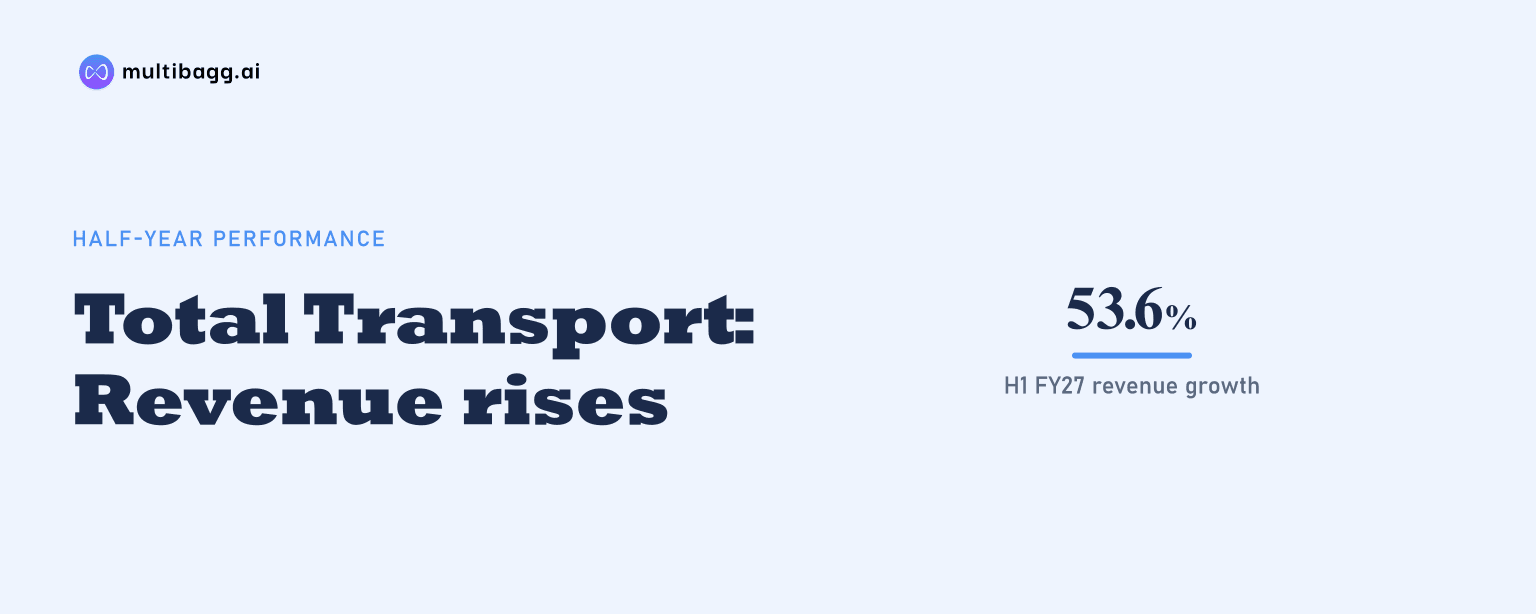
Total Transport Systems Limited reported H1 FY27 consolidated revenue of Rs 477.5 crore, up 53.6% from H1 FY26, although total less-than-container-load and full-container-load ocean volumes declined. Management attributed the increase to new clients, last-mile delivery expansion and higher air-cargo activity, with air-freight volume rising to 983 tonnes.
Know Total Transport Systems inside out
Results, valuation, peers and who's buying, in one view.
What did Total Transport report for H1 FY27?
Total Transport reported consolidated revenue of Rs 477.5 crore in H1 FY27, compared with Rs 310.9 crore in H1 FY26, a 53.6% year-on-year increase. Q2 FY27 accounted for Rs 283.9 crore of the first-half revenue, rising 46.7% from Rs 193.6 crore in Q1 FY27 and 73.7% from Rs 163.5 crore in Q2 FY26.
The revenue increase occurred despite lower aggregate volumes in Total Transport's two reported ocean-freight measures. Less-than-container-load consolidation, or LCL, fell to 199,484 cubic metres in H1 FY27 from 207,901 cubic metres in H1 FY26. Full-container-load freight forwarding, or FCL, declined to 8,460 twenty-foot equivalent units, or TEUs, from 9,555 TEUs.
The presentation shows a divergence between sales and these volume indicators: revenue increased by Rs 166.6 crore, while LCL volume fell by 8,417 cubic metres and FCL volume fell by 1,095 TEUs. It does not disclose revenue by service line, freight pricing, client additions or last-mile delivery volumes, so the respective contributions to revenue growth cannot be quantified from the presentation.
How did Total Transport's ocean-freight volumes change?
Total Transport's LCL volume fell 4.0% in H1 FY27 because a decline in export consolidation was larger than growth in imports. Import LCL volume rose to 97,131 cubic metres from 85,812 cubic metres, an increase of 11,319 cubic metres. Export LCL volume declined to 102,353 cubic metres from 122,089 cubic metres, a reduction of 19,736 cubic metres.
FCL freight forwarding declined in both import and export traffic during H1 FY27. Import FCL volume decreased to 1,139 TEUs from 1,253 TEUs, while export volume fell to 7,321 TEUs from 8,302 TEUs. Export FCL remained the larger activity at 7,321 TEUs, and its 981-TEU decrease represented most of the total FCL decline of 1,095 TEUs.
Q2 FY27 showed sequential recovery in both ocean measures, although neither exceeded the year-earlier quarter. LCL volume reached 107,980 cubic metres, up from 91,504 cubic metres in Q1 FY27 but below 109,163 cubic metres in Q2 FY26. FCL volume rose to 4,435 TEUs from 4,025 TEUs in Q1 FY27, while remaining below 5,013 TEUs in Q2 FY26.
Got a follow-up? Ask IRIS
What did management say drove Total Transport's revenue growth?
Management said new-client additions, expansion in last-mile delivery and increased air-cargo business volumes supported the H1 FY27 top-line increase. Air freight was the reported volume category that grew year on year, increasing to 983 tonnes from 807 tonnes. Its 176-tonne increase contrasted with the declines in total LCL and FCL volumes.
Export air freight drove the increase, rising to 828 tonnes in H1 FY27 from 632 tonnes in H1 FY26. Air-freight imports moved in the opposite direction, declining to 155 tonnes from 175 tonnes. In Q2 FY27, export air freight rose to 483 tonnes from 335 tonnes a year earlier, while imports fell to 66 tonnes from 104 tonnes.
Management also described Total Transport's service portfolio as diversified and its business model as asset-light. Those are management characterisations rather than measures of segment performance. The presentation provides no air-cargo revenue, client count, last-mile delivery revenue or delivery volume, leaving the weight of each stated driver undisclosed.
How did Total Transport's earnings change with revenue?
Total Transport's earnings grew faster than revenue in H1 FY27. Earnings before interest, tax, depreciation and amortisation, or EBITDA, rose 84.5% to Rs 16.9 crore from Rs 9.2 crore, and the EBITDA margin increased to 3.5% from 2.9%. Profit after tax rose to Rs 11.2 crore from Rs 5.3 crore, with its margin increasing to 2.4% from 1.7%.
Q2 FY27 also recorded higher profit measures than both the prior quarter and the year-earlier quarter. EBITDA was Rs 10.4 crore, compared with Rs 6.5 crore in Q1 FY27 and Rs 4.8 crore in Q2 FY26, while the margin reached 3.7%. Profit after tax was Rs 7.1 crore, versus Rs 4.1 crore sequentially and Rs 2.4 crore a year earlier.
Earnings before interest and tax, or EBIT, increased to Rs 17.0 crore in H1 FY27 from Rs 9.0 crore in H1 FY26, and the EBIT margin rose to 3.6% from 2.9%. The presentation reports operating expenses of Rs 412.5 crore in H1 FY27 against Rs 261.9 crore a year earlier, but it does not provide service-level pricing, mix or cost data to explain the margin change.
Conclusion
Total Transport's H1 FY27 figures show that revenue and profit increased even as its aggregate LCL and FCL ocean-freight volumes contracted. Revenue rose 53.6% to Rs 477.5 crore, EBITDA increased 84.5% to Rs 16.9 crore and air-freight volume reached 983 tonnes, while total LCL and FCL volumes fell from H1 FY26 levels.
Management's disclosed next steps are expansion into more cities, stronger last-mile delivery operations and dedicated teams for air cargo. The next results will show whether those plans sustain air-freight growth and whether LCL volume of 199,484 cubic metres and FCL volume of 8,460 TEUs return to year-on-year growth.