










Vilas Transcore H1FY27 profit falls 29% on lower steel prices
Key highlights
- CRGO lamination volume rose 28.1% year on year to 11,697 MT in H1FY27.
- Revenue from operations increased 6.0% year on year to Rs 242.5 crore in H1FY27.
- PAT fell 29.3% year on year to Rs 17.2 crore and PAT margin declined to 7.1%.
- EBITDA margin improved sequentially to 10.2% in H1FY27 from 8.8% in H2FY26.
powered by IRIS
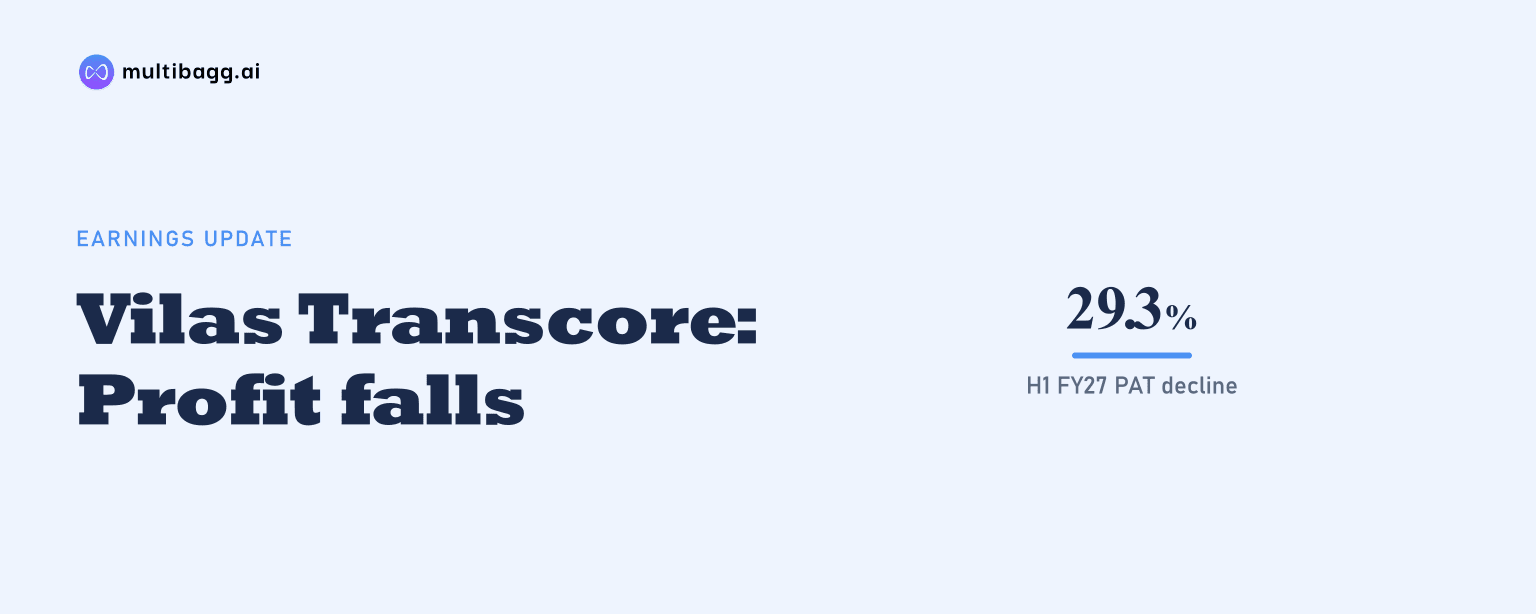
Vilas Transcore Limited reported first-half financial year 2027 (H1FY27) profit after tax of Rs 17.2 crore, down 29.3% year on year, as lower cold rolled grain-oriented steel prices constrained realisations despite a 28.1% rise in CRGO lamination volume to 11,697 metric tonnes (MT) and 6.0% revenue growth.
Know Vilas Transcore inside out
Results, valuation, peers and who's buying, in one view.
Why did Vilas Transcore’s profit fall despite higher CRGO volumes?
Vilas Transcore’s profit fell because lower CRGO steel prices reduced sales realisations, while higher depreciation and initial costs for expanded facilities and new product lines also affected year-on-year profitability. Revenue from operations rose to Rs 242.5 crore in H1FY27 from Rs 228.8 crore in H1FY26, but profit after tax (PAT) fell to Rs 17.2 crore from Rs 24.4 crore.
The difference between volume and revenue growth was pronounced in H1FY27. CRGO lamination volume increased by 2,563 MT from 9,134 MT in H1FY26 to 11,697 MT, whereas revenue increased by Rs 13.7 crore. Gross profit declined 7.7% to Rs 41.6 crore, and gross margin declined by 255 basis points (bps), where one basis point is one-hundredth of a percentage point, to 17.2% from 19.7%.
Earnings before interest, tax, depreciation and amortisation (EBITDA) declined 20.2% year on year to Rs 24.8 crore in H1FY27, with margin falling 336 bps to 10.2%. The reported EBITDA includes a Rs 1.4 crore exchange-rate gain treated as part of core operations. Depreciation and amortisation rose to Rs 3.1 crore from Rs 1.8 crore, while finance cost increased to Rs 1.6 crore from Rs 0.8 crore.
Did Vilas Transcore improve from H2FY26?
Vilas Transcore improved sequentially from H2FY26, with H1FY27 revenue up 4.6%, EBITDA up 22.0% and PAT up 13.5%. Revenue increased from Rs 231.9 crore in H2FY26 to Rs 242.5 crore in H1FY27, while PAT rose from Rs 15.2 crore to Rs 17.2 crore.
Margins also recovered from the preceding six months, though they remained below H1FY26 levels. Gross margin rose 123 bps from 15.9% in H2FY26 to 17.2% in H1FY27, EBITDA margin increased 146 bps from 8.8% to 10.2%, and PAT margin increased 56 bps from 6.5% to 7.1%.
Vilas Transcore said geopolitical tensions and supply-chain disruption, particularly transformer-oil availability, had affected production schedules at certain transformer manufacturers during the period. It said supply conditions gradually improved and customer activity began to normalise. Volume rose by 975 MT from 10,722 MT in H2FY26 to 11,697 MT in H1FY27, alongside the sequential margin recovery.
Got a follow-up? Ask IRIS
Which new products contributed to Vilas Transcore’s H1FY27 sales?
Vilas Transcore recorded disclosed sales from nanocrystalline cores, transformer radiators and copper and aluminium conductors during H1FY27. Nanocrystalline cores generated Rs 6.77 crore of revenue on sales volume of about 58,815 kilograms, the largest disclosed contribution among the newer product lines.
Transformer radiators generated Rs 2.67 crore of revenue and about 241 MT of sales volume. Vilas Transcore said customer onboarding and product approvals were progressing for radiators, while nanocrystalline cores continued through customer acceptance and production ramp-up. These lines had commercial sales in H1FY27 but were still being scaled.
Commercial conductor sales began in September 2026 and generated Rs 0.53 crore in H1FY27. Vilas Transcore identified production ramp-up and customer development as priorities for copper and aluminium conductors. The company lists annual capacities of 240 MT for nanocrystalline cores, 7,200 MT for radiators and 1,500 to 1,800 MT for copper conductors.
Vilas Transcore also received POWERGRID approval for CRGO slitting and lamination cutting up to 220 kilovolts at Unit III. Management said the approval enables participation in relevant POWERGRID projects and higher-voltage transformer applications. CRGO lamination capacity has expanded threefold from 12,000 MT per annum to 36,000 MT per annum, making volume ramp-up and utilisation central to the operating plan.
What do Vilas Transcore’s balance sheet and cash flow show?
Vilas Transcore ended September 2026 with total assets of Rs 459.2 crore and shareholders’ funds of Rs 345.8 crore, compared with total assets of Rs 406.5 crore at March 2026. Property, plant and equipment plus intangible assets rose to Rs 122.7 crore from Rs 81.4 crore, while inventories increased to Rs 115.4 crore from Rs 72.3 crore.
Working-capital balances and current liabilities also increased over the same period. Trade receivables were Rs 82.8 crore at September 2026 versus Rs 77.5 crore at March 2026, and trade payables rose to Rs 67.0 crore from Rs 28.1 crore. Operating cash flow was Rs 36.9 crore in H1FY27, but Rs 45 crore of investing outflow and Rs 11.9 crore of financing outflow reduced cash and cash equivalents to Rs 74.3 crore from the Rs 94.4 crore opening balance.
Conclusion
Vilas Transcore’s H1FY27 performance shows that increased CRGO output did not produce comparable earnings growth when price-linked realisations declined. The 28.1% increase in volume was accompanied by a 6.0% increase in revenue, while the 20.2% year-on-year decline in EBITDA and 29.3% decline in PAT reflected lower gross margin, higher depreciation and initial costs associated with expansion and new product lines.
The next disclosed measures to watch are management’s FY27 targets of 30% to 35% growth in both volume and revenue, alongside its expectation that EBITDA and PAT margins will be maintained. Execution will depend on CRGO capacity utilisation at 36,000 MT per annum, the scale-up of nanocrystalline cores and radiators, and conductor customer development after commercial sales began in September 2026.