










Transrail proposes 49% stake in 990 MW Maharashtra solar
Key highlights
- Transrail’s board approved the proposed 49% solar-SPV investment on 19 October 2026, subject to approvals and agreed conditions.
- The proposed Maharashtra portfolio comprises roughly 990 MW AC of solar capacity and has a stated project value of Rs 3,900 crore.
- The portfolio has a 25-year MSEDCL PPA at a fixed tariff of Rs 3.10 per unit.
- Transrail may increase its proposed 49% holding potentially up to 100%, subject to agreed terms and approvals.
powered by IRIS
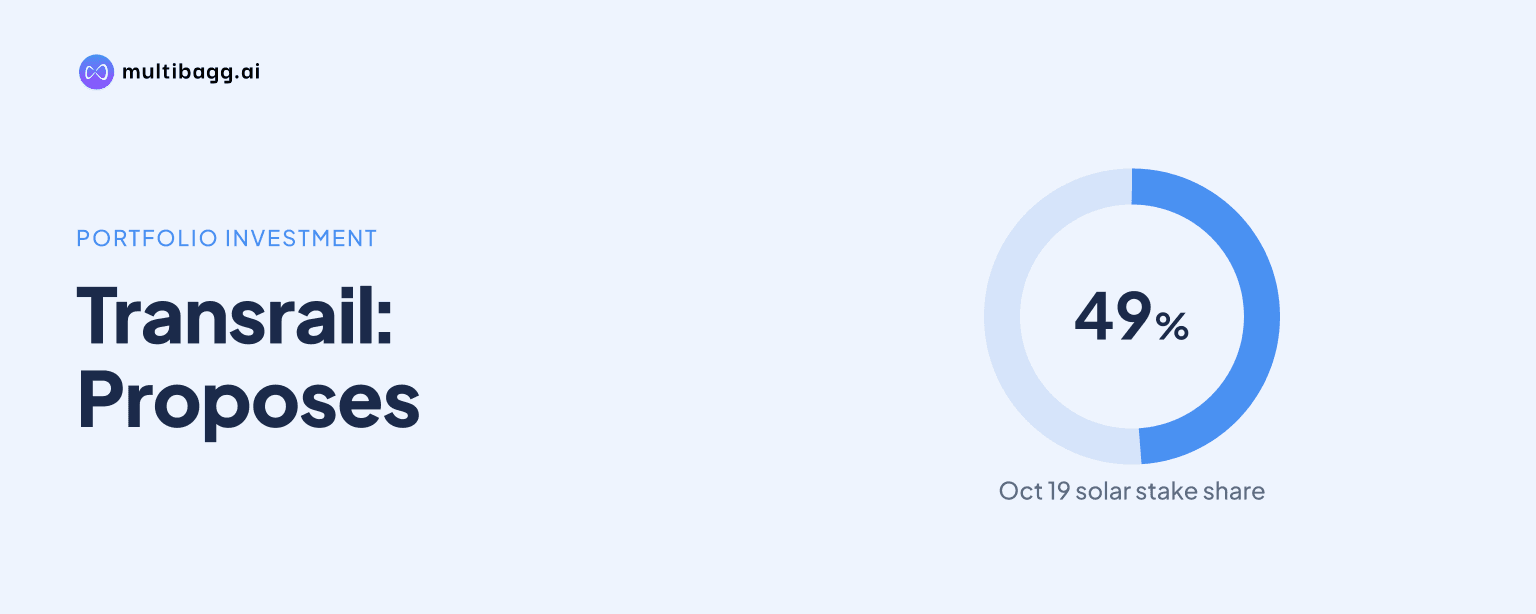
Transrail has proposed acquiring a 49% equity stake in a roughly 990 MW alternating-current solar portfolio in Maharashtra with a Rs 3,900 crore project value and a 25-year MSEDCL power purchase agreement. Transrail’s board approved the proposal on 19 October 2026, although the transaction remains subject to approvals and agreed conditions.
Know Transrail Lighting inside out
Results, valuation, peers and who's buying, in one view.
What has Transrail proposed to acquire?
Transrail has proposed acquiring 49% of a special purpose vehicle developing a roughly 990 MW alternating-current, or AC, solar portfolio in Maharashtra. The portfolio is under development through Maharashtra PM-KUSUM Component C, while the presentation places the value of the full project at Rs 3,900 crore rather than disclosing a purchase price for the proposed 49% holding.
The proposal is not a completed acquisition. Transrail says its board approved the arrangement on 19 October 2026, but completion remains subject to approvals and agreed conditions. The 49% stake, roughly 990 MW capacity and Rs 3,900 crore project value therefore describe the proposed transaction and a development-stage portfolio, rather than an operating generation asset.
The presentation does not disclose the equity investment required for the 49% stake, the special purpose vehicle’s debt funding or a scheduled commissioning date. It does state that the portfolio is a renewable-generation project, distinguishing the proposed asset from Transrail’s existing transmission engineering, procurement and construction activities and manufacturing operations.
How will the Maharashtra solar portfolio be contracted and controlled?
The proposed solar portfolio has a 25-year power purchase agreement, or PPA, with MSEDCL at a fixed tariff of Rs 3.10 per unit. This stated offtake arrangement provides the disclosed contract duration and tariff mechanism, but the presentation does not give expected annual generation, revenue, project debt or a date when the roughly 990 MW portfolio will begin supplying power.
Transrail says the agreed arrangements will provide it with financial and project-management control despite its initial 49% equity ownership. Onix Renewable Limited is named as the counterparty in those arrangements, while the stated control terms apply to a project valued at Rs 3,900 crore and still subject to approvals and agreed conditions.
The agreement also gives Transrail flexibility to increase its shareholding potentially up to 100%, subject to mutually agreed terms and applicable approvals. That provision is an option rather than a disclosed commitment: the presentation does not provide a timetable, valuation formula or funding amount for any ownership increase beyond 49%.
Why is Transrail entering renewable power generation?
Transrail presents the proposed 990 MW investment as an entry into renewable power generation beyond its engineering, procurement and construction, or EPC, business. Management says the transaction would apply the company’s engineering, procurement, project-management and execution capabilities to large power infrastructure, alongside potential long-term returns from owning a generation asset after commissioning.
The plan would put Transrail in both implementation and asset-ownership roles. The presentation says Transrail has constructed more than 37,675 circuit kilometres of transmission lines and has experience across 400 kilovolt, 765 kilovolt and 800 kilovolt segments, as well as high-voltage direct-current transmission projects. These capabilities are cited as relevant to project execution, not as evidence that the Maharashtra solar portfolio has been completed.
Transrail is pursuing the proposed solar asset while expanding its manufacturing base. Tower manufacturing capacity was 184,400 metric tonnes per annum in the current period, up from 84,000 metric tonnes per annum before the initial public offering, with 200,000 metric tonnes per annum targeted for FY27. Conductor capacity was 40,800 kilometres per annum, compared with 24,000 kilometres per annum before the initial public offering, and is targeted to reach 49,500 kilometres per annum by FY27.
Remaining tower and conductor expansion capital expenditure is scheduled for commissioning by the end of FY27. The manufacturing expansion and the Rs 3,900 crore proposed renewable project are separate initiatives, but both form part of Transrail’s stated effort to add capabilities across power-infrastructure activities.
Got a follow-up? Ask IRIS
What power-market demand backdrop does Transrail identify?
Transrail identifies a power system in which renewable capacity is expected to grow faster than non-renewable capacity between 2026 and 2032E. Its presentation shows India’s total generation capacity rising from 552 GW in 2026 to 874 GW in 2032E, with renewable capacity increasing by 307 GW and non-renewable capacity by 15 GW.
Renewable capacity is projected to rise from 308 GW to 615 GW, while non-renewable capacity moves from 244 GW to 259 GW. Transrail links this change to the need for more resilient transmission infrastructure and cites planned additions of 135,000 circuit kilometres of transmission lines and 800 gigavolt-amperes of substations over the next six years.
The presentation puts estimated transmission capital expenditure for those additions at more than Rs 10 lakh crore. It also identifies growth in power demand from urbanisation, industrialisation, cooling requirements, digital infrastructure and electric-vehicle penetration, while presenting the proposed 25-year MSEDCL PPA as the contracted offtake element of its Maharashtra generation plan.
Transrail also describes international transmission activity as an opportunity separate from the Maharashtra solar proposal. Global installed transmission length is shown rising from 5.3 million kilometres in 2021 to 7.2 million kilometres in 2030E and 12.7 million kilometres in 2050E, while projected global grid investment rises from USD 1,644 billion in calendar years 2019-23 to USD 3,053 billion in calendar years 2024-29E.
Conclusion
The proposed transaction would extend Transrail from transmission EPC and manufacturing into ownership of a contracted renewable-generation asset. Its disclosed terms combine a roughly 990 MW AC development portfolio, a Rs 3,900 crore project value, a 25-year PPA at Rs 3.10 per unit, and financial and project-management control under agreed arrangements despite initial ownership of 49%.
The next disclosed milestones are the approvals and agreed conditions required to complete the proposal approved on 19 October 2026. Transrail has also retained the option to raise its holding potentially to 100%, subject to mutually agreed terms and applicable approvals, while remaining tower and conductor expansion capital expenditure is scheduled for commissioning by the end of FY27.