










Transrail lifts tower capacity to 184,400 MTPA in H1FY27
Key highlights
- Transrail's tower capacity reached 184,400 MTPA in H1FY27, up from 84,000 MTPA before the IPO.
- Transrail targets 200,000 MTPA of tower capacity by FY27-end.
- Transrail's conductor capacity rose from 24,000 KMPA pre-IPO to 40,800 KMPA in H1FY27.
- Transrail reports more than 22,000 engineering man-months and more than 590 towers tested in-house.
powered by IRIS
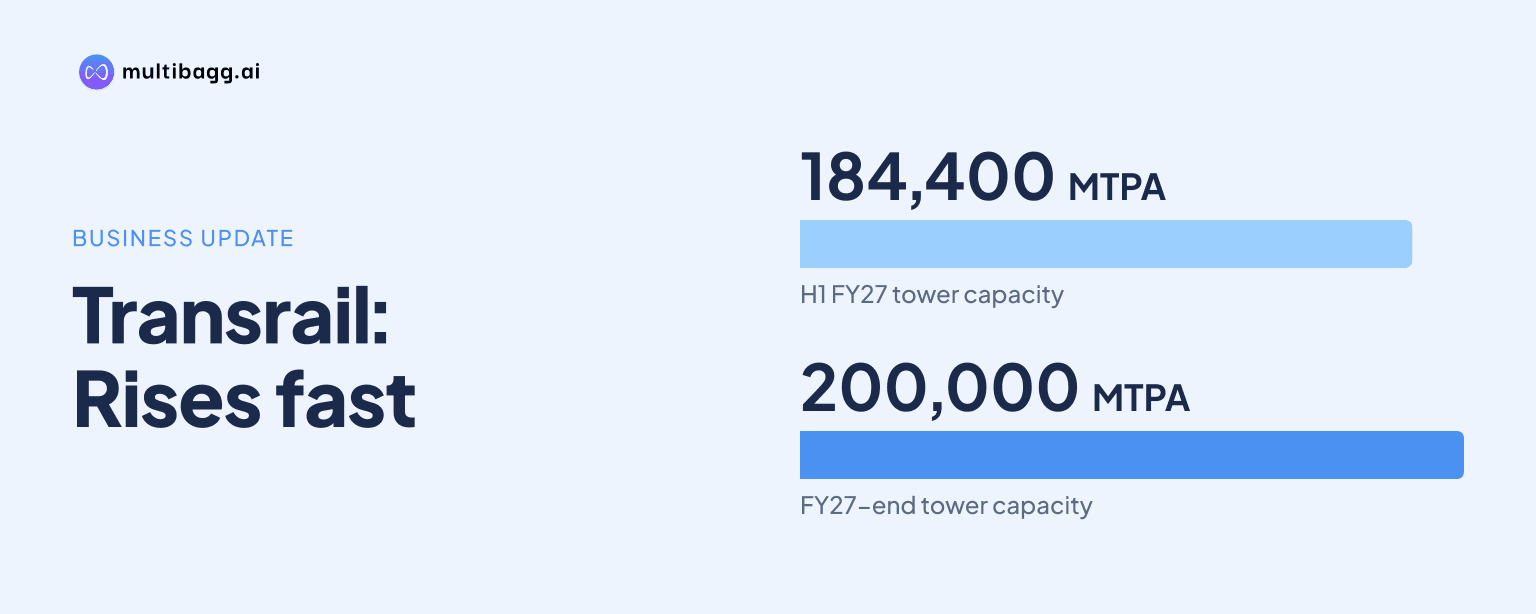
In H1FY27, Transrail increased tower manufacturing capacity to 184,400 metric tonnes per annum (MTPA), from 84,000 MTPA before its initial public offering (IPO), and plans to reach 200,000 MTPA by FY27-end. The company says remaining capital expenditure across tower and conductor facilities is scheduled for commissioning by the end of FY27.
Know Transrail Lighting inside out
Results, valuation, peers and who's buying, in one view.
How much tower capacity has Transrail added?
Transrail has added 100,400 MTPA of tower capacity from its pre-IPO base to H1FY27. The company’s manufacturing presentation lists 84,000 MTPA before the IPO and 184,400 MTPA as current capacity in H1FY27. The presentation describes the expansion from pre-IPO capacity to the FY27 level as 2.3 times.
The 15,600 MTPA gap between H1FY27 capacity and the FY27 target is linked to unfinished capital expenditure rather than a separately disclosed programme. Transrail states that the balance of capex across its tower and conductor operations is scheduled for commissioning by FY27-end. The presentation does not disclose capex spending, plant utilisation or the allocation of capacity between captive engineering, procurement and construction (EPC) requirements and external product orders.
What is Transrail's tower capacity target for FY27?
Transrail’s stated tower manufacturing target is 200,000 MTPA by the end of FY27. That target is 116,000 MTPA above its 84,000 MTPA pre-IPO capacity and 15,600 MTPA above the H1FY27 level. Management identifies FY27-end as the expected commissioning point for the remaining tower and conductor capex.
The target sits within Transrail’s integrated transmission and distribution (T&D) manufacturing model because the company says towers and conductors comprise 60% to 65% of total project cost. Its tower facilities are listed at Deoli, Vadodara, Butibori and Silvassa, with a tower-testing facility at Deoli. Transrail says this integration supports captive consumption, selected exports, supply-chain control and EPC execution, but it gives no FY27 revenue, order-book or export target specifically tied to the added tower capacity.
How is Transrail expanding conductor capacity?
Transrail increased conductor capacity to 40,800 kilometre per annum (KMPA) in H1FY27 from 24,000 KMPA before the IPO. The 16,800 KMPA increase runs alongside the tower expansion, while the company’s FY27 conductor capacity target is 49,500 KMPA. The presentation describes the pre-IPO-to-FY27 conductor expansion as 2.1 times.
The planned conductor capacity is 8,700 KMPA above the H1FY27 level, meaning commissioning work remained across both product lines when the presentation was issued. Transrail lists its conductor and pole factory in Silvassa, where it also reports monopole capacity of 12,000 MTPA. The supplied material does not specify whether the future conductor increment will serve domestic transmission projects, exports or a particular voltage segment.
The two product lines are expanding together rather than as stand-alone facilities. At the H1FY27 level, Transrail had 184,400 MTPA of tower capacity and 40,800 KMPA of conductor capacity; by FY27, it expects 200,000 MTPA and 49,500 KMPA, respectively. Since MTPA and KMPA measure different products, they cannot be combined, but the disclosed plan adds capacity in two components that Transrail says together comprise 60% to 65% of project cost.
Got a follow-up? Ask IRIS
What capabilities support Transrail's manufacturing expansion?
Transrail supports its manufacturing operations with in-house design, engineering and tower-testing capabilities. The company reports more than 22,000 cumulative engineering man-months and more than 590 towers tested in-house. Its engineering team covers key business segments and uses design software for optimisation, while its manufacturing footprint includes towers, conductors and monopoles.
Transrail says it has successfully tested transmission towers up to 1,200 kilovolts and has the capability to test towers exceeding 95 metres in height. The company links in-house testing to structural reliability and compliance with industry standards. The presentation does not quantify testing throughput, approval times or the proportion of production subject to a particular test.
Transrail lists ISO 9001:2015, ISO 14001:2015, ISO 45001:2018, ISO 27001:2022, ISO 3834-2 and ISO 17025:2017 among its certifications. It also identifies five modern manufacturing facilities supporting the three critical T&D components of towers, conductors and monopoles. The company says selected manufactured products are exported, but does not provide a revenue split among product exports, captive use and domestic third-party sales.
Conclusion
Transrail’s disclosed programme lifts tower capacity from 84,000 MTPA before the IPO to 184,400 MTPA in H1FY27, alongside conductor capacity rising from 24,000 KMPA to 40,800 KMPA. The planned FY27 capacities of 200,000 MTPA for towers and 49,500 KMPA for conductors extend manufacturing coverage of two components that Transrail says account for 60% to 65% of total project cost.
The next disclosed milestone is commissioning of the remaining tower and conductor capital expenditure by FY27-end. What to watch next is whether Transrail reaches its 200,000 MTPA tower and 49,500 KMPA conductor targets, and whether later disclosures provide utilisation, project deployment, export or financial information for the expanded facilities.