










Transteel Seating Technologies H1 Profit Falls 72.3% YoY
Key highlights
- Transteel reported H1 FY27 revenue of ₹72.0 crore, down 7.8% year-on-year.
- H1 FY27 net profit fell 72.3% year-on-year to ₹2.8 crore from ₹10.1 crore.
- Operating margin declined to 4.9% in H1 FY27 from 17.0% in H1 FY26.
- Trade receivables stood at ₹189.5 crore and other current assets included about ₹87 crore of unbilled debtors.
powered by IRIS
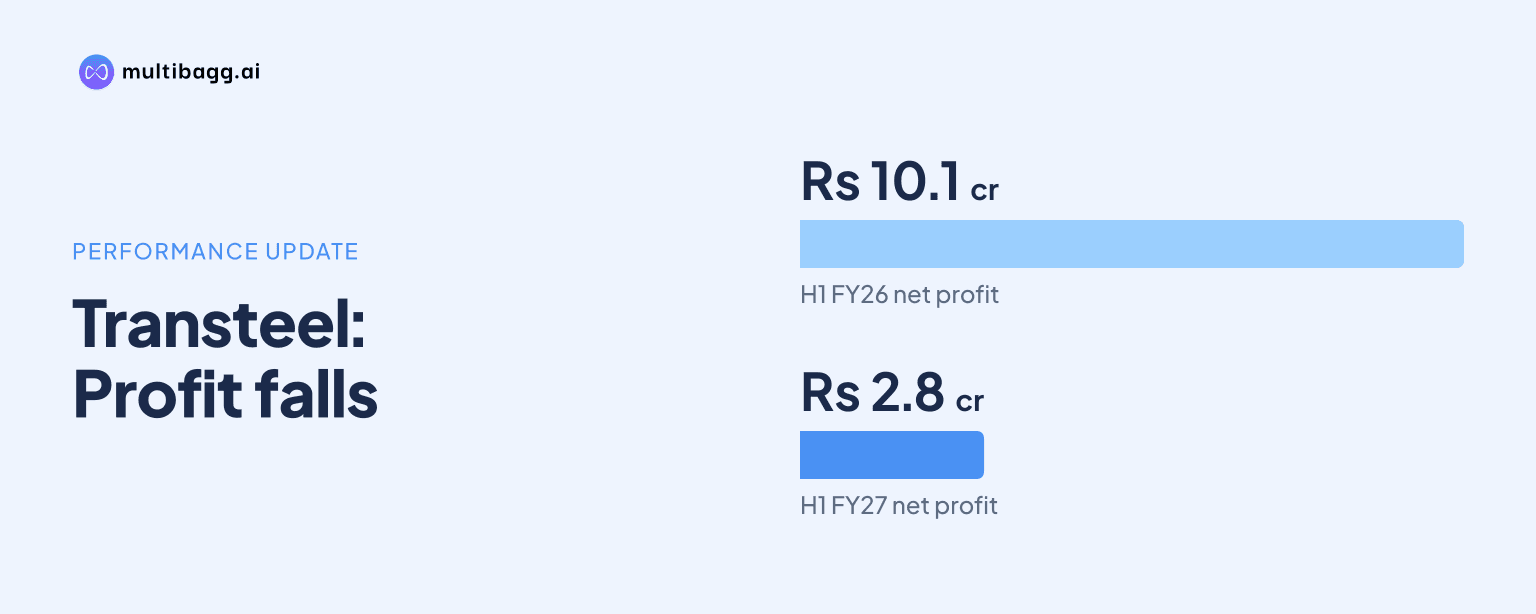
Transteel Seating Technologies Ltd reported H1 FY27 net profit of ₹2.8 crore, down 72.3% year-on-year, while revenue from operations fell 7.8% to ₹72.0 crore. The result matters because the decline in profitability coincided with auditor observations on the recoverability of significant receivable and unbilled balances.
Know Transteel Seating Technologies inside out
Results, valuation, peers and who's buying, in one view.
What did Transteel report for H1 FY27?
Transteel reported total income of ₹72.1 crore for the half year ended September 2026, compared with ₹78.3 crore in H1 FY26. Revenue from operations was ₹72.0 crore, against ₹78.1 crore a year earlier. Other income was negligible in the reported period.
Profit before exceptional items and tax declined to ₹3.5 crore from ₹13.3 crore in H1 FY26. Net profit fell to ₹2.8 crore from ₹10.1 crore. The reported operating margin was 4.9%, compared with 17.0% in the corresponding prior-year half.
The company’s board approved the unaudited standalone financial results for the half year ended September 30, 2026, at its meeting held on November 13, 2026. The results were disclosed through an NSE filing on November 14.
How did the earnings compare with the preceding half year?
Transteel’s H1 FY27 revenue was higher than the ₹61.3 crore reported in H2 FY26, but profitability was substantially lower. Net profit stood at ₹12.2 crore in H2 FY26, meaning H1 FY27 profit was lower by 77.0% on the comparison presented with the results.
Profit before exceptional items and tax was ₹16.5 crore in H2 FY26, compared with ₹3.5 crore in H1 FY27. The operating margin declined from 26.9% in the preceding half to 4.9% in the latest reported half, indicating that the rise in revenue from H2 FY26 was not matched by profit conversion.
The contrast follows a stronger March 2026 quarter, when the company had reported sales growth of 42% and profit growth of 71% from a year earlier. The H1 FY27 outcome therefore marks a material change from the growth recorded in that earlier quarter.
Why are receivables and unbilled balances important?
Receivables and unbilled balances are important because the auditor flagged uncertainty around billing, realisation and recovery of specified amounts. Trade receivables increased to ₹189.5 crore, while other current assets included about ₹87 crore of unbilled debtors, according to the information provided with the results.
The auditor noted uncertainty over billing and realisation of about ₹93 crore of unbilled amounts. It also cited the absence of confirmations concerning the recovery of long-overdue receivables and payables of about ₹190 crore and ₹168 crore, respectively. These observations relate to balance-sheet items rather than an announced write-off.
The scale of these balances is notable when compared with the company’s operations. Transteel reported FY26 revenue of ₹139.45 crore, while H1 FY27 revenue was ₹72.02 crore. Collection and billing progress on these balances can be relevant to assessments of working-capital quality and cash conversion.
Got a follow-up? Ask IRIS
What does the H1 FY27 result mean for investors and operations?
The H1 FY27 result shows lower revenue and a sharper fall in profit, with operating margin contracting to 4.9%. For investors, the disclosed figures place attention on earnings quality, the movement in debtor balances and the company’s ability to convert reported revenue into collections.
Transteel is an India-based furniture providing company. Its reported order book activity included an office-furniture order from Kia India Private Ltd valued at ₹0.67 crore, with execution expected within 30 days. This order is separately disclosed and is small relative to the company’s H1 revenue.
The company also stated that there was no deviation in the use of proceeds from its preferential issue in the board-meeting outcome. However, the results and the auditor’s observations remain the principal disclosed factors affecting the financial discussion for the half year.
How does H1 FY27 fit into Transteel’s recent financial record?
Transteel’s full-year profit was ₹22.3 crore in the year ended March 2026, following ₹12.67 crore in FY25 and ₹11.11 crore in FY24. H1 FY27 profit of ₹2.76 crore is materially below the ₹10.06 crore reported in H1 FY26.
Revenue of ₹72.02 crore in the latest half represents just over half of FY26 revenue of ₹139.45 crore, but the profit trend differs markedly. The lower margin in H1 FY27 indicates that revenue alone does not explain the change in earnings, making the reported operating-cost and balance-sheet developments relevant for readers of the filing.
Conclusion
Transteel’s H1 FY27 performance was marked by a 7.8% decline in revenue and a 72.3% fall in net profit to ₹2.8 crore. The reduction in operating margin, together with the auditor’s observations on receivables and unbilled balances, makes working-capital disclosures central to understanding the reported results.
The next disclosed operational item is the ₹0.67 crore Kia India office-furniture order, which is to be executed within 30 days. Investors will also watch subsequent company filings for updates on billing, collections, receivable confirmations and any further information relating to the balances cited by the auditor.