








Trident Techlabs adds Eaton automation and tests PhiTech 1000
MAX Plan at ₹4,999/yr

Find your next multibaggerBe a Pro Investor
Research stocks and track your picks on the go. Download the app.
Key highlights
- Trident Techlabs announced its Eaton substation automation partnership on 30 April 2026.
- Trident's PhiTech 1000 completed four to five years of in-house research and development and is under evaluation at two discoms.
- Trident reports a multi-year North India utility contract for network-planning software supply and maintenance.
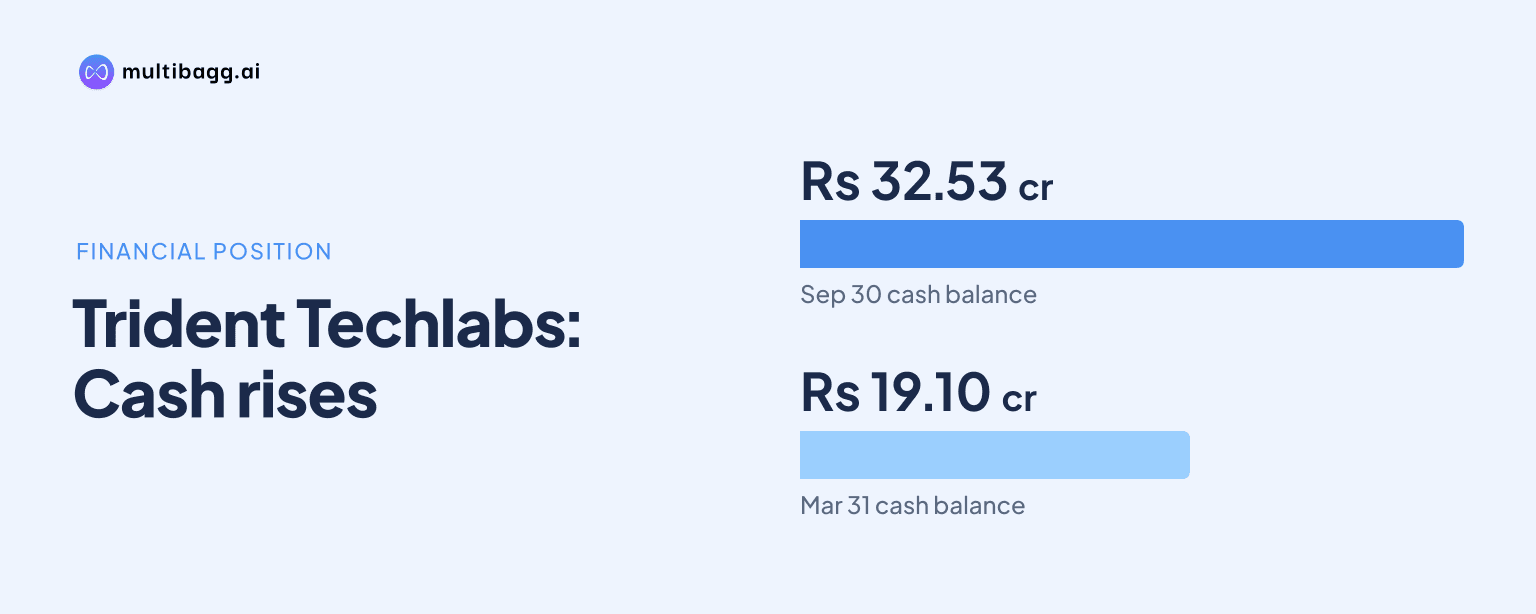
- Trident's standalone cash and bank balances rose to Rs 32.53 crore at 30 September 2026 from Rs 19.10 crore at 31 March 2026.
powered by IRIS
Trident Techlabs added utility-automation products through an Eaton partnership announced on 30 April 2026, while its PhiTech 1000 phase-identification device entered mandatory evaluations at two electricity distribution companies. The initiatives move Trident beyond power-system software distribution toward substation gateways, in-house hardware and utility services, although no related sales have been disclosed.
Know Trident Techlabs inside out
Results, valuation, peers and who's buying, in one view.
How is Trident entering utility automation?
Trident is entering utility automation through a strategic partnership with Eaton's Cooper Industries Inc., Canada, announced on 30 April 2026, covering substation gateways and allied automation products. The presentation describes the arrangement as an expansion from conventional power-system engineering and software solutions into utility-automation products and solutions. It does not disclose an order value, contract value or revenue contribution from the Eaton relationship.
The Eaton arrangement adds automation hardware to Trident's existing Power Solutions Group portfolio of software and services. CYME, whose principal is Eaton, USA, is used for transmission and distribution network analysis and cable-capacity calculation; Trident states an 80% to 90% Indian utility market share for CYME. Its portfolio also includes system studies, cable thermal analysis, substation and earthmat design, distributed energy resource integration and arc-flash safety work.
Trident also provides integration involving SAP, geographic information systems, automated meter reading, and supervisory control and data acquisition-distribution management systems. These capabilities sit alongside the new gateway offering, but the presentation does not specify whether Eaton products have been deployed with any of these systems. The disclosed partnership is therefore an addition to the product range rather than evidence of reported automation-product revenue.
What is PhiTech 1000 and what stage has it reached?
PhiTech 1000 is Trident's Make-in-India device designed to identify the connection of a low-voltage single-phase consumer to a three-phase distribution system and assign that consumer to one of the three phases. Trident says this addresses consumer-to-phase mapping data that most utilities have not maintained for 20 to 30 years. The device is under evaluation at two electricity distribution companies, or discoms.
The product uses power-line communication and an in-house-built mobile application after four to five years of internal research and development. Trident says customer evaluations are mandatory before approval and typically last more than six months. The two-discom activity is consequently an evaluation and approval-stage milestone, not a disclosed order, shipment or revenue stream.
PhiTech 1000 gives Trident a potential proprietary-hardware route in addition to its third-party software distribution and engineering work. The company identifies distribution automation in tier-2 and tier-3 cities as a growth driver, saying global majors can be priced out at the small-substation tier. The presentation does not state PhiTech 1000's price, manufacturing capacity, production location or expected timing of either evaluation outcome.
What utility business progress has Trident reported since April 2026?
Trident reports a multi-year contract with a North Indian power utility for supply and maintenance of software solutions used in network planning. The contract is the clearest disclosed recurring-service element in recent Power Solutions Group activity. The company does not name the utility or disclose the contract's value, duration, annual revenue contribution or start date.
Utilities in more than five states have entered procurement processes or serious negotiations for Trident's software solutions and allied services, according to the presentation. The company attributes this access to credentials built at leading discoms. Its named private-utility users include Tata Power Delhi, described as a continuous user since 2003, as well as Adani, Tata Power, Torrent Power, CESC, BYPL Delhi and Noida Power.
Trident also reports its first contract from a state-owned power utility in Sharjah for electrical power-network testing services. That contract is separate from the Eaton partnership and the two PhiTech 1000 evaluations. The presentation lists activity in Bangladesh, Nepal, Sri Lanka, Vietnam and the Middle East, but does not provide Power Solutions Group revenue by customer, geography or service line.
Got a follow-up? Ask IRIS
Which market drivers does Trident identify for this expansion?
Trident identifies distributed energy resource integration as a growth driver because rooftop solar, battery energy storage systems, windmills and electric-vehicle charging require network-planning tools. Management says utilities lack in-house planning manpower, creating a multi-year outsourcing opportunity for recurring services. The company already lists distributed energy resource integration among its Power Solutions Group services.
Distribution automation in tier-2 and tier-3 cities is a second stated driver, while overhead-to-underground cable conversion is a third. Trident says undergrounding projects can raise demand for CYMCAP-related services. These are company-described market opportunities, rather than revenue guidance or contracted automation demand.
For market context, the presentation cites a 13.24% compound annual growth rate for smart-grid infrastructure through 2030 and about 8.9% for distribution automation through 2035. It also cites planned Indian transmission and distribution capital expenditure of Rs 9.10 lakh crore for FY25 to FY32, and Rs 3,970 crore of Revamped Distribution Sector Scheme funding released in March 2025. Those figures describe sector conditions and do not represent Trident's order book.
How does the expansion compare with Trident's latest financial position?
Trident's standalone revenue was Rs 25.84 crore in H1 FY27, down from Rs 63.44 crore in H1 FY26 and Rs 33.63 crore in H2 FY26. Standalone profit after tax was Rs 1.37 crore, versus Rs 11.43 crore a year earlier and Rs 1.13 crore in the preceding half. The presentation describes government business as tender-driven, meaning tender timing can shift revenue between reporting periods.
Standalone earnings before interest, tax, depreciation and amortisation margin was 15.5% in H1 FY27, up from 9.8% in H2 FY26 but below 27.2% in H1 FY26. Management has said margins are expected to recover as semiconductor and UAE investments mature. The presentation does not separately report revenue, margin, expenditure or profit for the Power Solutions Group, Eaton products or PhiTech 1000.
At 30 September 2026, standalone cash and bank balances were Rs 32.53 crore, compared with Rs 19.10 crore at 31 March 2026. Total borrowings rose to Rs 25.73 crore from Rs 22.44 crore, resulting in net cash of Rs 6.80 crore against net debt of Rs 3.34 crore at the March date. Trade receivables fell to Rs 34.28 crore from Rs 57.65 crore over the same period.
Conclusion
Trident's Eaton partnership and PhiTech 1000 evaluations establish two separate automation routes: substation gateways supplied through a new principal relationship and an internally developed device for phase identification. Alongside these initiatives, the multi-year North India software supply-and-maintenance contract and the Sharjah testing-services contract show that the Power Solutions Group continues to pursue recurring and international utility work.
The next disclosures to watch are the approval outcomes from PhiTech 1000's two discom evaluations, which typically exceed six months, and whether procurement activity across more than five states converts into orders. Investors can also track whether the Eaton relationship produces separately disclosed sales, since H1 FY27 automation-product and Power Solutions Group revenue were not reported separately.

