








Trident’s UAE subsidiary follows first Sharjah utility contract
MAX Plan at ₹4,999/yr

Find your next multibaggerBe a Pro Investor
Research stocks and track your picks on the go. Download the app.
Key highlights
- Trident incorporated its UAE subsidiary in Dubai on 10 Nov 2026.
- Sharjah is Trident’s first disclosed Middle East utility contract, but its value and UAE revenue are undisclosed.
- Trident reports utility qualifications in the UAE and Saudi Arabia and with all utilities in Oman.
- Trident has proposals active in 7 countries and is negotiating with 3 African power utilities.
powered by IRIS
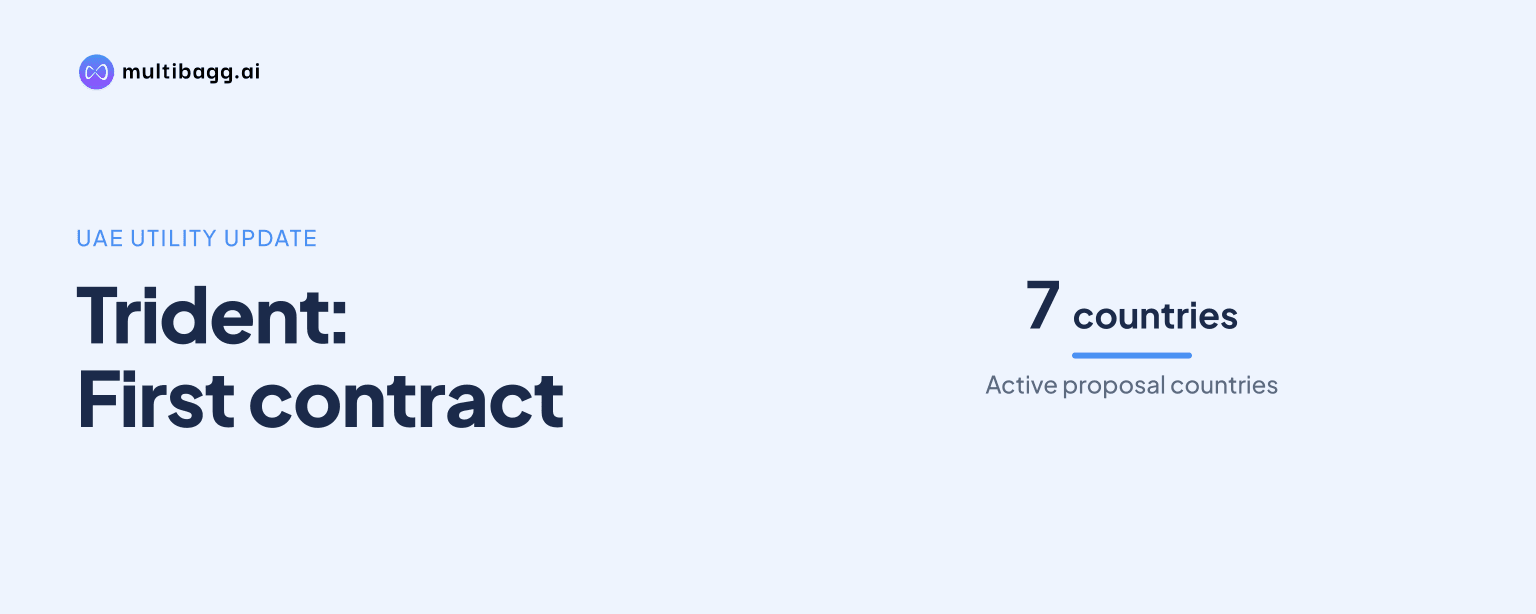
On 10 Nov 2026, Trident Techlabs incorporated a UAE subsidiary in Dubai after its first disclosed Middle East utility contract in Sharjah. The company has built regional access through utility qualifications, negotiations with 10 consultants and proposals in seven countries, but Trident has not separately disclosed UAE revenue.
Know Trident Techlabs inside out
Results, valuation, peers and who's buying, in one view.
What did Trident establish in the UAE?
Trident established a UAE subsidiary on 10 Nov 2026 and identifies Dubai as the hub for its Gulf Cooperation Council, or GCC, business. The presentation says a Dubai office had already been listed among Trident’s offices in 2025, while Sharjah is separately identified as the location of its first Middle East utility contract.
The subsidiary is part of an international investment phase that management flagged in June 2026. On the FY26 call, management said upfront investment in the semiconductor subsidiary and UAE build-out contributed to consolidated profit after tax, or PAT, of Rs 6.07 crore, compared with standalone PAT of Rs 12.56 crore. The presentation does not separately state the UAE operation’s cost, assets, employee count or contract value.
Trident’s regional portfolio covers three verticals. Power Solutions, described as the lead vertical, includes system studies, substation and earthmat design, arc-flash work, cable thermal analysis and distributed energy resource, or DER, integration. Cybersecurity includes security operations centres, application security and encrypted-traffic visibility, while Engineering Solutions covers electronic design automation, computer-aided engineering, reliability and validation services.
Does the Sharjah contract confirm wider UAE revenue?
No, the Sharjah engagement confirms one first Middle East utility contract, but it does not establish a separately reported UAE revenue stream. Trident explicitly says UAE revenue is not yet separately disclosed, and it does not name the customer or disclose the contract’s value, scope, duration, margin or revenue-recognition schedule.
The distinction is material because Trident labels its qualifications and negotiations as management-reported milestones rather than order wins. It reports qualification with utilities in the UAE and Saudi Arabia, qualification with all utilities in Oman, and successful subcontracting negotiations with 10 major Middle East consultants. Those activities may create routes to tenders, but the presentation does not classify them as booked revenue.
Trident also cites a separate regional technical reference: earthing-grid design for a 33 kilovolt substation in Abu Dhabi, completed using CYMGRD version 8.0. That assignment shows prior UAE-related Power Solutions work, but it is distinct from the Sharjah contract and has no disclosed financial value.
Got a follow-up? Ask IRIS
How is Trident building access across the GCC and Africa?
Trident is pursuing regional access through utility qualifications, consultant channels, exhibition participation and active proposals rather than through a disclosed multi-country order book. Its qualification coverage includes utilities in the UAE and Saudi Arabia and all utilities in Oman, while its consultant channel consists of negotiations with 10 major Middle East consultants.
The company also had a stall and participated at WETEX Dubai, the region’s annual water, energy and environment exhibition, after its Dubai office was listed in 2025. The presentation does not disclose the number of UAE employees, local customers or contracts that resulted from the exhibition or office presence.
Outside the GCC, Trident says negotiations are under way to provide services to three power utilities in Africa. Its next stated milestone is to convert access into orders, with proposals active in seven countries including Saudi Arabia, Oman and Nigeria. The company does not identify the other four countries, proposal values, award dates or expected conversion rates.
What do Trident’s financial comparisons show about the build-out?
Trident’s disclosed figures show lower consolidated results than standalone results for the cited measures, and management linked the FY26 PAT difference partly to the UAE build-out and semiconductor investment. Consolidated PAT was Rs 6.07 crore against standalone PAT of Rs 12.56 crore in FY26, while H1 FY27 consolidated earnings before interest, tax, depreciation and amortisation, or EBITDA, were Rs 3.83 crore versus Rs 4.01 crore standalone.
The figures cover different measures and periods, so they do not calculate the UAE subsidiary’s profitability or cost. They do identify the consolidated-versus-standalone EBITDA comparison as a stated measure for tracking the investment phase, alongside future disclosure of UAE revenue or orders.
Trident’s Power Solutions capabilities also serve Indian utility requirements such as rooftop solar, battery energy storage systems, windmills and electric-vehicle charging through DER planning tools. The presentation identifies cable-conversion work as a driver of CYMCAP services and distribution automation in tier-2 and tier-3 cities as an addressable market, but it does not state that these domestic themes will produce UAE sales.
Conclusion
Trident’s 10 Nov 2026 UAE incorporation formalises a Dubai-based GCC hub after a Dubai presence was listed in 2025 and after the first disclosed Sharjah utility contract. The evidence supports one confirmed Middle East utility contract, a separate 33 kilovolt Abu Dhabi design reference, utility qualifications in three GCC markets and negotiations with 10 consultants, but not a separately disclosed UAE revenue base.
The next disclosed milestone is conversion of qualified utility and consultant access into orders, with proposals active in seven countries including Saudi Arabia, Oman and Nigeria. Investors can also watch future consolidated-versus-standalone EBITDA comparisons after H1 FY27 and any disclosure of UAE revenue, order values or operating costs, as management’s stated plan is to convert access into orders.

