








Trident Techlabs targets subscription-led engineering model
MAX Plan at ₹4,999/yr

Find your next multibaggerBe a Pro Investor
Research stocks and track your picks on the go. Download the app.
Key highlights
- Trident reports 57.9% government, 26.3% PSU and 15.8% private customers in its Engineering Solutions Group customer mix.
- EDA accounts for 50% of Engineering Solutions Group revenue, while CAE and academic activities each account for 25%.
- Trident’s engineering portfolio includes six OEM relationships, with Siemens EDA described as a partnership of more than 16 years.
- The presentation cites a 21.8% compound annual growth rate for India’s engineering-software market through 2030.
powered by IRIS
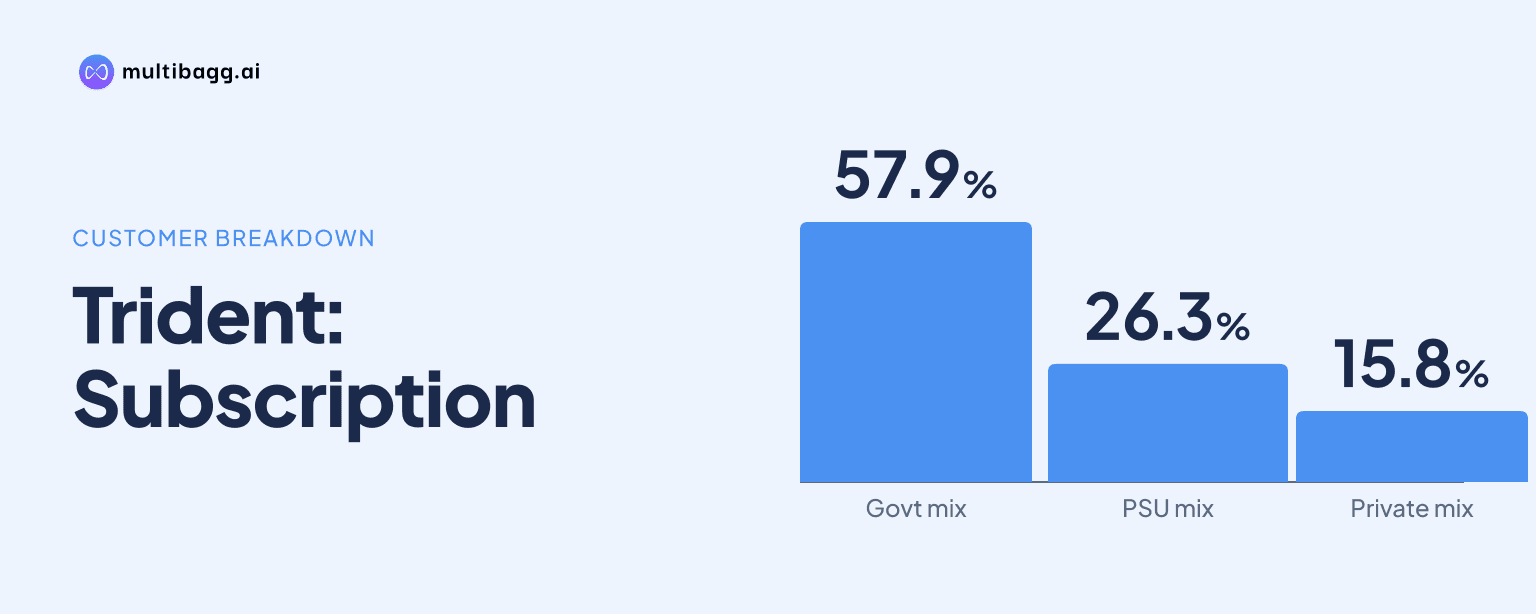
In its H1 FY27 presentation, Trident said it is targeting a shift in its Engineering Solutions Group toward annual subscriptions, implementation and technical manpower instead of individual product transactions, while government and public-sector undertaking customers account for 84.2% of the group’s current customer mix.
Know Trident Techlabs inside out
Results, valuation, peers and who's buying, in one view.
How is Trident changing its engineering-solutions business model?
Trident is seeking to operate as a technology-solutions partner rather than focus on individual product sales. Its stated model combines software licensing with engineering services, implementation, application support and technical manpower, while annual subscription licensing is intended to provide more predictable revenue than perpetual licences. The presentation identifies this as an Engineering Solutions Group objective, not as a reported revenue outcome.
Trident says it wants to engage at the customer’s problem-statement stage, before a request for quotation, or RFQ, is specified. Management’s stated rationale is that building a workflow around the customer’s problem can avoid competing only against a pre-defined product specification. Customer-specific demonstrations, proofs of concept, application engineering and customised workflows are the mechanisms it identifies to improve adoption and conversion.
The plan spans three existing Engineering Solutions Group sub-verticals. Electronic design automation, or EDA, represents 50% of group revenue, while computer-aided engineering, or CAE, and academic labs, training and research each represent 25%. The transition is therefore being pursued in a group where EDA remains the largest disclosed revenue component, rather than through a separately reported services division.
Which OEM partners support Trident’s solution portfolio?
Trident’s wider portfolio is based on six original equipment manufacturer, or OEM, relationships spanning EDA, CAE, reliability, validation and optimisation tools. Siemens EDA is described as a relationship of more than 16 years and covers integrated-circuit design from specifications to layout. Cadence MSC and Relyence are described as long-standing partners for multi-body dynamics, computational fluid dynamics, structural and fatigue work, and reliability analysis including mean time between failures and warranty prediction.
Three newer relationships extend that stack beyond established offerings. Keysight supports radio-frequency and photonics design, DEP MeshWorks provides advanced simulation and CAE tools, and PSeven supplies multi-CAE engineering optimisation. Trident says these additions complement its EDA, CAE and reliability offerings, allowing it to assemble integrated solutions instead of offering only a single vendor’s licence.
The service catalogue shows the work Trident intends to attach to these tools. It includes application-specific integrated circuit design and implementation, field-programmable gate array design, mechanical and electronics engineering, validation, printed-circuit-board design to manufacture, reliability and quality solutions, data analytics and artificial intelligence. The presentation does not quantify revenue from these lines, so it does not show how much current Engineering Solutions Group revenue is recurring.
Who are Trident’s engineering customers and end markets?
Trident’s Engineering Solutions Group customer mix is concentrated in public institutions: government customers account for 57.9%, public-sector undertakings, or PSUs, account for 26.3%, and private customers account for 15.8%. Government and PSU customers therefore make up 84.2% of the stated mix. The company cites deeper engagement with the Defence Research and Development Organisation, defence establishments, space organisations, PSUs, Council of Scientific and Industrial Research laboratories and private customers.
Trident serves aerospace and defence, electronics and semiconductor, industrial and manufacturing, automotive, energy and power, and academia and research. Named public-sector and research examples include Defence Research and Development Organisation laboratories, the Indian Space Research Organisation, the National Aerospace Laboratories, Bharat Heavy Electricals, Hindustan Aeronautics and Bharat Dynamics. These end markets align with the portfolio’s simulation, design validation, reliability and implementation capabilities.
Academic activity accounts for 25% of Engineering Solutions Group revenue under Trident’s stated mix. The company plans technology adoption across Indian Institutes of Technology, National Institutes of Technology, engineering colleges and research institutions through labs, training and industry-oriented research. The presentation does not give a target for institutions, contracts or subscription renewals in this channel.
Got a follow-up? Ask IRIS
What opportunities does Trident identify for subscriptions and services?
Trident identifies semiconductor, electric vehicles, advanced electronics and multidisciplinary engineering as markets where design, simulation and reliability tools are gaining relevance. It calls electric vehicles its largest private-market opportunity, while saying penetration is gradual because OEM tools must be customised to each manufacturer’s environment. Management describes integration work as the bottleneck and as an advantage once delivered.
The presentation says software licensing is shifting from perpetual licences to annual subscriptions, including in government contracts. That shift supports Trident’s recurring-revenue objective because subscriptions require periodic renewal rather than a one-time perpetual sale. However, the company does not disclose subscription revenue, renewal rates, contract duration, backlog or the proportion of government contracts already using annual licensing.
The presentation cites an Indian engineering-software market projected to grow at a 21.8% compound annual growth rate to USD 6,342 million by 2030. Its 2025 to 2027 market-size chart readings are explicitly described as approximate, while the 2030 figure is attributed to Grand View Horizon. This market estimate is context for Trident’s plan, not a company revenue forecast.
What remains undisclosed about Trident’s transition?
Trident does not disclose subscription revenue, renewal rates, implementation-project revenue, application-support contracts or technical-manpower assignments in the H1 FY27 presentation. The company provides the 50%, 25% and 25% sub-vertical mix, but no services-versus-licences revenue split. As a result, the stated shift toward recurring revenue cannot yet be measured from the disclosed financial mix.
The private-customer share is 15.8%, compared with 84.2% for government and PSU customers combined, as Trident pursues electric-vehicle and industrial opportunities alongside public-sector relationships. The presentation frames its engagement with defence, space, PSUs and research institutions around larger opportunities, but gives no order values or conversion rates for demonstrations and proofs of concept. Its strategy is therefore specified, while financial execution remains unquantified.
Conclusion
Trident is repositioning its Engineering Solutions Group around integrated engineering outcomes through a six-partner OEM stack, solution-led sales activity and service offerings that include implementation, support and technical manpower. The group’s disclosed revenue mix is led by EDA at 50%, while its customer mix is led by government and PSU organisations at a combined 84.2%.
The next items to watch over Trident’s stated three-to-five-year direction are annual-subscription adoption in government contracts, disclosure of service revenue and evidence that electric-vehicle integrations convert into contracts. Management identifies customisation as the electric-vehicle bottleneck, while the presentation leaves unresolved how quickly subscriptions and attached services will become a measurable share of Engineering Solutions Group revenue.

