










True Colors plans Rs 320-340 crore Bardoli paper venture
Key highlights
- True Colors plans a 50:50 joint venture with Swastik Strategic Ventures LLP for a Rs 320-340 crore paper plant in Bardoli, Gujarat.
- The proposed facility would produce 8-10 crore metres of base and speciality paper a month, targeting the 29 GSM grade.
- Management estimates India imports 70%-75% of lower-GSM sublimation coated paper, creating an import-substitution opportunity.
- Commercial production is indicated for H2 FY29, subject to incorporation, financing, construction and final equipment configuration.
powered by IRIS
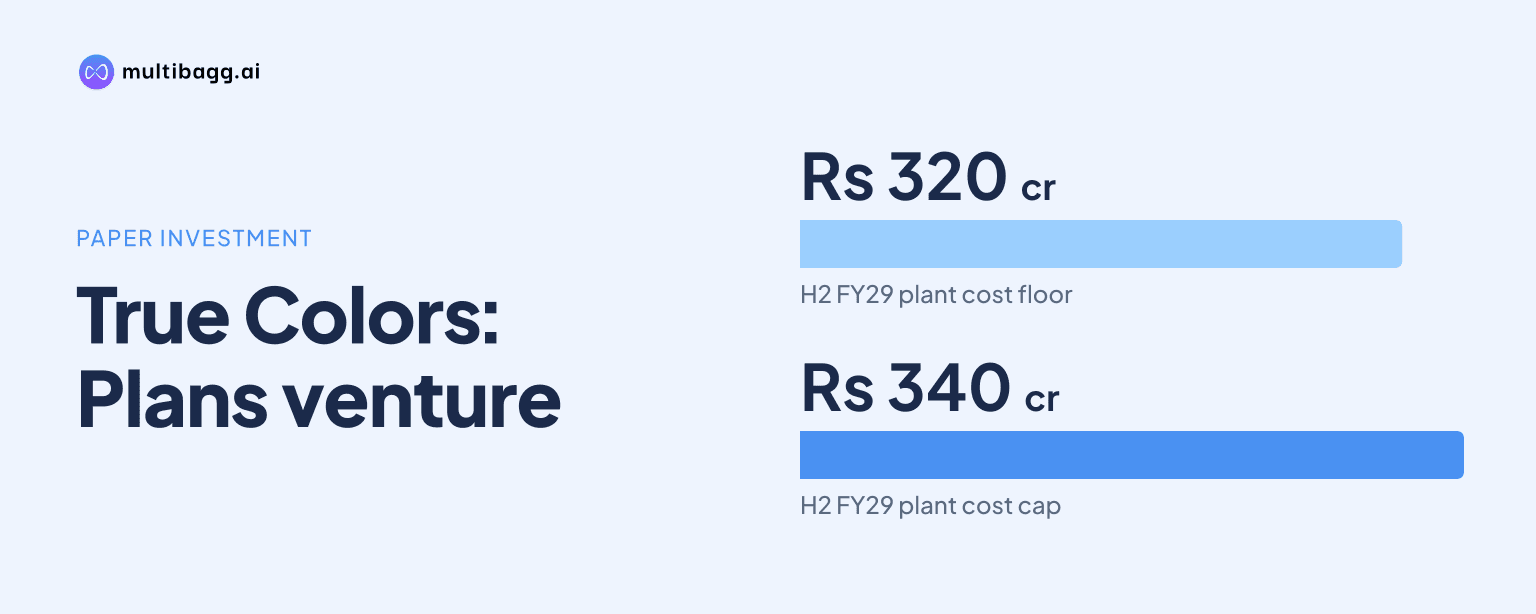
True Colors Limited plans a 50:50 joint venture to build a Bardoli, Gujarat plant producing 8 to 10 crore metres of base and speciality paper a month. The Rs 320-340 crore project targets the 29 grams per square metre, or GSM, grade that management says India imports heavily, with commercial production indicated for H2 FY29.
Know True Colors inside out
Results, valuation, peers and who's buying, in one view.
What is True Colors' proposed paper joint venture?
True Colors has announced an equal joint venture to manufacture base and speciality paper, the primary raw material for its sublimation paper business. The proposed company, True Colors Advance Materials Private Limited, would manufacture, process, coat, convert and market paper, speciality paper and allied products. True Colors would hold 50.00% through a cash subscription at Rs 10 per share, and the venture would be jointly controlled with Swastik Strategic Ventures LLP.
The project takes True Colors upstream from coating sublimation paper to producing base paper. Management says in-house output would secure supply, control quality at source and retain margins paid to external and imported suppliers. The company expanded its sublimation-paper coating capacity from 30 lakh metres to 2 crore metres a month over three years, and identifies base-paper supply as the next constraint on paper growth.
Why is True Colors targeting lower-GSM base paper in India?
True Colors is targeting lower-GSM paper because management estimates that India imports 70% to 75% of its lower-GSM sublimation coated paper. The presentation attributes this dependence to limited domestic technology for application-specific lower-GSM grades. The planned configuration identifies 29 GSM as the imported lower-GSM grade, while the 45 GSM upper range remains under finalisation.
The import-substitution rationale is linked to sublimation paper being a consumable, as every metre of digital textile printing uses paper. Management cites compound annual growth of about 13.77% for the global digital textile printing market from 2025 to 2030. It also estimates India’s digital-printing penetration at 8% to 9%, against 80% to 95% in Europe, although these market measures do not establish the venture’s eventual sales or utilisation.
How large is the True Colors paper project and how will it be funded?
True Colors estimates the Bardoli project will cost Rs 320-340 crore, subject to final configuration, and have capacity of 8-10 crore metres of paper a month. At management’s reference realisation of Rs 4-5 per metre, the proposed paper capacity would exceed the company’s current 2 crore metres monthly sublimation-paper coating capacity. The presentation does not disclose expected utilisation, revenue, profit or a final equipment specification.
Funding is proposed through partner equity and project-level debt raised at the joint venture, using a 25:75 equity-to-debt mix. The estimated Rs 320-340 crore cost includes Rs 200-220 crore for plant, machinery and utilities, and Rs 120-140 crore for infrastructure, civil work and other costs. True Colors says the project is eligible for the Viksit Gujarat Industrial Policy 2026, but does not quantify any incentive or provide financing terms.
Got a follow-up? Ask IRIS
When could the True Colors paper plant begin production?
True Colors indicates commercial production in H2 FY29, while describing that date as indicative rather than committed. The board has approved the proposal, and incorporation of True Colors Advance Materials Private Limited was proposed within about 60 days of the announcement. Management also expects the facility’s first contribution from FY29, making construction and ramp-up a plan rather than a reported operating outcome.
The H2 FY29 timeline is later than True Colors’ ink-manufacturing programme. The company plans the first 150 tonnes a month of INKIA manufacturing capacity by the end of FY27, followed by a 500-tonnes-a-month FY28 target and a long-term target of 1,000 tonnes a month. For the paper venture, incorporation, final product configuration, debt raising, construction and commissioning must occur before the production indication can be assessed against plan.
How does the joint venture fit True Colors' current business?
True Colors presents the venture as the next stage in an ecosystem spanning machines, inks, sublimation paper and base paper. In H1 FY27, revenue from operations rose 21.1% year on year to Rs 183.01 crore, while sublimation-paper volume more than doubled to 9.97 crore metres. The existing coating operation was running at what management called optimum utilisation after capacity reached 2 crore metres a month.
Consumables increased their contribution to revenue during H1 FY27, alongside growth in the installed machine base. Inks and paper accounted for 56.2% of revenue, compared with 48.7% a year earlier, while cumulative active installed machines rose to 956 from 859 in H1 FY26. The proposed venture would be accounted for using the equity method, with True Colors recognising its share of the joint venture’s results in consolidated statements.
Conclusion
True Colors’ proposed joint venture is a substantial upstream expansion aimed at reducing dependence on imported base paper for its sublimation-paper business. The Rs 320-340 crore estimated cost, 8-10 crore-metres monthly capacity and 29 GSM product focus show that management intends to address a supply constraint it links to India’s estimated 70% to 75% import dependence in lower-GSM paper.
The next developments to watch are incorporation within the stated roughly 60-day period, finalisation of the 45 GSM configuration, financing at the proposed 25:75 equity-to-debt mix and progress towards indicative H2 FY29 production. Management says core profitability, guidance and capital-allocation policy remain unchanged during construction, while the venture’s first contribution is expected from FY29.