










True Colors targets 1,000 tonnes of monthly ink capacity
Key highlights
- True Colors plans to scale in-house ink capacity from 150 tonnes per month by end-FY27 to 1,000 tonnes per month long term.
- The three-phase ink project carries planned capital expenditure of Rs 100-115 crore, including Rs 40-45 crore for Phase 1.
- True Colors says its Phase 1 facility is eligible for a 35% capital subsidy under the Viksit Gujarat Industrial Policy 2026.
- Consumables generated Rs 151.52 crore, or 50.25% of True Colors’ FY26 revenue of Rs 301.55 crore.
powered by IRIS
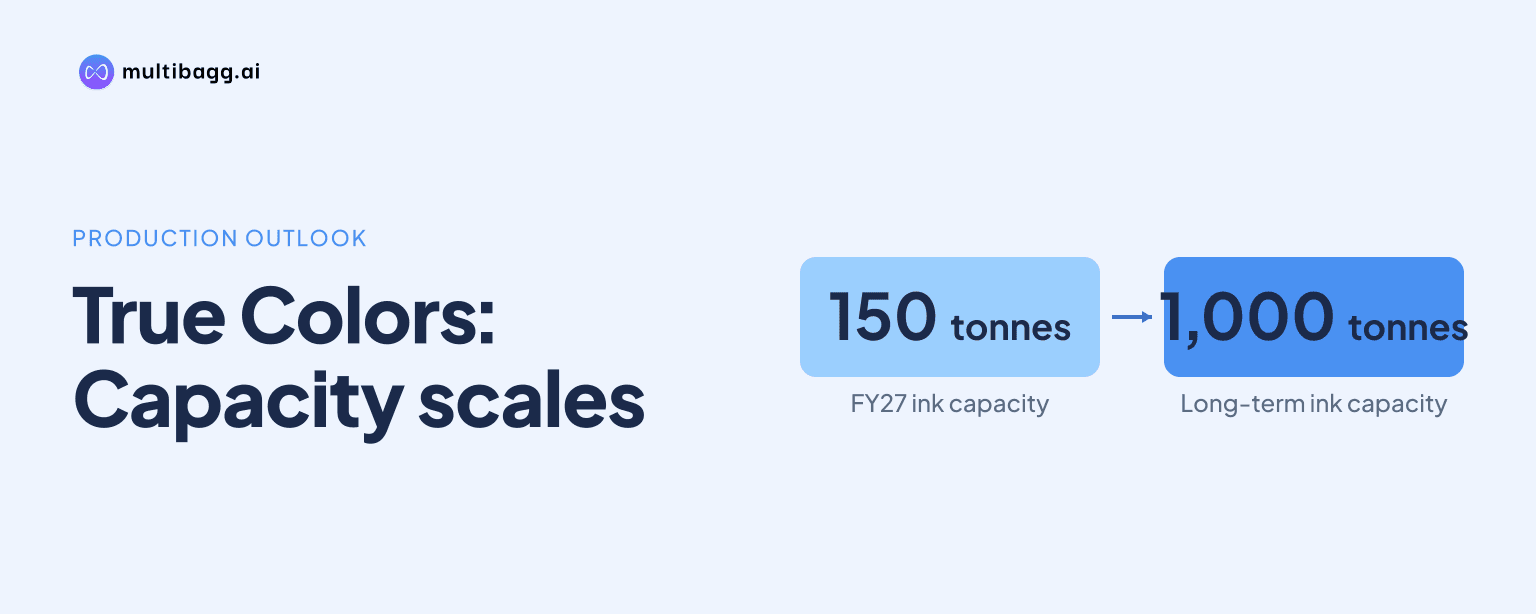
True Colors Limited plans to establish in-house ink manufacturing capacity of 1,000 tonnes per month in the long term, beginning with 150 tonnes per month by the end of FY27. The first phase exceeds its FY26 average ink sales volume of about 95 tonnes per month and is intended to replace imported supply for self-consumption and white-labelling requirements.
Know True Colors inside out
Results, valuation, peers and who's buying, in one view.
How will True Colors build its ink manufacturing capacity?
True Colors plans a three-phase build-out from 150 tonnes per month at the end of FY27 to 500 tonnes per month in FY2028 and 1,000 tonnes per month in the long term. Phase 1 manufacturing is to begin at the existing campus, while the company says it has secured land equivalent to 3.5 times its current facility footprint for wider long-term expansion.
The Phase 1 facility was under development at the time of the H1FY27 presentation and is intended to replace imported volumes serving self-consumption and white-labelling customers. True Colors says the facility is eligible for a 35% capital subsidy under the Viksit Gujarat Industrial Policy 2026, although the presentation does not state the subsidy amount, approval status or disbursement timing.
At full scale, True Colors plans to manufacture sublimation, reactive, disperse and pigment inks. Its current ink range also includes acid, ultraviolet, direct-to-film, solvent, eco-solvent, flushing solvent and desktop formulations, serving uses from polyester transfer printing to cotton, silk, viscose, signage and heat-transfer applications.
Why is True Colors replacing imported ink supply?
True Colors says import substitution is the principal rationale because India currently sources 100% of its inks from China and Japan. Management says manufacturing under the INKIA brand is expected to reduce dependence on imported products and lessen exposure to currency movements and supply-chain volatility, but it does not quantify expected savings.
The project follows a decade-long expansion in ink supply volumes. True Colors began ink supply in 2016 as an importer selling 3 to 5 tonnes per month, then reported average sales of about 58 tonnes per month in FY24, 80 tonnes in FY25 and 95 tonnes in FY26.
Phase 1 capacity would be about 55 tonnes per month higher than the FY26 average sales volume. That difference could support import replacement and white-labelling requirements, but True Colors does not disclose a target utilisation rate, external-sales target or split between internal consumption and third-party customers.
What supports recurring demand for True Colors inks?
True Colors links ink demand to its 956 machines in the field, stating that each installation can create recurring orders for ink and sublimation paper. Ink and sublimation paper represented 56.24% of H1FY27 revenue, according to the company’s recurring-revenue framework.
The company says machine warranties covering spare parts, print heads and electronics are tied to inks it supplies, with a change of ink supplier voiding the warranty. It also identifies colour consistency for repeat textile orders and post-warranty access to service and parts as operational mechanisms supporting repeat consumables purchases.
Print heads have a stated life cycle of about three to four years, while the company also describes replacement as occurring approximately every two to three years in its customer-relationship material. In either case, True Colors says replacement can trigger an upgrade discussion and potentially generate another machine installation and associated consumables demand.
In FY26, consumables, comprising ink supply, sublimation paper and spare parts, generated Rs 151.52 crore, or 50.25% of total revenue of Rs 301.55 crore. Consumables were the largest of the three verticals, ahead of digital printed fabrics at Rs 89.09 crore and technology at Rs 60.94 crore, although their 5.47% year-on-year growth was below 34.75% for fabrics and 155.19% for technology.
Got a follow-up? Ask IRIS
How does ink manufacturing fit True Colors’ wider operations?
True Colors operates across technology distribution, consumables and digital printed fabrics, and holds five original equipment manufacturer authorisations. Its technology business installed 109 machines in FY26, while its 60-plus dedicated service engineers support customers across major textile clusters, providing the service base cited in its consumables model.
The company already manufactures sublimation paper, reporting more than 2 crore metres of monthly capacity and about 100% utilisation as of September 2026. Its FY26 infrastructure disclosure separately reported annual paper capacity of 12.55 crore metres, production of 12.45 crore metres and utilisation of 51.88%; the presentation does not reconcile these measures with the later monthly capacity and utilisation disclosure.
True Colors also has digital fabric-printing capacity of more than 75,000 metres per day. The business provides sublimation printing on polyester and reactive printing on cotton and viscose, creating a direct internal use case for consumables alongside sales to the installed machine base.
The manufacturing plan follows True Colors’ October 2025 strategic partnership with ITACA of Spain for premium pigment inks. Commercial ink supplies from that relationship began in H1FY27, but the presentation does not disclose technology-transfer terms, volume commitments, pricing or the relationship between ITACA products and planned INKIA manufacturing.
What will determine the financial outcome of the ink expansion?
True Colors says ink is among its highest-margin product categories and management expects in-house manufacturing to improve and stabilise margins over the long term. This remains an expectation rather than a reported outcome, as the presentation gives no standalone ink margin, unit production cost, commissioning-date detail beyond the end-FY27 target or forecast profit contribution.
The three phases carry planned capital expenditure of Rs 100-115 crore in aggregate. Phase 2 would add 350 tonnes per month to the Phase 1 level, and the pace of utilisation will depend on demand from the 956-machine installed base, white-labelling requirements and additional commercial sales, none of which are quantified.
Conclusion
True Colors is attempting to move from imported ink distribution to domestic production while retaining its machine, paper and fabric-printing operations. The planned 150-tonne-per-month Phase 1 is larger than FY26 average ink sales of about 95 tonnes per month, while the 1,000-tonne long-term objective would substantially extend the company’s current consumables platform.
The next disclosed milestone is Phase 1 commencement by the end of FY27, with Rs 40-45 crore of planned capital expenditure and stated eligibility for a 35% capital subsidy. Progress on construction, commissioning, utilisation, import replacement and any disclosed financial impact will indicate how the FY28 500-tonne-per-month target is developing.