










TTK Prestige Q2 EBITDA rises 71% as margin hits 17.9%
Key highlights
- TTK Prestige's Q2 operating EBITDA before exceptional items rose 70.9% to Rs 171.7 crore.
- TTK Prestige's domestic Q2 sales increased 23.4% to Rs 944.5 crore, while exports fell 30.4% to Rs 14.8 crore.
- TTK Prestige's post-provision operating EBITDA margin reached 17.9%, up from 12.8% in Q2 2025-26.
- TTK Prestige held more than Rs 755 crore of free cash balance, including short-term liquid investments, on September 30, 2026.
powered by IRIS
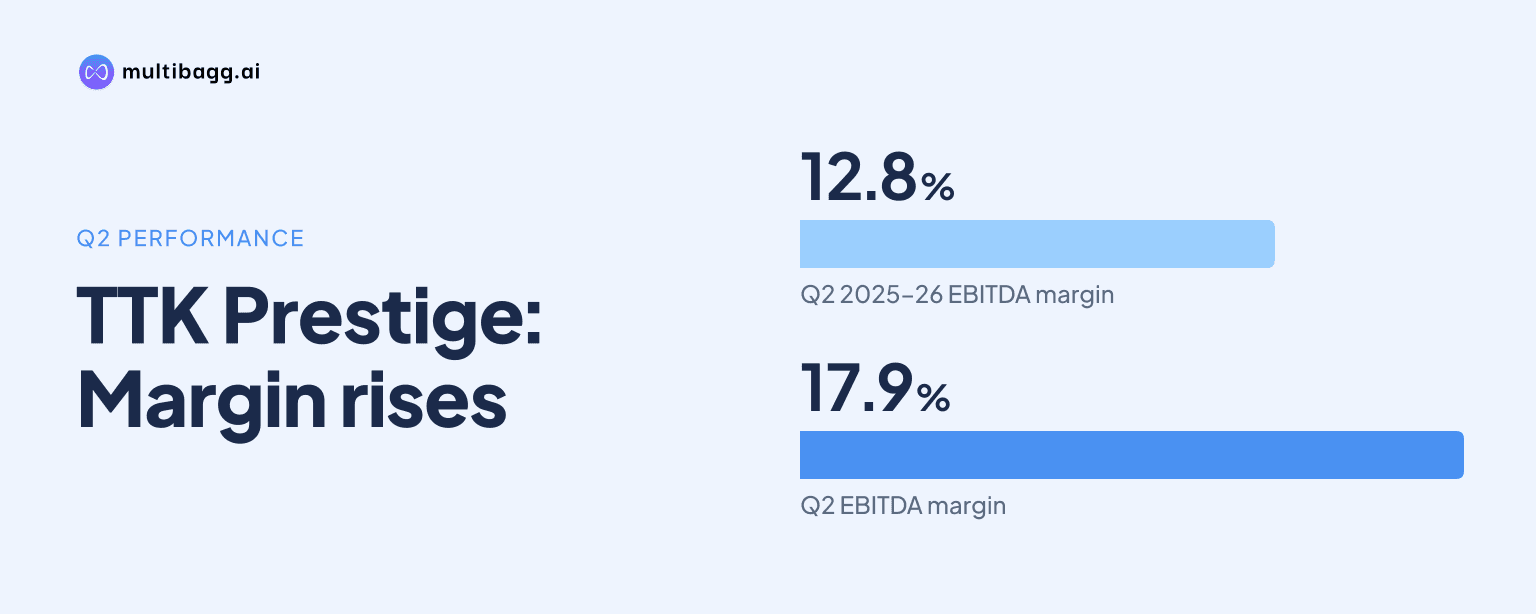
TTK Prestige Limited reported operating EBITDA before exceptional items of Rs 171.7 crore for Q2 2026-27, up 70.9% year on year, as domestic sales increased 23.4% to Rs 944.5 crore and the operating EBITDA margin after business-excellence costs rose to 17.9% from 12.8%.
Know TTK Prestige inside out
Results, valuation, peers and who's buying, in one view.
How did TTK Prestige's Q2 sales and EBITDA change?
TTK Prestige's standalone total sales rose 21.9% to Rs 959.3 crore in the quarter ended September 30, 2026, from Rs 786.6 crore a year earlier, while operating EBITDA before exceptional items rose faster, by 70.9%, to Rs 171.7 crore from Rs 100.5 crore. The difference between sales and profit growth coincided with a lower charge for ongoing business-excellence efforts included in other expenses.
Domestic sales provided the main revenue increase, reaching Rs 944.5 crore versus Rs 765.4 crore in Q2 2025-26. Export sales moved in the opposite direction, falling 30.4% to Rs 14.8 crore from Rs 21.3 crore. Management said exports continued to struggle amid the West Asia crisis and tariff challenges, leaving exports at 1.5% of Q2 sales, compared with 2.7% a year earlier.
Why did TTK Prestige's operating margin increase?
TTK Prestige's operating EBITDA margin after the business-excellence provision increased to 17.9% in Q2 2026-27 from 12.8% in Q2 2025-26, while the margin before that provision was 18.0%, compared with 15.0%. Other expense included Rs 0.7 crore for efforts to achieve business excellence and sustainable cost savings, substantially below Rs 17.9 crore in the previous year's quarter.
The Q2 margin outcome came despite inflation in key commodity inputs, which management said put pressure on gross margins. TTK Prestige attributed its mitigation of a significant portion of the impact to strategic sourcing, supply-chain efficiencies and timely pricing interventions. The company also cited operational excellence through sustainable manufacturing and enhanced supply-chain efficiency as an enabler of performance across channels and product categories.
Which TTK Prestige products and channels drove Q2 sales?
TTK Prestige said appliances were its largest standalone Q2 category at Rs 462.5 crore, up 23.5% from Rs 374.4 crore, and accounting for 48.2% of sales, compared with 47.6% a year earlier. Management identified induction cooktops as the primary growth driver and reported demand for electrical appliances, induction-based pressure cookers, cookware and value-added kitchenware.
Cookware recorded the fastest growth among the three main reported domestic categories, increasing 28.7% to Rs 162.6 crore from Rs 126.4 crore, while cookers rose 18.7% to Rs 275.2 crore. Cookware's sales share increased to 17.0% from 16.1%, whereas cookers' share declined to 28.7% from 29.5%. Management said cookware led category growth on premiumization and a favourable product mix.
TTK Prestige reported broad-based channel growth, with general trade leading, followed by e-commerce, modern trade, exclusive brand outlets and Canteen Stores. Its Prestige Xclusive network comprised 727 stores across 346 towns. The repositioned Judge brand generated about Rs 46.3 crore in Q2, up about 79% from about Rs 25.8 crore, while the company introduced seven new stock-keeping units, or SKUs, during the quarter.
Got a follow-up? Ask IRIS
What do TTK Prestige's half-year results and exceptional items show?
TTK Prestige's first-half operating EBITDA before exceptional items rose 72.0% to Rs 260.5 crore from Rs 151.4 crore, on total sales growth of 27.1% to Rs 1,730.7 crore. Domestic sales increased 28.6% to Rs 1,703.1 crore, while export sales declined to Rs 27.6 crore from Rs 36.8 crore. The post-provision operating EBITDA margin was 15.1%, up from 11.1% a year earlier.
The half-year business-excellence expense was Rs 13.1 crore, down from Rs 35.6 crore, and the margin before this provision was 15.7%, versus 13.7%. Profit before tax before exceptional items increased 73.6% to Rs 245.6 crore. Profit after tax rose 65.7% to Rs 174.4 crore, and diluted earnings per share increased to Rs 12.72 from Rs 7.68.
Q2 standalone profit before tax before exceptional items was Rs 163.1 crore, up 73.1% from Rs 94.2 crore, while profit after tax increased 54.1% to Rs 108.02 crore. The quarter included Rs 15.5 crore of investment impairment: Rs 13.5 crore related to the proposed divestment of Ultrafresh Modular Solutions Limited and Rs 2 crore on compulsorily convertible debentures, or CCDs, in GramyaHaat Rural-Tech Private Limited, following a settlement agreement in October 2026.
At the consolidated level, Q2 turnover rose 21.0% to Rs 1,009.0 crore and profit after tax rose 65.2% to Rs 104.4 crore after the Rs 2 crore GramyaHaat CCD impairment. First-half consolidated turnover increased 26.3% to Rs 1,822.8 crore, while consolidated profit after tax rose 84.0% to Rs 163.4 crore. The half-year consolidated result included a Rs 7.3 crore reversal of a provision related to the New Labour Code and the Rs 2 crore CCD impairment.
Conclusion
The quarter's sales mix shifted further toward domestic appliances and cookware. Appliances supplied 48.2% of standalone Q2 sales at Rs 462.5 crore, while cookware increased its share to 17.0% after 28.7% growth. Exports accounted for 1.5% of sales after declining to Rs 14.8 crore, compared with a 2.7% share a year earlier.
The next disclosures to watch are the outcome of the proposed Ultrafresh Modular Solutions Limited divestment, commodity-cost and pricing actions, and the sales contribution from seven new SKUs introduced in Q2. TTK Prestige also reported more than Rs 755 crore of free cash balance, including short-term liquid investments, as of September 30, 2026, while continuing to fund capital investment and manage working capital.