










TTK Prestige Reports Q2 EBITDA of ₹166 Crore, Margin at 16.46%
Key highlights
- TTK Prestige reported Q2 EBITDA of ₹166 crore, compared with ₹96.5 crore in the prior-year quarter.
- TTK Prestige’s Q2 EBITDA margin rose 489 basis points to 16.46% from 11.57%.
- The supplied Q2 snapshot lists revenue of ₹729 crore, up 19.67% year-on-year.
- TTK Prestige reported Q1 FY2026-27 consolidated revenue of ₹813.85 crore, up 33.6% year-on-year.
powered by IRIS
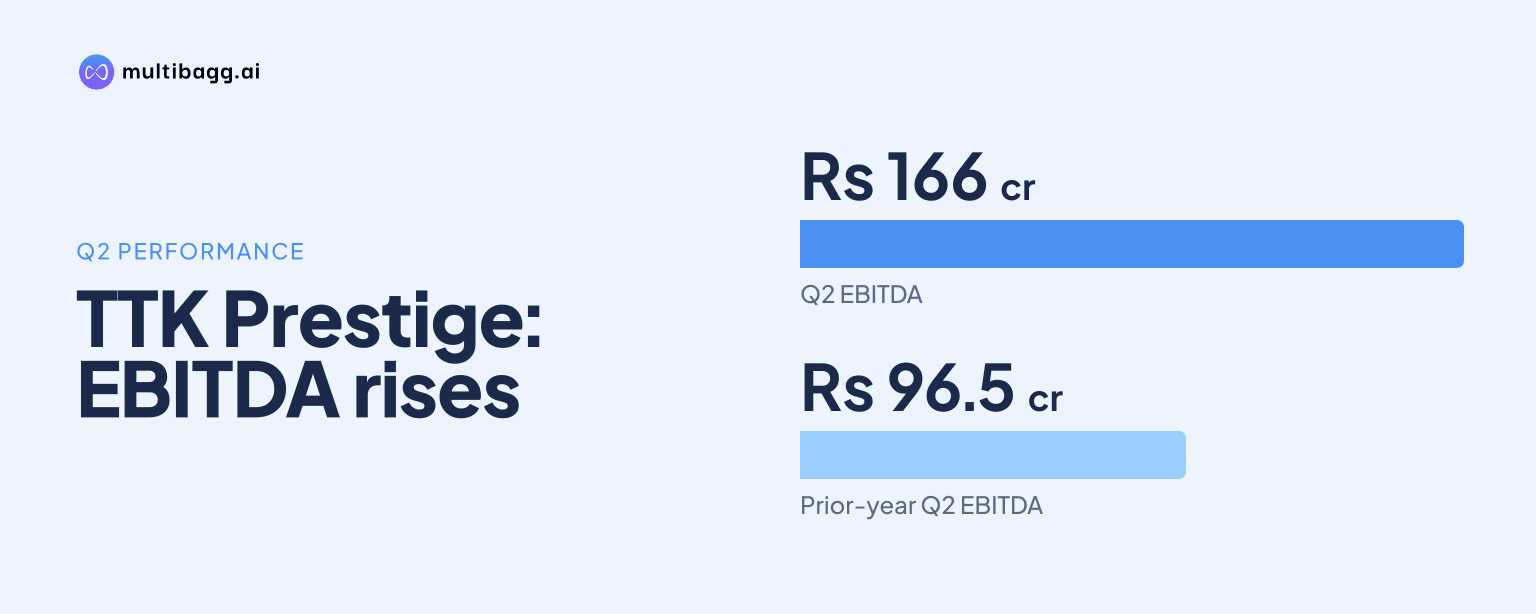
TTK Prestige Ltd reported Q2 EBITDA of ₹166 crore, up 72.02% from ₹96.5 crore a year earlier, with EBITDA margin improving to 16.46% from 11.57%. The operating performance is significant because it indicates a marked expansion in profitability alongside the company’s reported revenue growth.
Know TTK Prestige inside out
Results, valuation, peers and who's buying, in one view.
What did TTK Prestige report for Q2?
TTK Prestige reported EBITDA of ₹166 crore for Q2, compared with ₹96.5 crore in the corresponding quarter of the previous year. This represents year-on-year growth of about 72.02% in operating profit, based on the figures in the data snapshot.
The company’s EBITDA margin rose to 16.46% from 11.57% in the prior-year quarter. The 489-basis-point increase indicates that operating profit grew faster than sales during the period. The available data attributes the improvement to enhanced operational efficiency, without giving a detailed breakup of costs or segment-level performance.
The earnings update was associated with TTK Prestige’s Q2 results review scheduled for November 6, 2026. The source identifies the quarter as Q2 FY2026-27 and notes an earnings conference after market close. Investors will look to the company’s results materials and call commentary for details on product categories, expenses and the drivers of the margin movement.
How did TTK Prestige’s key Q2 figures compare with last year?
TTK Prestige’s reported Q2 operating metrics showed a sharp improvement from the corresponding prior-year period. EBITDA increased by ₹69.5 crore, while margin expanded by 4.89 percentage points.
The data snapshot also lists revenue of ₹729 crore, showing year-on-year growth of 19.67%, and net profit of ₹36 crore, up 40.83% year-on-year. These figures provide a broader indication of growth, although the supplied information does not include the prior-year revenue and net-profit amounts or a reconciliation between standalone and consolidated financial measures.
The difference between EBITDA growth and reported revenue growth is notable. On the information available, it suggests improved operating leverage or a more favourable cost and product mix. However, the source does not provide enough detail to quantify the contribution of pricing, raw materials, employee expenses, advertising or other operating costs.
Got a follow-up? Ask IRIS
What is the background to TTK Prestige’s recent performance?
TTK Prestige Ltd is the flagship company of the TTK group and operates in India’s kitchenware and home-appliance market. Its portfolio includes pressure cookers, cookware, induction cooktops and other kitchen appliances, with premiumisation and domestic demand cited as recent growth factors.
In Q1 FY2026-27, the company reported consolidated revenue of ₹813.85 crore, up 33.6% year-on-year, and consolidated net profit of ₹58.97 crore, up 133.8% year-on-year. Domestic sales increased 35.6%, while export revenue declined 17.9% to ₹12.8 crore because of shipping and logistics disruptions, according to the supplied earnings information.
Q1 EBITDA rose 102.3% year-on-year to ₹81.6 crore, and the EBITDA margin expanded 340 basis points to 10.0%. The company cited selective price increases and an improved premium-product mix despite commodity inflation of about 8%. It also stated that, after adjusting for ₹12.4 crore of strategic expenses, the EBITDA margin would have been 11.6%.
The repositioned Judge brand was another reported contributor in Q1, with revenue rising 89.9% year-on-year to ₹34.6 crore. That earlier quarter established a backdrop of stronger domestic demand and improving profitability before the Q2 operating figures cited in the current update.
Why does the Q2 margin expansion matter to investors?
The Q2 margin expansion matters because EBITDA margin measures the share of revenue retained after operating costs, before interest, tax, depreciation and amortisation. TTK Prestige’s move to 16.46% from 11.57% represents a substantial change in operating profitability in the reported period.
For investors, the key issue is whether this improvement is supported by repeatable business factors. The available information points to operational efficiency, while Q1 disclosures had referred to price actions and a better premium-product mix. The Q2 data provided does not state whether those factors continued, nor does it disclose the impact of commodity costs, distribution spending or promotional expenditure.
The figures also arrive after a strong first-quarter performance, when domestic sales growth outpaced the company’s export business. Demand for kitchen appliances and cookware in India, product mix and input-cost movements remain relevant to the company’s operating performance, particularly because Q1 management commentary had flagged commodity inflation.
The scheduled earnings call provides a formal channel for management to discuss the quarterly performance. Until more detailed financial statements, presentations or call commentary are considered, the reported EBITDA, margin, revenue and net-profit figures are the principal indicators available from the supplied information.
Conclusion
TTK Prestige’s reported Q2 EBITDA of ₹166 crore and EBITDA margin of 16.46% indicate a considerably stronger operating outcome than the corresponding quarter a year ago. The ₹69.5 crore increase in EBITDA and 489-basis-point margin expansion are the central financial developments, while the data snapshot also shows revenue growth of 19.67% and net-profit growth of 40.83%.
The next point to watch is management’s explanation of the Q2 numbers through its November 6, 2026 results review and earnings conference. Investors will seek clarity on the sustainability of margins, domestic demand trends, product mix, strategic expenses, commodity-cost pressures and the outlook for exports affected by logistics disruptions.