










Tulsyan NEC Q2 review qualified over legacy receivables
Key highlights
- Tulsyan NEC’s September 30, 2026 standalone review was qualified over evidence for earlier-period receivables.
- Tulsyan NEC reported trade receivables of Rs 148.90 crore at September 30, 2026, up from Rs 92.71 crore at March 31.
- Tulsyan NEC’s September-quarter standalone net loss was Rs 16.08 crore, compared with Rs 30.85 crore in June 2026.
- Tulsyan NEC’s revised non-convertible debenture redemption date is September 30, 2027.
powered by IRIS
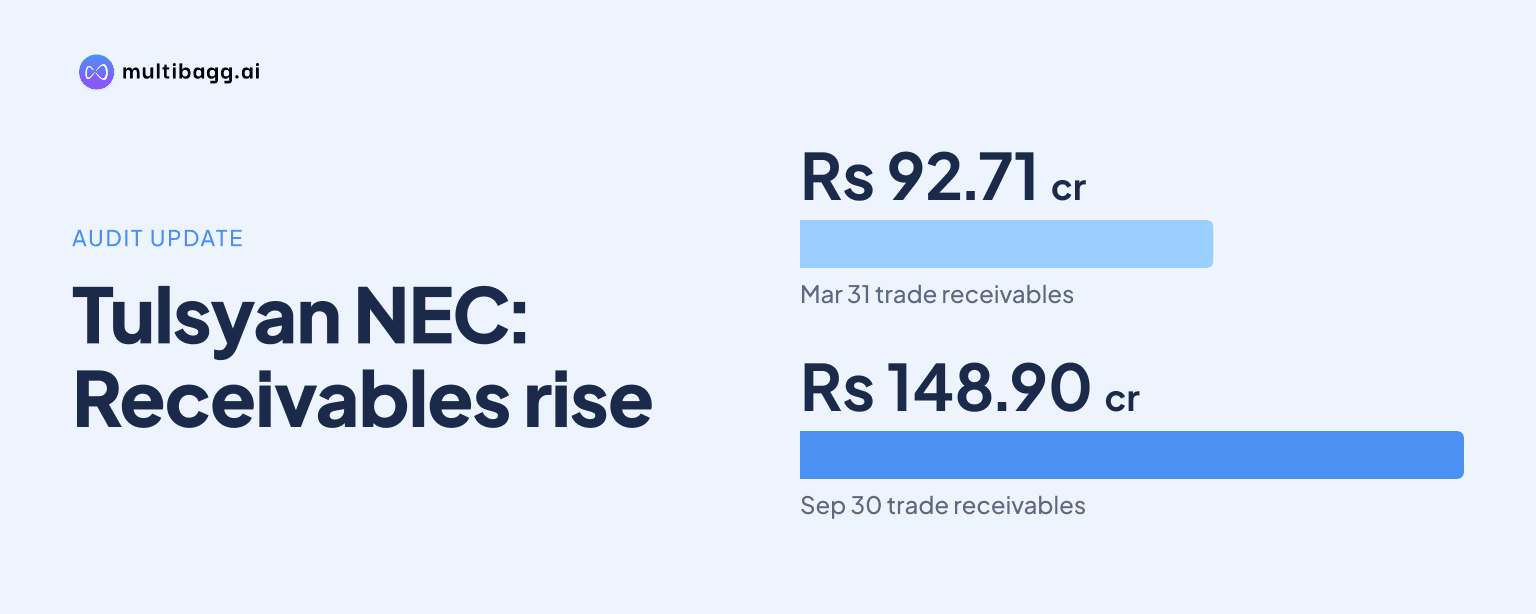
Tulsyan NEC Limited received a qualified standalone limited-review conclusion for the quarter ended September 30, 2026 after its auditor could not obtain sufficient evidence over earlier-period trade receivables; the company reported Rs 148.90 crore of total trade receivables at that date. The auditor did not quantify any possible adjustment.
Know Tulsyan NEC inside out
Results, valuation, peers and who's buying, in one view.
Why did Tulsyan NEC’s auditor qualify the September-quarter review?
Tulsyan NEC’s auditor qualified its conclusion because direct confirmations and sufficient alternative audit evidence were unavailable for outstanding trade receivables relating to earlier periods. S R B R & Associates LLP said this prevented it from determining whether the carrying value of those balances needed additional provisions, write-offs or writebacks as at September 30, 2026.
The possible accounting effect was not quantified in the November 11, 2026 review report. The qualification applies to adjustments, if any, that may be necessary because of the evidence gap, rather than specifying that a particular provision or write-off must be made. The filing also does not disclose the amount of earlier-period receivables included within the Rs 148.90 crore reported balance.
The auditor issued a limited-review conclusion under Standard on Review Engagements 2410, or SRE 2410, for the quarter and six months ended September 30, 2026. The report states that such a review is substantially narrower in scope than an audit and does not provide assurance that all significant matters that could be identified in an audit would be found.
How did Tulsyan NEC’s reported receivables change by September 2026?
Tulsyan NEC reported standalone trade receivables of Rs 148.90 crore at September 30, 2026, up from Rs 92.71 crore at March 31, 2026. The Rs 56.19 crore movement measures the total reported balance, while the auditor’s qualification refers only to receivables from earlier periods and gives no ageing analysis or customer-level split.
Inventories increased by Rs 29.03 crore to Rs 87.20 crore between March 31 and September 30, 2026, while cash and cash equivalents declined by Rs 0.36 crore to Rs 1.00 crore. These balance-sheet movements do not establish the recoverability of the older receivables, which is the specific matter on which the auditor lacked evidence.
Total assets rose by Rs 71.45 crore to Rs 860.45 crore over the same period, while total equity fell by Rs 46.93 crore to Rs 161.98 crore. The September 30 statement records trade receivables as a current financial asset, but the filing provides no collection update, ageing schedule or stated expected-credit-loss provision connected to the balances cited in the qualified conclusion.
What did Tulsyan NEC report for the September 2026 quarter?
Tulsyan NEC reported revenue from operations of Rs 227.86 crore for the quarter ended September 30, 2026, compared with Rs 139.43 crore in the preceding June 2026 quarter and Rs 214.73 crore in the quarter ended September 30, 2025. Its standalone net loss was Rs 16.08 crore, narrower than the Rs 30.85 crore loss in June but wider than the Rs 5.93 crore loss a year earlier.
For the six months ended September 30, 2026, revenue from operations was Rs 367.29 crore, down from Rs 447.69 crore in the corresponding prior-year period. The half-year net loss increased to Rs 46.93 crore from Rs 16.93 crore, while finance costs rose to Rs 42.00 crore from Rs 33.86 crore.
The quarterly revenue increase from June was led by Power, whose revenue rose to Rs 52.82 crore from Rs 2.15 crore. Steel Division revenue increased to Rs 163.62 crore from Rs 125.76 crore, though it remained below Rs 169.10 crore in September 2025. Synthetic Division revenue was Rs 11.41 crore, compared with Rs 11.52 crore in June 2026.
Got a follow-up? Ask IRIS
What did the filing show about Tulsyan NEC’s segment results and borrowings?
Tulsyan NEC’s September-quarter segment result before finance cost was Rs 6.22 crore, compared with a loss of Rs 11.15 crore in June 2026 and a profit of Rs 11.44 crore in September 2025. Finance cost of Rs 22.30 crore exceeded that aggregate segment result, producing the reported pre-tax loss of Rs 16.08 crore.
Power reported a segment result before finance cost of Rs 4.47 crore in the September quarter, against a Rs 8.11 crore loss in June and a Rs 6.90 crore loss a year earlier. Steel reported Rs 2.44 crore of segment profit, compared with a Rs 3.27 crore loss in June, while Synthetic Division reported a Rs 0.69 crore segment loss after a Rs 0.23 crore profit in June.
Non-current borrowings stood at Rs 335.25 crore at September 30, 2026, compared with Rs 314.63 crore at March 31, 2026. Current borrowings increased to Rs 75.73 crore from Rs 69.94 crore, while finance costs for the six months reached Rs 42.00 crore, compared with Rs 33.86 crore in the corresponding 2025 period.
The filing also reported trade payables of Rs 192.52 crore at September 30, 2026, up from Rs 120.40 crore at March 31. Total liabilities were Rs 698.48 crore at September 30, compared with Rs 580.09 crore at the preceding financial year-end, based on the standalone statement of assets and liabilities.
What are the revised debenture terms disclosed by Tulsyan NEC?
Tulsyan NEC disclosed an agreed moratorium on coupon payments for its non-convertible debentures, or NCDs, from April 1, 2026 through August 31, 2026. The company said coupon amounts would be ramped up monthly after that period, and the final redemption date was revised to September 30, 2027.
The company said the full principal, coupon, redemption premium needed to meet the agreed internal rate of return, or IRR, default or penal interest, and other costs and charges under the debenture trust deed are proposed to be paid on the final redemption date. The filing does not state the NCD principal amount, the revised coupon rates or the monthly ramp-up amounts.
The auditor identified the revised NCD terms as an emphasis-of-matter item, not as the basis for its qualified conclusion. Its conclusion was not modified for the NCD revision, whereas the absence of evidence over earlier-period receivables was explicitly identified as the basis for the qualification for the September 30, 2026 quarter.
What operating plan did Tulsyan NEC disclose for its power business?
Tulsyan NEC said it entered into a fuel-supply agreement with Mahanadi Coalfields Limited on May 12, 2026 to purchase coal for power-generation purposes. Mahanadi Coalfields Limited is a subsidiary of Coal India Limited, according to the filing, and the arrangement relates to the Power segment, which reported Rs 52.82 crore of September-quarter revenue.
Management said the agreement is expected to support a stable coal supply in coming years at a comparatively lower cost than imported coal used in earlier years. The disclosure gives no coal volume, contracted price, duration, savings estimate or expected financial effect, so the filing does not quantify the possible impact on Power segment costs.
The Power segment’s September-quarter revenue of Rs 52.82 crore was materially above Rs 2.15 crore in June 2026, but its half-year revenue of Rs 54.97 crore was below Rs 113.54 crore in the corresponding prior-year period. Its half-year segment result before finance cost was a Rs 3.64 crore loss, compared with a Rs 2.36 crore profit a year earlier.
Conclusion
The September 2026 disclosure combines a qualified standalone limited review with higher quarterly revenue and a narrower sequential loss. The central unresolved item is the auditor’s inability to assess whether earlier-period receivables require provisions, write-offs or writebacks, while reported trade receivables increased to Rs 148.90 crore at September 30, 2026.
The disclosed next milestones are the monthly ramp-up of NCD coupon payments following the April-to-August 2026 moratorium and the revised final redemption date of September 30, 2027. Management’s May 12, 2026 coal-supply agreement is also expected by management to provide stable supply at a comparatively lower cost than earlier imported coal.