










TACC's non-binding MoU covers up to 40,000 tonnes of AAM
Key highlights
- TACC announced a non-binding MoU on November 12, 2026 for up to 40,000 tonnes of synthetic graphite-based AAM.
- The proposed supply remains subject to final technical and commercial requirements of both parties.
- TACC states first-phase AAM production of 20,000 MT annually and committed expansion of 44,000 MT.
- The MoU also contemplates R&D on anode materials for faster charging and higher energy density.
powered by IRIS
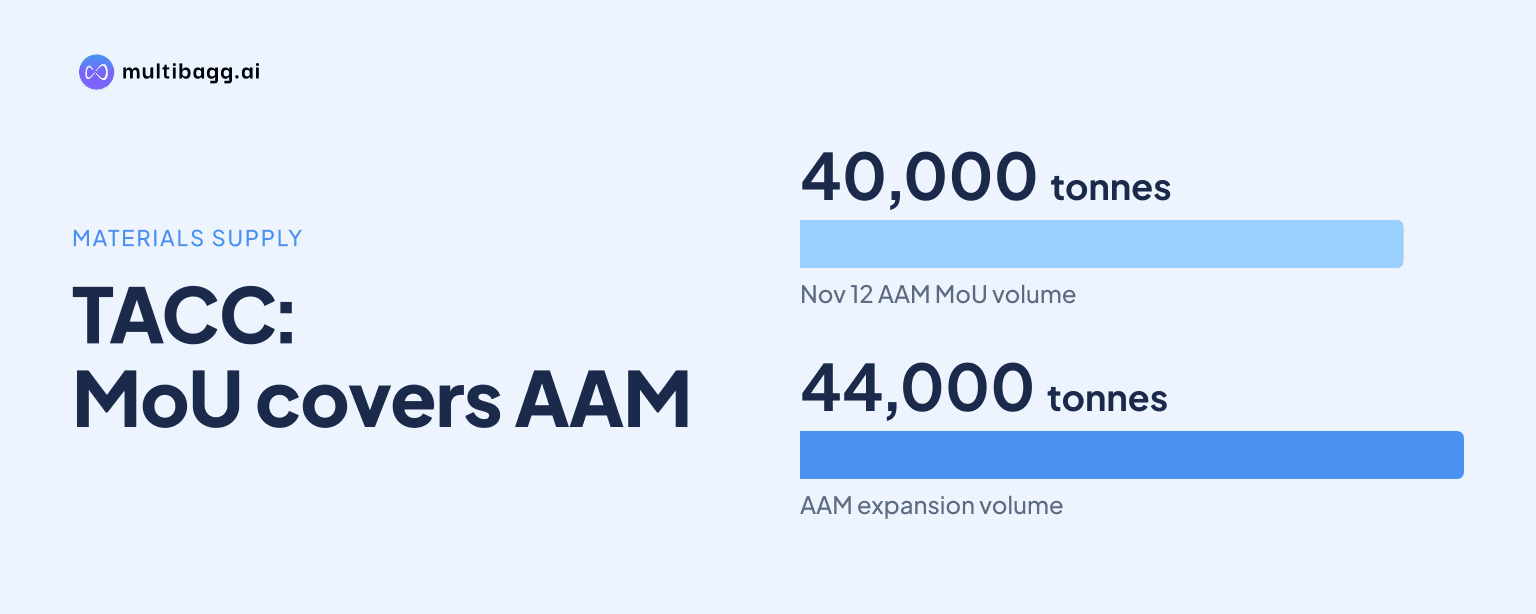
TACC Limited announced on November 12, 2026 that its non-binding Memorandum of Understanding covers proposed long-term supply of up to 40,000 tonnes of synthetic graphite-based Anode Active Material, or AAM, to an unnamed global lithium-ion cell manufacturer, subject to final technical and commercial requirements.
Know HEG Advanced Materials inside out
Results, valuation, peers and who's buying, in one view.
What does TACC's 40,000-tonne MoU cover?
TACC's MoU covers a proposed progressive, long-term supply arrangement for up to 40,000 tonnes of synthetic graphite-based AAM for electric-mobility applications. The November 12, 2026 release identifies the other party only as a global lithium-ion cell manufacturer. It also says the arrangement has scope for further scale-up as the partner's cell-manufacturing capacity expands.
The 40,000-tonne figure is a proposed maximum supply volume rather than a disclosed annual sales target or order-book addition. TACC did not disclose a supply start date, the duration of the arrangement, delivery locations, pricing, or the amount that could be supplied in any particular year. Those omissions mean the proposed volume cannot be translated into annual production, revenue or contracted demand from the announcement.
Is TACC's MoU a binding supply contract?
No, TACC explicitly describes the November 12 MoU as non-binding, with supply conditional on further discussions and finalisation of technical and commercial requirements by both parties. The arrangement is therefore an expression of mutual intent rather than a final contract with settled operating terms. The release does not state that either party has committed to purchase or deliver a defined annual quantity.
The mechanism disclosed is a progressive supply arrangement, making technical qualification and commercial agreement unresolved steps before supply can proceed. TACC did not disclose AAM specifications, qualification milestones, pricing formulas, capital expenditure, payment terms or penalties. It also did not name the cell manufacturer, so the partner's capacity, procurement requirements and timetable are not available from the November 12 release.
How does the proposed volume compare with TACC's capacity plans?
TACC said its first phase will produce 20,000 metric tonnes, or MT, of AAM annually, while its committed expansion is 44,000 MT. The proposed 40,000-tonne supply is twice the stated first-phase annual output, but the figures are not directly comparable because TACC did not state whether the MoU volume would be delivered in one year or over multiple years.
The disclosed plans therefore span a 20,000-tonne annual first phase, a 44,000-tonne committed AAM expansion and a separate 500-tonne annual graphene target. The release does not say whether the 44,000-tonne expansion is additional to first-phase output or represents capacity after expansion. It also does not allocate the proposed 40,000 tonnes between first-phase production, expanded capacity or other customers.
TACC is a wholly owned subsidiary of HEG Advanced Materials Limited and is developing carbon materials and advanced-material solutions for energy storage and industrial applications. HEG Advanced Materials said its wider materials work includes anode materials, graphene and future material development, including silicon-based anodes. The MoU, however, concerns synthetic graphite-based AAM rather than graphene or silicon-based anodes.
Got a follow-up? Ask IRIS
What research work is included in TACC's MoU?
TACC's MoU also sets out in-principle discussions on research and custom material development for advanced anode formulations intended to enable faster charging and higher energy density. Those are the two battery-performance objectives identified in the November 12 release for next-generation electric vehicles. The announcement does not disclose a research budget, development timetable, target cell chemistry or performance threshold.
TACC Managing Director and Chief Executive Officer Ankur Khaitan said management's focus is on turning the shared intent into execution and developing next-generation anode materials with the consistency and quality expected by the partner. Chairman Riju Jhunjhunwala said the arrangement reflects trust in TACC's graphite capabilities and supports its aim of building a globally competitive battery-materials value chain. These are management statements, and the release provides no commercial milestone for measuring research progress or conversion of the MoU into supply.
TACC's 500-tonne annual graphene target sits alongside its AAM programme, but the MoU's research provision is limited to advanced anode formulations. The company says it has in-house research and development and manufacturing capabilities, while disclosing no date for commercial production of custom AAM formulations. The proposed 40,000-tonne supply is consequently tied both to product-development discussions and to final technical and commercial supply requirements.
What remains undisclosed about TACC's proposed supply?
TACC has not disclosed the name of the global lithium-ion cell manufacturer, the value of the proposed supply, a delivery schedule or a contract duration. The November 12 release also gives no indication of the volumes that could be delivered annually under the 40,000-tonne framework. As a result, the announcement does not establish a reported revenue contribution or production utilisation level.
The release similarly provides no commissioning date for TACC's 20,000-MT annual first phase, no timing for its 44,000-MT committed expansion and no progress date for its 500-MT annual graphene target. The supply proposal has scope to scale as the partner expands cell manufacturing capacity, but neither the partner's expansion timetable nor a scale-up trigger is disclosed. Those factors leave the timing and ultimate scale of any supply arrangement unresolved.
Conclusion
The November 12, 2026 MoU provides TACC with a proposed route to supply up to 40,000 tonnes of synthetic graphite-based AAM for electric mobility and to explore faster-charging, higher-energy-density anode formulations. It is relevant to TACC's stated 20,000-MT annual first-phase AAM production and 44,000-MT committed expansion, but it does not establish a binding purchase commitment, revenue amount or delivery schedule.
The next disclosed matters to watch are whether TACC and the unnamed cell manufacturer finalise technical and commercial requirements, set a supply timeframe and convert the non-binding MoU into an enforceable arrangement. TACC has also disclosed a 20,000-MT annual first phase, 44,000-MT committed AAM expansion and 500-MT annual graphene target, although the release gives no commissioning dates or progress milestones for those plans.