










REPLUS expansion would raise battery capacity to 6 GWh
Key highlights
- REPLUS is constructing a 5-GWh expansion that would lift total manufacturing and integration capacity from 1 GWh to 6 GWh.
- REPLUS's operational 1-GWh facility has a 700-MWh prismatic line and a 300-MWh cylindrical line.
- The 5-GWh facility is planned as a high-speed, fully automatic prismatic line with battery-rack assembly and integration.
- REPLUS presents approximately 9,000 MWh of volume demand, including 4,000 MWh in EMEA business and 3,200 MWh in ESS India.
powered by IRIS
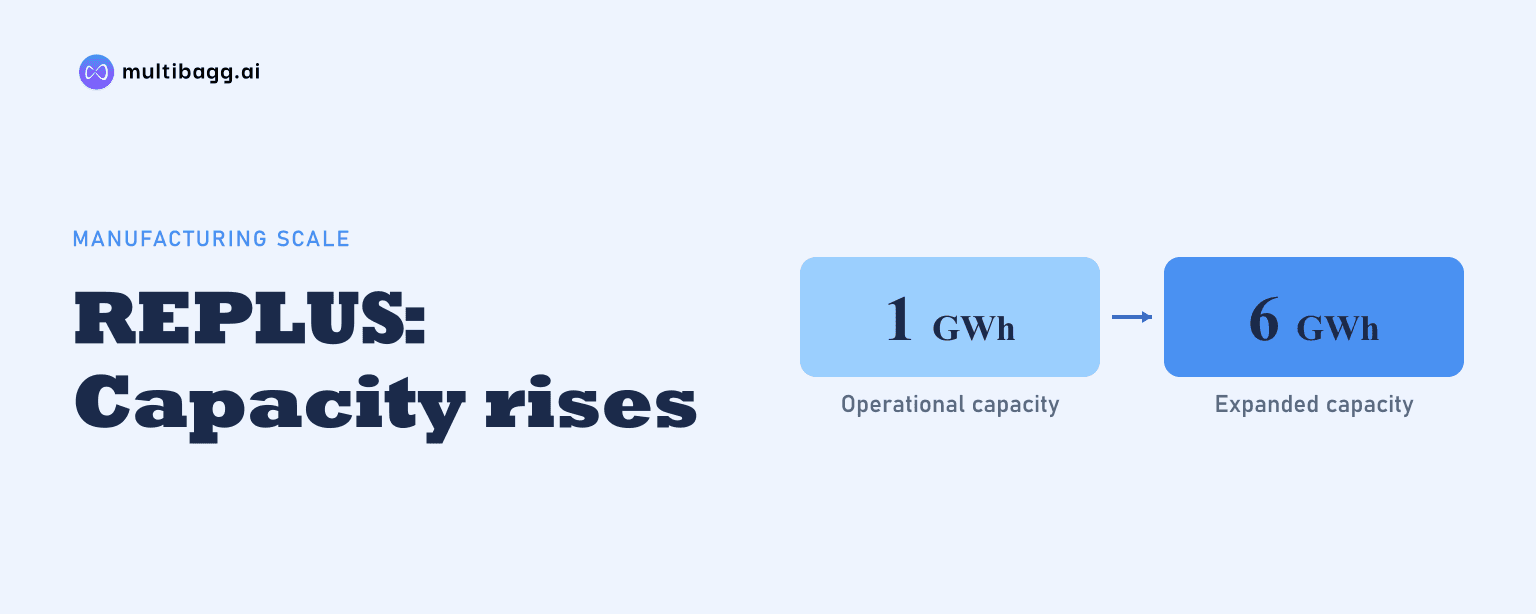
REPLUS Engitech Private Limited is building a 5-GWh battery expansion that would take its manufacturing and integration capacity from 1 GWh at its operational facility to 6 GWh after completion. The under-construction project is described as a high-speed, fully automatic prismatic line with battery-rack assembly and integration.
Know HEG Advanced Materials inside out
Results, valuation, peers and who's buying, in one view.
What battery capacity is REPLUS adding?
REPLUS is adding 5 GWh to its existing 1-GWh facility, taking stated post-completion manufacturing and integration capacity to 6 GWh. The investor presentation identifies the 5-GWh project as under construction and calls it an expansion facility, while the 1-GWh facility is described as operational.
The addition is five times the capacity of the operational facility, and the 6-GWh total would be six times the current 1-GWh base. REPLUS does not disclose the investment cost, construction location, expected completion date, commissioning schedule or capacity-utilisation target for the 5-GWh project.
REPLUS describes its operational site as a fully automated battery manufacturing facility in Pune, Maharashtra. In its battery-gigafactory summary, it lists 1 GWh as initial manufacturing capacity and 6 GWh as expansion capacity, linking the larger figure to the stated scale-up programme.
How is REPLUS's current facility configured?
REPLUS's current 1-GWh facility has a 700-MWh prismatic line and a 300-MWh cylindrical line. The two lines together equal the 1-GWh operating capacity disclosed for manufacturing EV and stationary battery systems.
The new 5-GWh facility is specified as a prismatic line, unlike the existing facility's dual prismatic and cylindrical configuration. This means the disclosed expansion is centred on prismatic-cell processing, although REPLUS does not provide a separate breakdown of the new line's module, pack, rack or container capacity.
REPLUS says the 5-GWh line will include battery-rack assembly and integration in addition to automated manufacturing. Its disclosed production sequence runs from prismatic cell to module, module to pack, pack to rack, rack to container, and then container solution with FFS and liquid cooling.
Got a follow-up? Ask IRIS
What products and systems can REPLUS manufacture?
REPLUS lists battery packs for light commercial vehicles, electric buses and electric trucks in 5-kWh, 10-kWh, 16-kWh, 32-kWh and 35-kWh formats. It also lists battery modules, packs and rack systems ranging from 1.2 kWh to 100 kWh.
For stationary storage, REPLUS identifies battery energy storage system, or BESS, cabinet and container solutions of 261 kWh and 5 MWh. The expansion's rack assembly and container integration are therefore aligned with the company’s disclosed BESS product formats as well as its EV battery-pack range.
REPLUS states that its capabilities include battery management systems, or BMS, energy management systems, or EMS, embedded hardware and software, thermal management, testing, system integration and lifecycle support. It also reports ICAT-certified EV battery packs and TSEC-approved battery packs, while listing collaborations with COEP, MIT and IITGN.
The company identifies electric mobility, stationary storage and specialised applications as its target areas. Its existing 1-GWh facility already has dual lines for EV and stationary systems, whereas the 5-GWh addition specifically adds a high-speed prismatic line with rack assembly and integration.
Which markets are shown in REPLUS's volume demand?
REPLUS presents approximately 9,000 MWh of segmental volume demand across ESS India, EMEA business, EV business and product sales. EMEA, covering Europe, the Middle East and Africa, is the largest category at 4,000 MWh and 45% of the total shown.
ESS India is the second-largest category at 3,200 MWh and 36%. Together, EMEA business and ESS India account for 7,200 MWh of the approximately 9,000-MWh total presented, placing the two largest disclosed segments in energy-storage-related and overseas business categories.
EV business is listed at 380 MWh, or 4%, below both EMEA business at 4,000 MWh and ESS India at 3,200 MWh. Product sales are shown at 1,400 MWh and 16%; the displayed segment shares add to 101%, consistent with rounding against the presentation's approximate total.
The 6-GWh figure is a post-completion capacity measure rather than reported production, sales or utilisation. REPLUS provides no revenue, backlog, customer names, pricing, margin forecast or output target for the 5-GWh facility, so the presentation does not establish how quickly the added capacity would be used.
Conclusion
REPLUS's 5-GWh project would lift manufacturing and integration capacity from 1 GWh to 6 GWh after completion. The expansion combines a high-speed automated prismatic line with rack assembly and integration, while the existing site has 700 MWh of prismatic capacity and 300 MWh of cylindrical capacity. Its disclosed demand view is led by 4,000 MWh of EMEA business and 3,200 MWh of ESS India.
The next item to watch is completion of the under-construction 5-GWh facility, for which REPLUS has not disclosed a date, cost or utilisation target. Separately, HEG Advanced Materials identifies a 200-MWh BESS independent power producer project in Gujarat with target commissioning in Q3 FY27; that project is distinct from REPLUS's manufacturing expansion but is part of the group’s disclosed storage activity.