










HEGAM targets 500 MT graphene plant after 90 MT commitments
Key highlights
- HEGAM targets 500 MT of graphene capacity with commercial operation planned for September 2028.
- HEGAM reports 90 MT of confirmed graphene oxide equivalent orders and letters of intent.
- HEGAM says its graphene reduced cement use in ready-mix concrete by approximately 30%.
- HEGAM's operating demonstration plant has 10 MT of capacity.
powered by IRIS
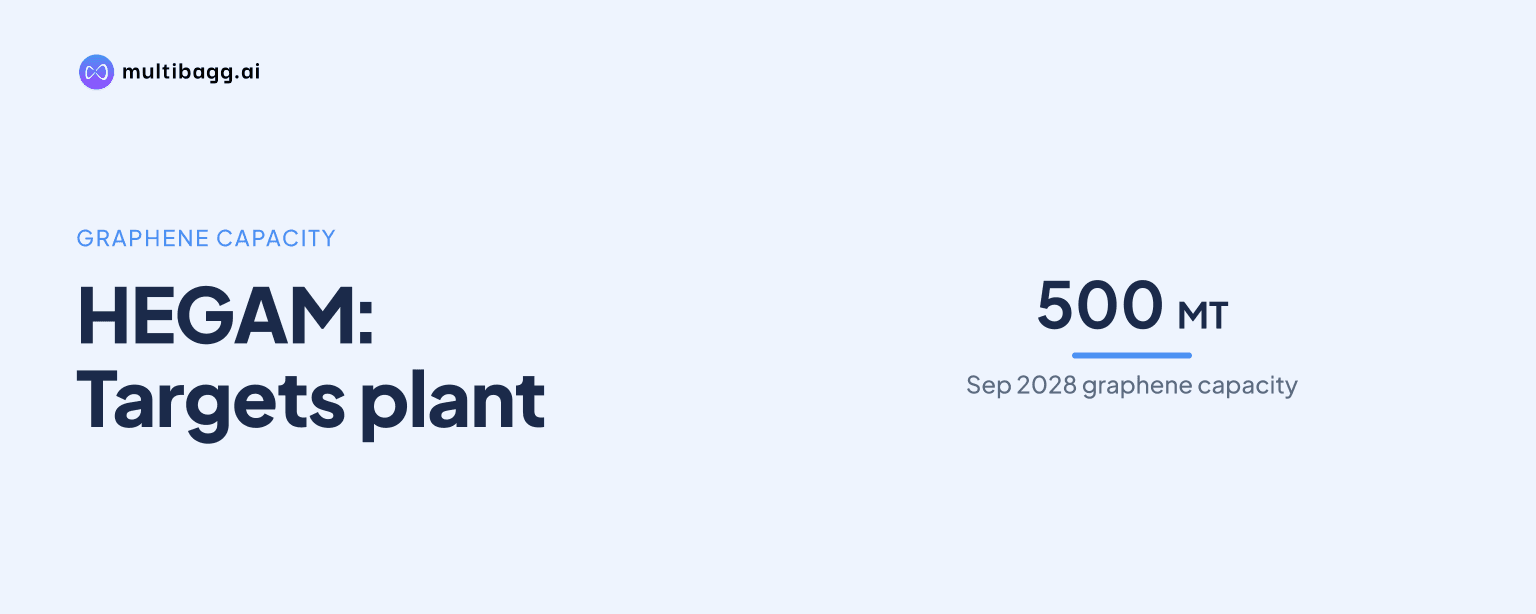
HEG Advanced Materials, referred to as HEGAM, targets a 500-metric-tonne (MT) graphene plant with a commercial operation date of September 2028 after reporting 90 MT of confirmed orders and letters of intent. Its presentation also cites a 10-MT operating demonstration plant and an approximately 30% reduction in cement use in ready-mix concrete.
Know HEG Advanced Materials inside out
Results, valuation, peers and who's buying, in one view.
What commercial demand has HEGAM secured for graphene?
HEGAM has disclosed 90 MT of confirmed orders and letters of intent in graphene oxide equivalent material. The largest component is 54 MT associated with an international graphene company, followed by 21 MT for paints and coatings and 15 MT for concrete and construction. The presentation identifies these volumes as orders and letters of intent rather than revenue or contracted utilisation of the proposed 500-MT plant.
The disclosed 90 MT equals 18% of the proposed 500-MT capacity. That comparison shows that the reported commitments are below the planned plant's stated capacity, while HEGAM has separately presented market-demand estimates based on assumed adoption rates. The presentation does not disclose delivery dates, pricing, customer names, contract terms or the division between binding orders and letters of intent.
How does HEGAM's proposed capacity compare with its market pipeline?
HEGAM estimates pilot-stage demand of 2,270 MT to 2,420 MT across concrete and roads, paints and coatings, and textiles, compared with its proposed 500-MT plant. The company defines pilot penetration as 1% and states that 500 MT is under one-fifth of that pilot-demand estimate. At what it calls full penetration of 5%, the same three application groups represent 11,000 MT to 12,400 MT.
Concrete and roads account for roughly four-fifths of HEGAM's stated pilot-demand range, versus about one-tenth each for paints and textiles. Separately, HEGAM says about 60% of its material is aimed at construction and infrastructure. Construction is therefore the main outlet in the company's capacity rationale, while paints, textiles, lubricants and battery applications are additional target segments.
Got a follow-up? Ask IRIS
Which graphene applications has HEGAM validated with customers?
HEGAM says its in-house graphene has proven an approximately 30% reduction in cement use in ready-mix concrete. A high-performance concrete sample is under validation with NCCBM under a memorandum of understanding. For road infrastructure, HEGAM says its graphene product is at an advanced stage of validation with CSIR-CRRI.
Application readiness differs by segment. HEGAM says a commercial-scale textile trial has been completed with established results as a multifunctional advanced textile. Paints and coatings samples are being tested in real-world conditions with global paint manufacturers, while lubricant samples are under testing and validation with a global lubricant manufacturer to reduce friction coefficient and enhance fuel efficiency.
HEGAM also lists fast-charging battery anodes and data-centre thermal interface materials as development areas. It says multiple graphene-based anode products are under development for fast-charging applications using in-house material and cell-engineering expertise, rather than reporting a completed commercial trial or secured battery order. Its broader target list includes lithium batteries, electric vehicles, polymers, high-voltage cables, water filtration, desalination, packaging, 3D printing and asphalt, without individual demand estimates for those segments.
What must HEGAM deliver before September 2028?
HEGAM must scale from its operating 10-MT demonstration plant to the proposed 500-MT facility before the September 2028 commercial operation date. This is a 50-fold increase in stated capacity. The presentation says its first process patent has been published and that final grant is expected soon.
Customer validation remains part of the disclosed scale-up plan. HEGAM reports co-development with a global paints group and commercial-scale validation at different stages with key customers across applications. It says it has technical know-how to produce graphene, graphene oxide, reduced graphene oxide and dispersions for specific applications, and that graphite is customised for graphene manufacturing.
The presentation describes HEGAM's process as independent and patented while also stating that final grant for its first published patent is expected soon. It does not disclose capital expenditure, funding, project approvals, plant-construction milestones, feedstock volumes or the planned production mix across graphene products. The 10-MT demonstration plant, 90 MT of orders and letters of intent, and the ready-mix concrete result are disclosed progress markers, whereas the 2,270-MT to 2,420-MT pilot-demand figure is based on the company's market-penetration assumptions.
Conclusion
HEGAM has presented an early graphene commercialisation case built on a 10-MT operating demonstration unit, 90 MT of reported orders and letters of intent, and an approximately 30% cement-use reduction in ready-mix concrete. Construction and infrastructure are its principal intended outlet, representing about 60% of its material focus and most of its estimated pilot-market demand across the three quantified application groups.
The next disclosed milestone is the September 2028 commercial operation date for the proposed 500-MT plant. Progress to watch under HEGAM's stated plan includes the expected final patent grant, outcomes of NCCBM and CSIR-CRRI validation work, and whether paint, textile and lubricant trials convert into further identified commercial volumes.