










HEG Advanced Materials plans 44,000 MT anode capacity by 2029
Key highlights
- TACC plans 44,000 MT of anode capacity by March 2029, including a 24,000-MT Phase II addition.
- TACC reported 61% overall progress and 72.25% process-building progress on the 20,000-MT Phase I plant.
- TACC says customer discussions cover more than 100,000 MT, with commercial validation planned for early 2027.
- TACC's 200-MT Mandideep demonstration plant has operated for the past 12 months.
powered by IRIS
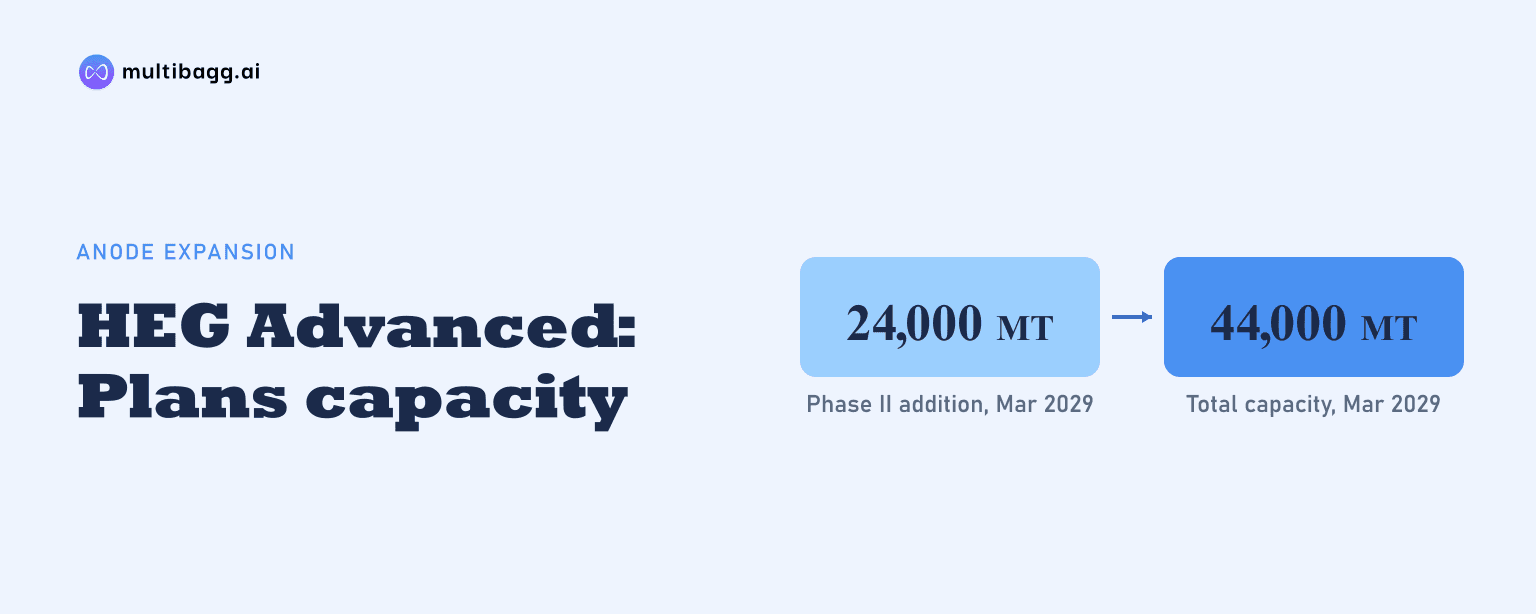
HEG Advanced Materials plans to build 44,000 MT of anode capacity by March 2029 through a 20,000-MT first phase and a further 24,000-MT phase, while TACC reports customer discussions covering more than 100,000 MT. Phase I was 61% complete, with its process building 72.25% complete, in the presentation update.
Know HEG Advanced Materials inside out
Results, valuation, peers and who's buying, in one view.
How will TACC reach 44,000 MT of anode capacity?
TACC plans to reach 44,000 MT by commissioning a 20,000-MT Phase I facility and adding 24,000 MT in Phase II, which is scheduled for commercial operations in March 2029. The presentation defines an anode as a battery material that stores and releases ions during charging and discharging, with uses in electric vehicles and energy-storage systems.
TACC operates a 200-MT demonstration plant at Mandideep, Madhya Pradesh, using the process flow and technology planned for its commercial facility. The company says the unit has supplied material for global customer validation over the past 12 months, while sample approvals and material qualification are at an advanced stage.
Phase II is planned at the existing Dewas site, using the same land footprint as Phase I. TACC says the existing 220-kilovolt connection will serve both phases, while shared utilities, facilities and team expenditure will be used across the two plants. This plan links the additional 24,000 MT of capacity to infrastructure being installed for Phase I.
What is the status of TACC's 20,000-MT Phase I plant?
TACC reported 61% overall progress on its 20,000-MT Phase I plant, with the process building 72.25% complete and commercial operations targeted for June 2027. The work disclosed includes steel and reinforced cement concrete shop structures, furnace foundations, shop-building cladding and delivery of imported equipment.
TACC says critical process equipment has started arriving at the site and further deliveries are under way. It also reported transmission-tower erection for the 220-kilovolt line, with equipment installation and integration planned in parallel during the following three months. The June 2027 target therefore remains dependent on construction and commissioning work still in progress.
The capacity roadmap separately labels the Phase I commercial operations date as “Jun FY28”, while the construction page states June 2027. TACC has not provided capital expenditure for Phase I, a detailed commissioning timetable, or a production ramp-up schedule after commercial operations begin.
Got a follow-up? Ask IRIS
How do TACC's customer talks compare with planned capacity?
TACC says memoranda of understanding and agreements covering more than 100,000 MT are under discussion, exceeding its planned 44,000-MT capacity by March 2029. The company describes these as advance talks and progressive commitments, rather than disclosing binding sales contracts, and says commercial validation is expected to begin in early 2027.
The 2027 discussion range of 10,000 to 12,000 MT is below Phase I's 20,000-MT capacity. By 2029, the 40,000-to-50,000-MT range spans the planned 44,000-MT platform, while the 2030 range of 50,000 to 60,000 MT is above it. TACC identifies further expansion beyond Phase II, but does not disclose its scale or timing.
TACC attributes the discussions to demand for non-China anode supply, stating that planned non-China cell capacity exceeds 1 terawatt-hour by 2030 and non-China anode demand will exceed 1 million tonnes. It reports positive validations and supply discussions with customers across North America, Europe and Asia-Pacific, alongside large-scale pilot validations in India, where it cites more than 100 gigawatt-hours of domestic cell capacity planned by 2035.
Why is TACC planning to make crucibles in-house?
TACC plans backward integration into crucibles because the graphite vessels hold anode powder during graphitisation at about 3,000 degrees Celsius. Each crucible is reused for about four to five firings, and TACC identifies it as its second-largest raw material after green coke.
TACC says most of its crucibles are imported, leaving supply availability, prices and lead times outside its control. At a 44,000-MT anode scale, the company says in-house manufacturing would replace imported crucibles, although the presentation does not provide the proposed crucible capacity, construction timeline or manufacturing cost.
The integration plan accompanies development work on higher-end anodes. TACC says silicon-doped anodes can enable energy density above 20% and support higher capacity and charging rates for premium applications. It is also developing graphene-based anode products for fast-charging and high-power applications, but has not provided commercial launch dates or sales forecasts for those products.
Conclusion
TACC's plan combines a 200-MT demonstration plant, a 20,000-MT commercial Phase I facility and a 24,000-MT Phase II addition into 44,000 MT of planned anode capacity by March 2029. The more than 100,000 MT of customer discussions is larger than that proposed capacity, but the presentation characterises the volume as discussions, validations and progressive commitments rather than disclosed firm orders.
The next disclosed milestones are commercial validation in early 2027, equipment installation and integration during the following three months, and Phase I commercial operations targeted for June 2027. TACC also targets Phase II commercial operations in March 2029, while its in-house crucible plan has no disclosed capacity or execution timetable.