










TVS Supply Chain Solutions Q2 Revenue Rises 38.5%
Key highlights
- TVS Supply Chain Solutions reported Q2 FY27 revenue of ₹3,687.2 crore, up 38.5% year-on-year.
- Q2 FY27 PBT before redundancy costs rose 107.6% to ₹50.6 crore from ₹24.4 crore.
- India revenue increased 64.1% to ₹1,177.4 crore, while rest-of-world revenue grew 29.0% to ₹2,510 crore.
- The business-development pipeline increased to ₹8,200 crore from ₹7,500 crore.
powered by IRIS
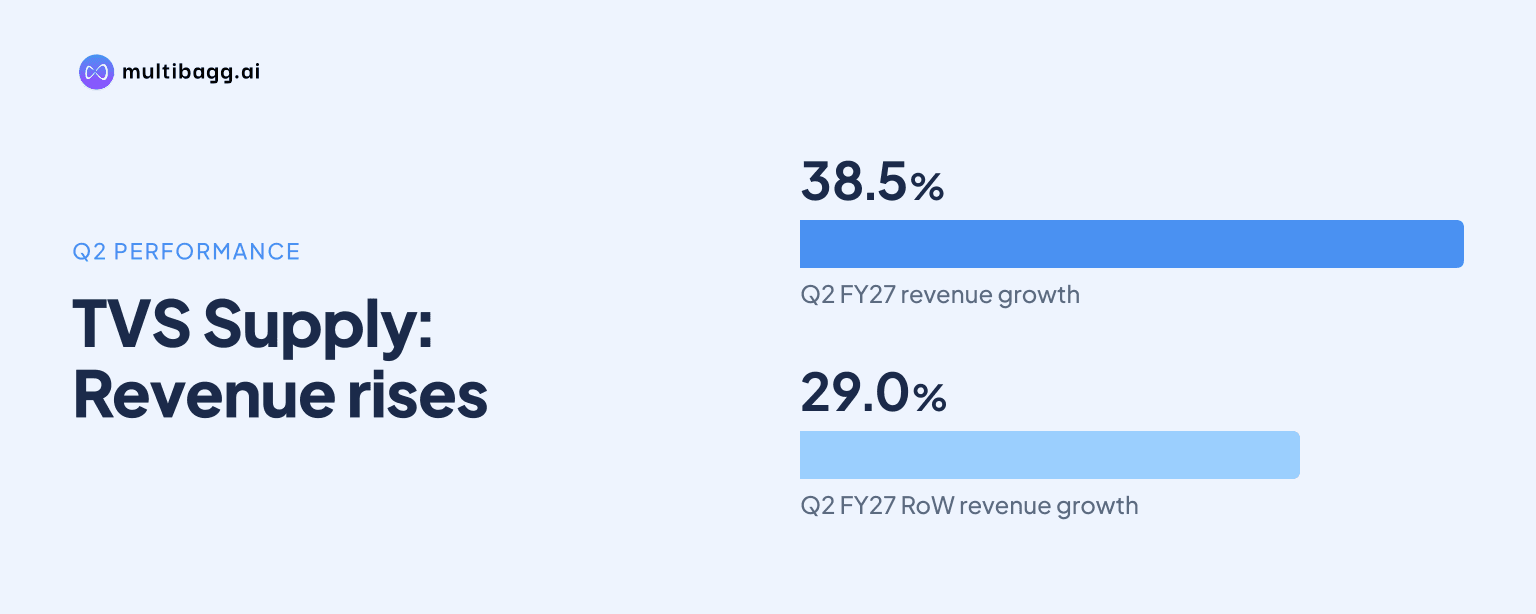
TVS Supply Chain Solutions Ltd reported record Q2 FY27 revenue of ₹3,687.2 crore, up 38.5% year-on-year, while profit before tax before redundancy costs more than doubled to ₹50.6 crore. The result matters because growth was spread across India, overseas operations and both major business segments, supporting management's FY27 growth and profitability targets.
Know TVS Supply Chain Solutions inside out
Results, valuation, peers and who's buying, in one view.
What did TVS Supply Chain Solutions report for Q2 FY27?
TVS Supply Chain Solutions reported consolidated revenue from operations of ₹3,687.2 crore for the quarter ended Q2 FY27, compared with ₹2,662.6 crore a year earlier. Revenue also rose 10.6% sequentially from ₹3,335 crore in Q1 FY27, making this the company's highest quarterly revenue reported in the earnings material.
Adjusted EBITDA increased 50.2% year-on-year to ₹268.1 crore. The adjusted EBITDA margin improved by 60 basis points to 7.3%, indicating that operating profit grew faster than revenue during the quarter.
Profit before tax, before redundancy costs, rose 107.6% to ₹50.6 crore from ₹24.4 crore in Q2 FY26. Consolidated profit after tax was ₹36.5 crore, compared with ₹16.3 crore in the corresponding quarter of the previous year. The reported PAT increase was 123.9% year-on-year.
Which businesses and regions drove the quarterly growth?
TVS Supply Chain Solutions said its growth was broad-based across segments and geographies. The Integrated Supply Chain Solutions, or ISCS, business reported revenue growth of 24.8% year-on-year to ₹2,487.9 crore. Its margin expanded by 50 basis points year-on-year to 9.2%, according to the earnings-call material.
Global Forwarding Solutions, or GFS, was the faster-growing segment, with revenue rising 79.1% year-on-year to ₹1,199.3 crore. The disclosed segment performance shows that both contract-led supply-chain operations and forwarding activities contributed to the consolidated revenue increase.
India was the strongest geography. India revenue increased 64.1% year-on-year to ₹1,177.4 crore, aided by 36.1% growth in India ISCS and 135.8% growth in India GFS. Revenue from the rest of the world rose 29.0% to ₹2,510 crore. Management also cited 21% growth in ISCS outside India.
How did the first half and new-business pipeline develop?
TVS Supply Chain Solutions reported H1 FY27 revenue of ₹7,022.4 crore, a 33.6% increase from the comparable prior-year period. Adjusted EBITDA for the first half was ₹500.3 crore. The company said revenue growth during the half year spanned segments and regions.
New-business revenue exceeded ₹500 crore for the third consecutive quarter. This measure is relevant because it reflects the contribution from business wins that have moved into revenue generation, rather than only the expansion of existing customer relationships.
The business-development pipeline increased to ₹8,200 crore from ₹7,500 crore. Management described this pipeline as providing demand visibility, though a pipeline is not the same as contracted revenue and does not establish the timing or conversion of potential business.
Got a follow-up? Ask IRIS
What is management's FY27 outlook after the second quarter?
TVS Supply Chain Solutions maintained a target of revenue growth above 20% for FY27. Management also indicated an aim to double profitability and achieve adjusted operational PBT of around ₹200 crore during the financial year.
The outlook follows a quarter in which revenue grew faster than the stated full-year target and PBT before redundancy costs more than doubled. However, the earnings material does not provide a quarter-by-quarter forecast, nor does it specify how much of the ₹8,200 crore business-development pipeline will convert into FY27 revenue.
The company said India remained its standout geography, while growth in the rest of the world and the overseas ISCS business showed that the result was not limited to one market. This mix matters for investors assessing the sources of revenue growth across the logistics and supply-chain portfolio.
Why do these results matter for investors and operations?
TVS Supply Chain Solutions' results show a combination of higher revenue, improved adjusted EBITDA margin and stronger pre-tax profit. The 60-basis-point expansion in adjusted EBITDA margin to 7.3% and the 50-basis-point expansion in ISCS margin to 9.2% are the key disclosed indicators of operating improvement.
For customers and industry operations, the data points to continued activity across integrated supply-chain and forwarding services. India GFS revenue, in particular, grew 135.8% year-on-year, while India ISCS rose 36.1%. The figures demonstrate differing growth rates within the portfolio but do not disclose customer-level contracts or pricing details.
Investors will also note the distinction between operational performance and prior-period comparisons. The company has stated that prior-year H1 profit included a one-time investee gain. For the current quarter, the reported PBT comparison is presented before redundancy costs, which should be considered when comparing profitability measures across periods.
Conclusion
TVS Supply Chain Solutions delivered its highest reported quarterly revenue in Q2 FY27, with ₹3,687.2 crore of revenue, ₹268.1 crore of adjusted EBITDA and ₹36.5 crore of PAT. Strong India growth, particularly in GFS, alongside 29.0% rest-of-world revenue growth and higher ISCS margins, supported the improvement in earnings.
The next disclosed markers are progress toward management's FY27 revenue-growth target of above 20%, adjusted operational PBT of around ₹200 crore and profitability-doubling ambition. Investors can also track whether new-business revenue remains above ₹500 crore and how the ₹8,200 crore business-development pipeline develops.