










UGRO Capital resets reserves, lifts H1 pro forma profit
Key highlights
- UGRO Capital’s pro forma net worth would fall by Rs 575 crore to Rs 2,454 crore after the proposed merger accounting.
- H1 FY27 pro forma profit after tax was Rs 126.3 crore, Rs 7.7 crore above reported profit after tax of Rs 118.6 crore.
- H1 FY27 early-repayment reversals would decline to Rs 58 crore on a pro forma basis from Rs 120.5 crore reported.
- Emerging Market LAP and GROx represented 53% of Rs 15,019 crore of AUM at 30 September 2026, up from 32% nine months earlier.
powered by IRIS
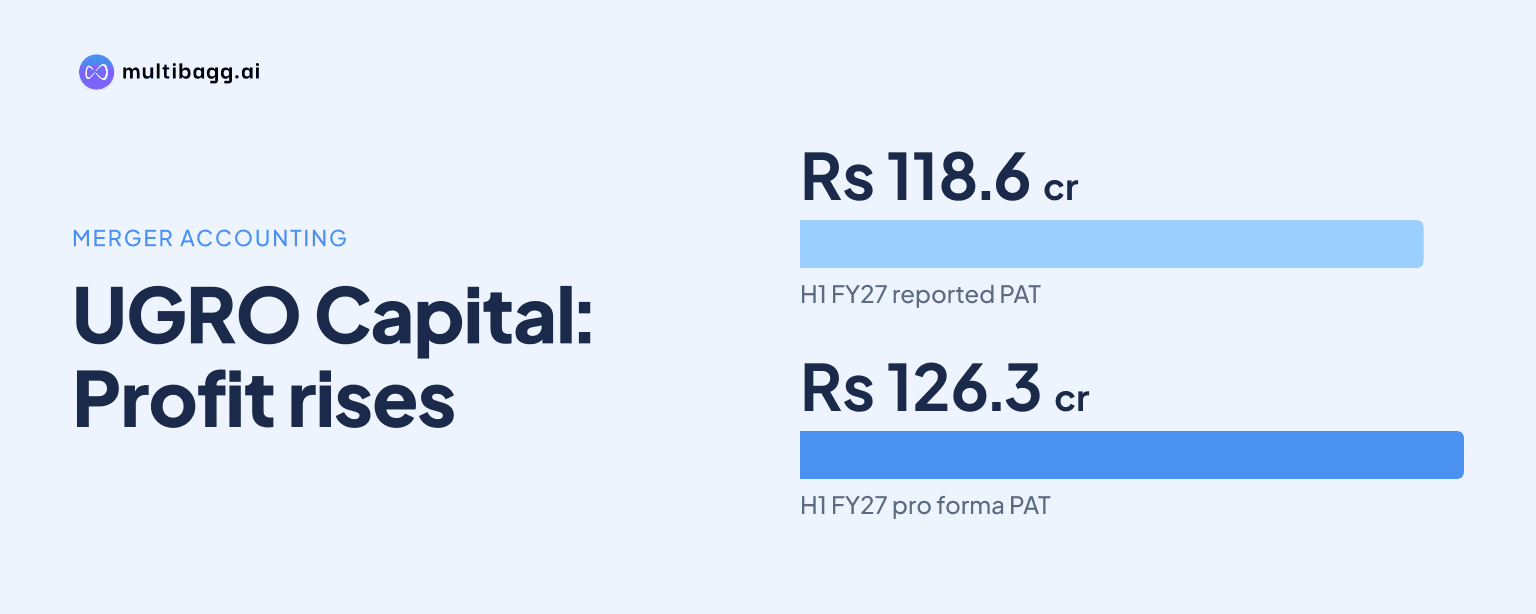
UGRO Capital Limited said its proposed Profectus merger will reduce pro forma net worth by Rs 575 crore to Rs 2,454 crore, while lifting H1 FY27 pro forma profit after tax by Rs 7.7 crore to Rs 126.3 crore. The one-time reserves adjustment shifts co-lending income recognition to observed behavioural loan tenure.
Know Ugro Capital inside out
Results, valuation, peers and who's buying, in one view.
Why is UGRO Capital changing its co-lending accounting?
UGRO Capital is changing the accounting because income recognised upfront on co-lent and directly assigned loans was later reversed when borrowers repaid before their contractual loan maturity. Between FY22 and FY26, those reversals totalled Rs 318 crore, equal to 44% of cumulative profit before tax over the period, according to management. The company said this was not a credit loss because lifetime income booked ultimately matched cash received, but it made reported earnings volatile.
Under the proposed scheme, UGRO Capital will measure its future share of interest spread over the period loans are actually expected to run, using observed borrower-prepayment behaviour rather than contractual tenure. The company said early repayments will therefore have a smaller effect on income already recognised. The change applies alongside the merger of Profectus Capital into UGRO Capital, which had its National Company Law Tribunal final hearing scheduled for 20 November 2026.
The reset follows a February 2026 strategic pivot away from prime loans sourced through intermediaries, which had also been shared with banks and non-banking financial companies through co-lending and direct assignment. At its peak, 45% of assets under management, or AUM, sat off balance sheet with nine banks and seven non-banking financial companies. The prime intermediated book has since fallen 32% over nine months and represented 47% of AUM at 30 September 2026.
How much will the merger accounting reduce net worth?
UGRO Capital estimates that the accounting adjustment will lower pro forma net worth to Rs 2,454 crore from reported net worth of Rs 3,029 crore, a reduction of Rs 575 crore. The reduction will be charged once against general reserves and securities premium rather than the profit and loss account, subject to National Company Law Tribunal approval and statutory-auditor review.
The Rs 308 crore adjustment comprises Profectus goodwill and acquisition costs, while the Rs 266 crore item reflects remeasurement of excess interest spread on co-lent and assigned loans. On this basis, book value would be about Rs 158 per share, versus reported book value of Rs 195 per share. Management said goodwill and upfront spreads had already been deducted from tier 1 capital, so the reserve adjustment itself would not reduce regulatory capital.
UGRO Capital reported standalone capital adequacy of 18.8% before the scheme and said it would rise to about 22% on the merged pro forma basis. Management attributed the increase to removal of the regulatory deduction for its investment in Profectus. At quarter-end, reported leverage was 3.6 times and liquidity was about Rs 1,500 crore, figures management said provide headroom for planned growth without new equity through FY29.
Got a follow-up? Ask IRIS
Why does the accounting reset increase H1 profit?
UGRO Capital’s H1 FY27 pro forma profit after tax rises because lower reversals of previously recognised income outweigh lower upfront recognition on newly originated co-lending and assignment transactions. Reported H1 profit after tax was Rs 118.6 crore, up 53% year on year, while the pro forma result was Rs 126.3 crore, an increase of Rs 7.7 crore.
The decline in H1 reversals to Rs 58 crore from Rs 120.5 crore is larger than the Rs 7.7 crore profit increase because income booked at origination also falls under the behavioural-tenure method. That trade-off is central to comparability: the new approach reduces both the initial income uplift and subsequent reversal. Management said it expects the result to reduce quarterly volatility rather than simply accelerate earnings.
In Q2 FY27, net income from co-lending and direct assignment was Rs 109.1 crore, calculated from gross income of Rs 160.9 crore less Rs 51.8 crore of reversals. The reversal was lower than Rs 68.7 crore in Q1 FY27. Total income rose 25% year on year and 8% quarter on quarter to Rs 578.4 crore, while profit before tax rose 12% year on year to Rs 68.3 crore.
What supports UGRO Capital’s shift toward recurring income?
UGRO Capital is building recurring on-balance-sheet income through Emerging Market LAP and GROx, which together accounted for Rs 7,929 crore, or 53%, of Rs 15,019 crore of AUM at 30 September 2026. Their share was 32% nine months earlier, while the defocused book declined to Rs 7,090 crore from Rs 10,458 crore in December 2025.
Emerging Market LAP, or loans against property, reached Rs 4,268 crore of AUM, up 10% in the quarter and 42% year on year. Quarterly disbursements were Rs 692 crore, compared with Rs 592 crore in Q1 FY27, and portfolio yield was about 18.4%. The 317-branch network across 13 states produced average monthly disbursements of about Rs 73 lakh per branch, compared with Rs 62 lakh in the previous quarter and Rs 48 lakh in FY26.
GROx AUM reached Rs 3,661 crore, up 22% during the quarter and from Rs 1,270 crore 12 months earlier. It disbursed Rs 2,253 crore in Q2 FY27, compared with Rs 1,853 crore in Q1 FY27, and managed about 4.1 lakh active merchants at September-end. Its typical loan is just below Rs 1 lakh with a tenure of about 13 months, while about 95% of repayments are collected daily at source.
The two businesses had gross non-performing assets, or GNPAs, of 1.7%, compared with 3.9% in the defocused book. Emerging Market LAP GNPA was 2% and GROx GNPA was 1.4%, against company-wide GNPA of 2.7%. Credit cost nevertheless rose to Rs 86.9 crore in Q2 FY27 from Rs 65.6 crore in Q1, or 3.6% of average on-book loans from 2.8%, which management linked largely to seasoning of newer portfolios.
Conclusion
The proposed merger accounting makes UGRO Capital’s reported equity base lower by Rs 575 crore, but its H1 FY27 pro forma profit higher by Rs 7.7 crore because recurring income is measured over expected behavioural tenure. The change separates a reserve adjustment from operating profitability and makes comparisons with earlier results less direct, especially where upfront co-lending income and later reversals shaped reported earnings.
The next disclosures to watch are the 20 November 2026 National Company Law Tribunal hearing and management’s plan to publish merger-restated financials over the following two quarters if the scheme is sanctioned. UGRO Capital is targeting a 3% to 3.5% steady-state return on assets by FY29, from 2.7% on the H1 FY27 pro forma basis, while guiding 20% to 30% annual growth in Emerging Market LAP and 35% to 40% in GROx.