










UGRO GROx reaches 4.1 lakh borrowers, Rs 2,253 crore disbursals
Key highlights
- UGRO GROx quarterly disbursals rose to Rs 2,253 crore from Rs 1,853 crore in the previous quarter.
- UGRO GROx had about 4.1 lakh active merchants in September, up from 1.5 lakh a year earlier.
- UGRO GROx AUM reached Rs 3,661 crore, up 22% during the quarter.
- UGRO GROx reported a portfolio yield of about 26% and gross non-performing assets of 1.4%.
powered by IRIS
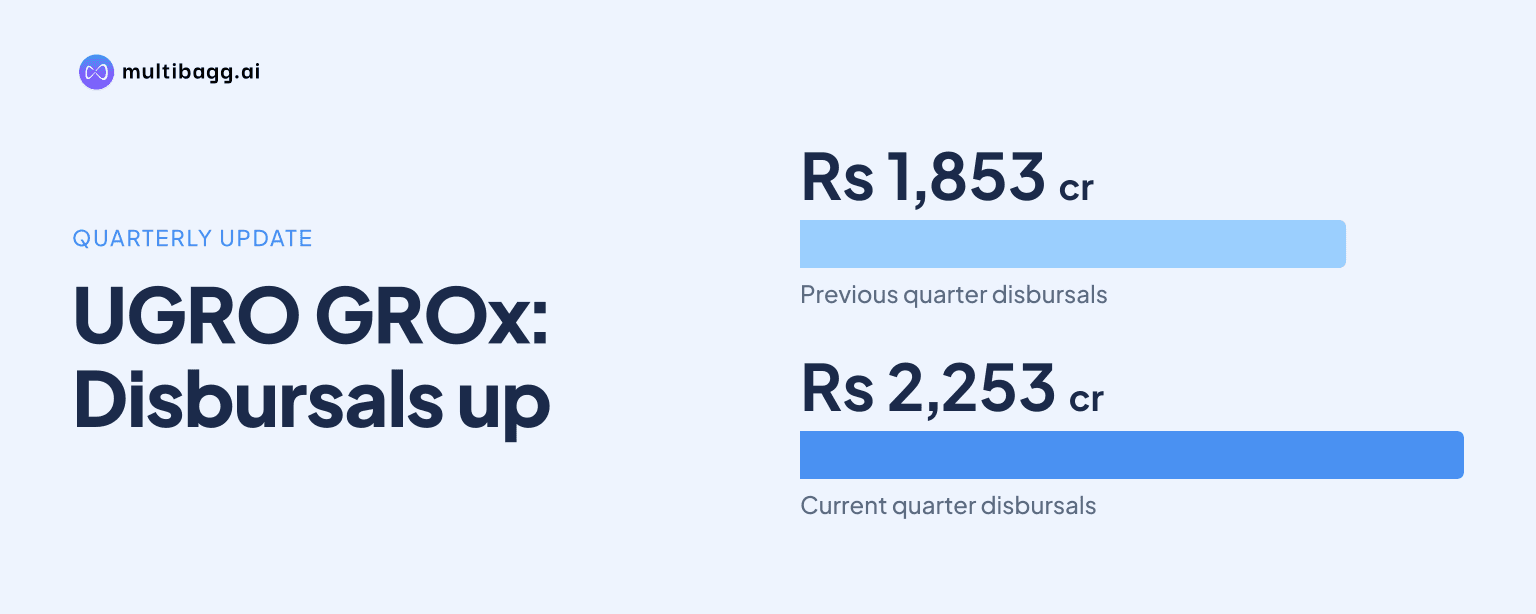
UGRO’s GROx embedded merchant-finance platform had about 4.1 lakh active merchant borrowers in September, after quarterly disbursals rose to Rs 2,253 crore from Rs 1,853 crore in the preceding quarter. GROx assets under management, or AUM, reached Rs 3,661 crore, rising 22% during the quarter, while gross non-performing assets were 1.4%.
Know Ugro Capital inside out
Results, valuation, peers and who's buying, in one view.
How fast is GROx merchant lending growing?
GROx is expanding through higher disbursals, a larger borrower base and rapid loan turnover. Quarterly disbursals increased by Rs 400 crore to Rs 2,253 crore from Rs 1,853 crore in the previous quarter, while active merchants rose from 1.5 lakh a year earlier to about 4.1 lakh in September. Management said GROx was disbursing about Rs 750 crore, or roughly 83,000 loans, each month.
GROx AUM reached Rs 3,661 crore, compared with Rs 1,270 crore 12 months earlier. Its 22% quarterly AUM growth exceeded the 10% quarterly expansion in Emerging Market LAP, UGRO’s secured loan-against-property business. The two focus businesses together accounted for Rs 7,929 crore, or 53%, of UGRO’s total AUM of Rs 15,019 crore, up from 32% nine months earlier.
UGRO said total AUM was flat quarter-on-quarter by design because its defocused portfolio ran down faster than the targeted businesses grew. On-book loans increased from Rs 9,519 crore in June to Rs 9,693 crore in September. GROx and Emerging Market LAP therefore supplied the growth while the defocused book fell to Rs 7,090 crore from Rs 10,458 crore nine months earlier.
How does GROx originate and collect merchant loans?
GROx originates loans inside payment-partner applications and makes underwriting decisions in minutes using live merchant transaction data. UGRO named PhonePe, Paytm and BharatPe among its partner platforms. Its technology and data-analytics stack is embedded in those platforms, providing transaction information that management said supports underwriting, pricing and credit-limit decisions.
The typical GROx loan is just under Rs 1 lakh and has a tenure of about 13 months. Management said the platform mainly makes short-tenure loans with daily and weekly repayments, and about 95% of repayments are collected daily at source. That structure differs from Emerging Market LAP, where average loan tickets are Rs 17 lakh to Rs 19 lakh and are secured against property.
Each GROx decision also draws on the repayment history of more than 7 lakh loans, according to management. A new partner can bring merchants to the platform without a branch build-out, while completed-loan data can be used in subsequent risk and pricing decisions. Management said UGRO currently lends to only a small fraction of merchants active on partner platforms.
GROx reconciles settlements daily and monitors merchant transaction trends for early warning signals. Its collection process can escalate from digital reminders to calls, field visits and legal action where required. Management said the book turns over in nine to 10 months, allowing it to reprice loans and tighten credit parameters relatively quickly.
Got a follow-up? Ask IRIS
How is GROx credit risk managed and shared?
GROx reported gross non-performing assets of 1.4%, below the 2% reported in Emerging Market LAP and the 1.7% figure across the two focus businesses. UGRO’s overall gross non-performing assets were 2.7% in September, compared with 2.6% in June. The defocused book had gross non-performing assets of about 3.9%, higher than either focus business.
GROx is unsecured merchant lending, and management said partners provide default-loss guarantees within the Reserve Bank of India limit. Partner collection-linked payouts of 5% to 7% are also tied to portfolio performance. These mechanisms link partner compensation and contractual loss sharing to collections, while UGRO reports GROx AUM and asset-quality measures.
Management put GROx credit cost at about 3.5% to 4%, with part shared by partners, compared with 1.5% to 2% for secured Emerging Market LAP. GROx operating cost was about 1% of AUM and its portfolio yield about 26%, versus an 18.4% yield for Emerging Market LAP. The higher yield and different credit-cost profile reflect the unsecured, short-tenure product structure.
UGRO’s company-wide credit-cost charge was Rs 86.9 crore in the September quarter, up from Rs 65.6 crore in the preceding quarter. As a share of average on-book loans, it rose to 3.6% from 2.8%. Management attributed the movement mainly to seasoning in newer Emerging Market LAP and GROx portfolios, and said this would be monitored more closely in coming quarters.
What does GROx mean for UGRO’s portfolio plan?
UGRO has guided for GROx to grow 35% to 40% annually, compared with 20% to 30% guidance for Emerging Market LAP. Management said GROx’s earlier growth came from a low base. It expects the two focus businesses to account for about 87% of the portfolio by FY29, compared with 53% at the September reporting point.
High disbursals do not convert one-for-one into GROx AUM because loans repay quickly. During the earnings call, management said GROx could disburse Rs 800 crore to Rs 900 crore in a month while receiving Rs 600 crore to Rs 700 crore of repayments in the same month. It therefore expects GROx to represent roughly 25% to 30% of AUM over time, while Emerging Market LAP could account for about 60%.
The shift toward the two focus businesses coincided with a higher total portfolio yield of 18.7%, up 53 basis points quarter-on-quarter and 108 basis points year-on-year. Interest income was Rs 385.5 crore, up 20% year-on-year, while total income was Rs 578.4 crore, up 25%. Management attributed the yield movement to growth in on-book loans and a mix shift toward Emerging Market LAP and GROx.
Management’s FY29 objective is a steady-state return on assets of 3% to 3.5%, against 2.7% on a pro forma first-half basis. It said this depends on the focus businesses achieving their guided growth, credit costs staying within expected losses and operating costs being contained as volumes rise. Quarterly operating expenses were Rs 127.2 crore, compared with Rs 205 crore in the fourth quarter of FY26.
Conclusion
GROx has become a larger component of UGRO’s strategy to replace its declining defocused book with on-book, recurring-interest lending. The September figures show a platform with Rs 3,661 crore of AUM, daily collection mechanisms and data-led underwriting, alongside a branch-led secured lending business with a different loan size, tenure and credit-cost profile.
The next measures to watch are GROx’s progress against management’s 35% to 40% annual growth guidance, the company-wide credit-cost trend after the Rs 86.9 crore September-quarter charge, and the focus-business mix on the path to about 87% by FY29. UGRO also said the merger of Profectus Capital had a National Company Law Tribunal final hearing scheduled for 20 November, with restated financials planned after the scheme is sanctioned.