










Ugro Capital Limited Q2 FY27 disbursements rise 77% to ₹3,159 crore
Key highlights
- Ugro Capital Limited recorded ₹3,159 crore of Q2 FY27 net disbursements, up 77% year-on-year.
- Ugro Capital Limited crossed ₹1,000 crore of disbursements in each month of Q2 FY27.
- Focus businesses represented ₹7,929 crore, or 53%, of Ugro Capital Limited’s ₹15,019 crore AUM.
- Ugro Capital Limited’s operating costs fell 7% year-on-year to ₹127.2 crore in Q2 FY27.
powered by IRIS
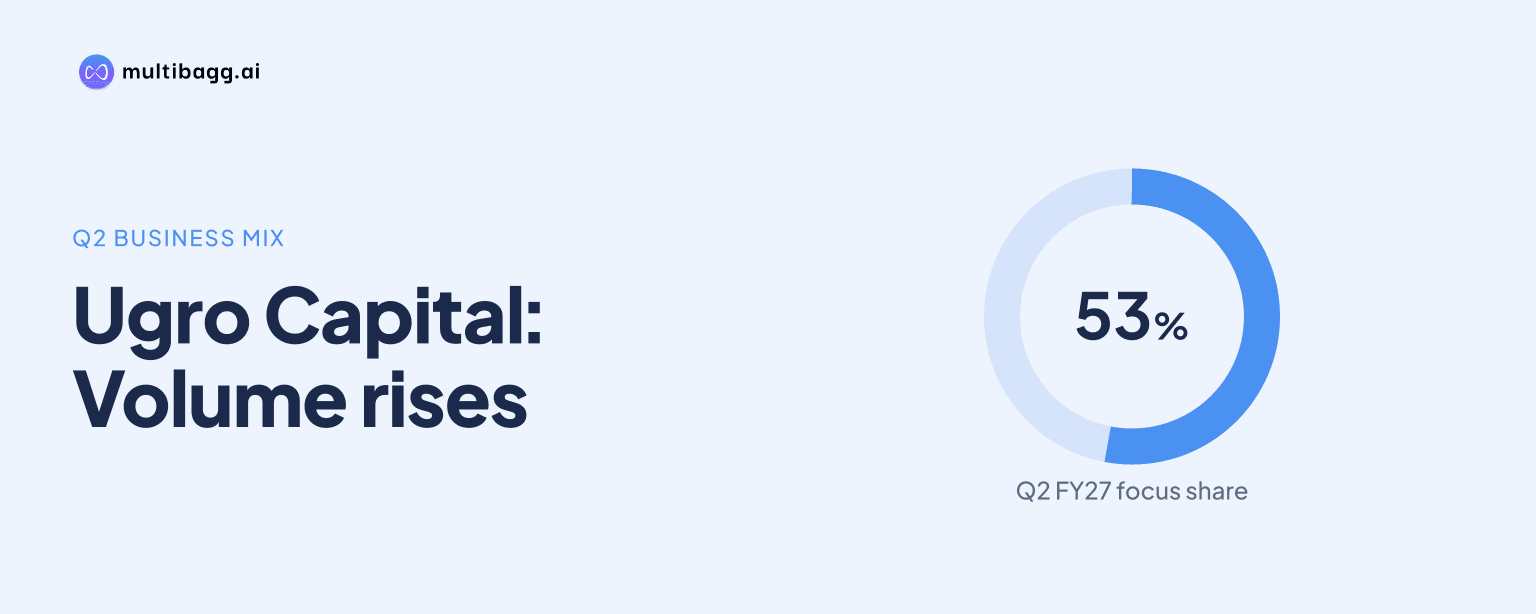
Ugro Capital Limited reported net disbursements of ₹3,159 crore in Q2 FY27, up 77% year-on-year, after crossing ₹1,000 crore of monthly disbursements in each month of the July-September quarter. The non-bank lender’s focused businesses also reached 53% of its ₹15,019 crore assets under management, marking a material change in its portfolio mix.
Know Ugro Capital inside out
Results, valuation, peers and who's buying, in one view.
How did Ugro Capital perform in Q2 FY27?
Ugro Capital delivered higher lending volumes and year-on-year profit growth in Q2 FY27, although credit costs limited the increase in profit before tax. Net disbursements rose 77% year-on-year and 24% sequentially to ₹3,159 crore. The company disbursed ₹1,057 crore in July, ₹1,010 crore in August and ₹1,092 crore in September, making this its first quarter with monthly disbursements above ₹1,000 crore throughout.
Consolidated revenue for the quarter was ₹544.31 crore, up 19.52% year-on-year. Profit before tax rose 12% year-on-year and 11% quarter-on-quarter to ₹68.3 crore, while profit after tax increased 17% year-on-year to ₹50.7 crore. The company said the comparatively slower growth in pre-tax profit reflected higher credit costs and the effect of a one-time deferred tax credit recorded in the previous quarter.
The results were declared on November 5, 2026, and management discussed them during its November 6 earnings call. The company noted that Q2 FY27 and Q1 FY27 results are consolidated and include Profectus Capital and GROx Technologies, whereas Q2 FY26 was reported on a standalone basis. This difference is relevant when interpreting year-on-year comparisons.
What is driving the change in Ugro Capital’s loan portfolio?
Ugro Capital’s Emerging Market LAP and GROx businesses are driving the portfolio shift, together accounting for ₹7,929 crore, or 53%, of AUM at the end of Q2 FY27. Their share was 32% nine months earlier, according to management. The company has identified these as focus businesses as it seeks a greater contribution from higher-yielding and annuity-led income streams.
Emerging Market LAP refers to lending against property in the company’s targeted market segments, while GROx is another focused lending business. The rapid increase in their share means these segments have become central to the lender’s growth profile rather than remaining smaller portfolio additions. The company’s total AUM of ₹15,019 crore provides the base against which this transition is being measured.
The expansion in disbursements came alongside this mix change. Management presented the quarterly performance as evidence that its newer focus areas were scaling while maintaining monthly origination levels above ₹1,000 crore. The figures do not by themselves establish future portfolio performance, but they show that the strategic shift has already altered the composition of the loan book.
Got a follow-up? Ask IRIS
How did costs and profitability move during the quarter?
Ugro Capital reduced operating costs by 7% year-on-year to ₹127.2 crore in Q2 FY27, supporting profitability despite higher credit costs. Employee costs declined 35% year-on-year. Management said this cost performance was in line with its FY27 operating-cost guidance of ₹490 crore.
The cost reduction is significant because the company is simultaneously increasing disbursements and building its focus businesses. Lower operating expenses can improve operating leverage when loan volumes rise, although reported profit also depends on funding costs, credit costs, income recognition and tax items. In this quarter, the 12% rise in profit before tax was lower than the growth in disbursements and revenue.
Profit after tax for the first half of FY27 rose 53% to ₹118.6 crore. However, quarter-on-quarter comparisons need context because the prior quarter included a one-time deferred tax credit, as stated by management. Investors assessing earnings quality may therefore distinguish recurring operating progress from the effect of such accounting items.
What does the Profectus Capital merger mean for Ugro Capital?
The proposed merger of Profectus Capital into Ugro Capital is expected to reduce income volatility by better aligning income recognition with behavioural loan tenure. Management said it would use pro forma figures reflecting the accounting approach planned for the merger, which is intended to address the timing of income recognition in the combined business.
Management also said pro forma capital adequacy would rise to about 22% after the merger. This would provide capacity for growth without requiring new equity, based on the company’s stated assessment. The merger therefore has both accounting and capital implications, beyond the addition of Profectus Capital to consolidated results.
For investors, the transaction makes comparability especially important. Ugro Capital has explicitly flagged that the current-year quarterly figures include subsidiaries while the comparable Q2 FY26 data was standalone. The reported growth numbers remain useful, but the different reporting perimeter should be considered alongside the company’s operational metrics.
How does the quarter affect investors and the MSME lending market?
The quarter shows that Ugro Capital is expanding lending activity while attempting to control operating expenses and reposition its portfolio toward focus businesses. Net disbursements of ₹3,159 crore and focus-business AUM of ₹7,929 crore indicate the scale of this transition. At the same time, higher credit costs affected pre-tax profit growth, underlining that loan-book growth and profitability may not move at the same pace.
For the broader MSME lending market, the results highlight the importance of underwriting, funding, collection performance and operating efficiency as lenders pursue larger portfolios. Ugro Capital’s management has linked its strategy to higher-yielding, annuity-led income, but the disclosed quarter also shows why credit-cost trends remain important to earnings assessment.
Conclusion
Ugro Capital Limited’s Q2 FY27 performance combined record monthly lending activity with a substantial change in portfolio composition. Net disbursements rose 77% year-on-year to ₹3,159 crore, while the company’s focus businesses increased to 53% of AUM. Cost control supported profit growth, though higher credit costs and a prior-quarter tax item affected the pace of pre-tax earnings growth.
The next areas to watch are progress toward the company’s FY27 operating-cost guidance of ₹490 crore, the performance of its focus-business loan book, and developments in the Profectus Capital merger. Management has indicated that the merger could result in pro forma capital adequacy of about 22% and reduce income-recognition volatility, making its implementation and reported accounting effects relevant for future results.