










UHT completes Vertiv CDU prototype, equipment due Jan 2027
Key highlights
- UHT says it completed and dispatched the Gallery CDU prototype as the first supplier to do so.
- UHT targets 31 January 2027 to complete remaining machinery and equipment installation.
- UHT’s CDU pipework capability covers 1.5-inch to 6-inch collaring in 316/316L stainless steel.
- UHT reported H1FY27 revenue of Rs 32.19 crore, up 50.1% year on year.
powered by IRIS
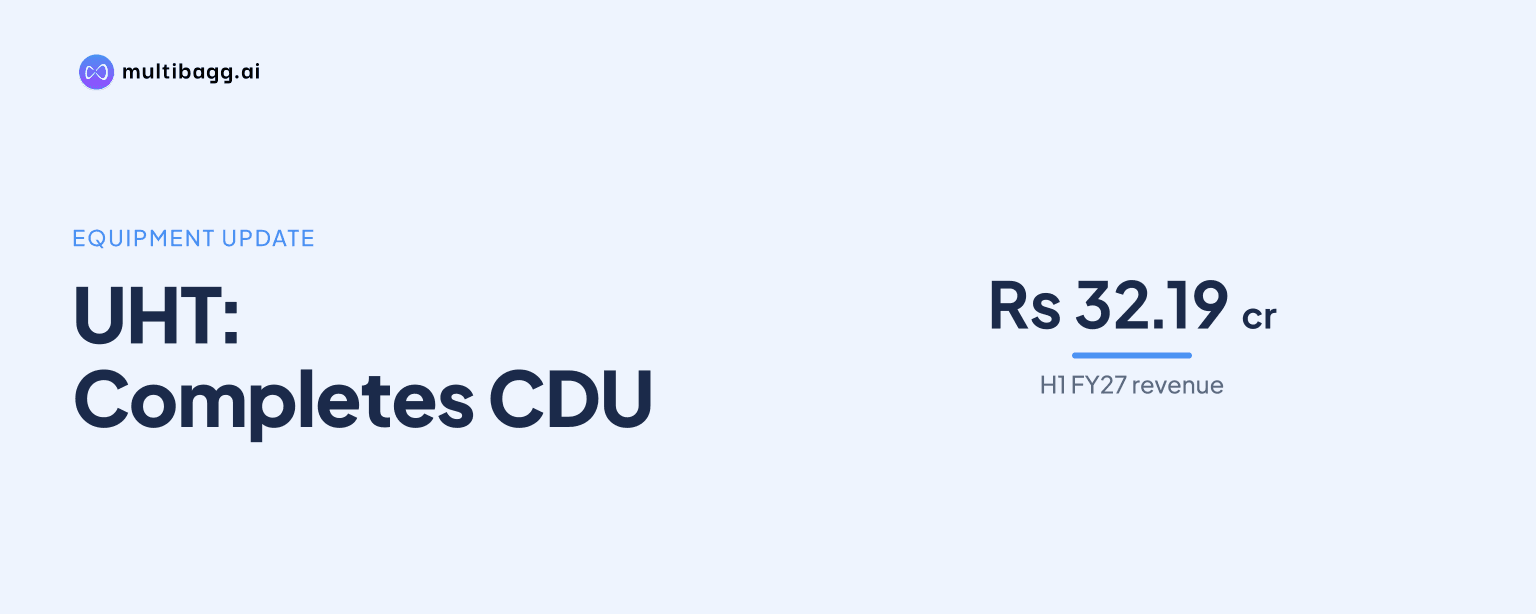
United Heat Transfer Limited says it completed and dispatched Vertiv’s Gallery cooling distribution unit, or CDU, prototype as the first supplier to do so, while targeting 31 January 2027 to complete remaining machinery and equipment installation at its dedicated Ambad Plant facility. The milestones cover prototype completion and the planned production set-up for scalable manufacturing.
Know United Heat Transfer inside out
Results, valuation, peers and who's buying, in one view.
What did UHT complete for Vertiv?
UHT completed and dispatched the Gallery CDU prototype for the Vertiv project. UHT says it was the first supplier to achieve prototype completion. The prototype is part of UHT’s liquid-cooling capability for the data-centre and high-density heating, ventilation and air-conditioning market.
The completed unit sits within a product category that UHT describes as using precision stainless-steel pipework, orbital welding and thermal-management systems. UHT specifies CDU operating pressure of up to 16 bar, giving a stated operating parameter for the product family rather than only a general heat-transfer description.
How is UHT preparing Ambad Plant for CDU production?
UHT has exclusively allocated Ambad Plant to the Vertiv project and upgraded the facility to Vertiv’s requirements. The disclosed work includes a revised shop-floor layout, epoxy flooring and specialised machinery, which UHT says establish infrastructure for scalable production and timely deliveries.
UHT has also deployed a dedicated workforce across key departments and completed the Vertiv Supplier Audit Checklist, or VSAC. These measures separate the dispatched prototype from the remaining factory set-up, because installation of the outstanding machinery and equipment is targeted for completion by 31 January 2027.
The production preparation coincides with higher reported activity in H1FY27, although UHT does not attribute the financial movement to the Vertiv programme. Revenue from operations increased 50.1% year on year to Rs 32.19 crore in H1FY27 from Rs 21.44 crore in H1FY26, while orders under execution totalled Rs 49.97 crore for delivery during the remainder of FY27.
What CDU pipework capabilities does UHT disclose?
UHT says its dedicated CDU manufacturing floor can fabricate 316 and 316L stainless-steel pipework with collaring capacity from 1.5 inches to 6 inches. The disclosed process combines precision fabrication, collared joints, orbital tungsten inert gas, or TIG, welding and a mirror-polished finish.
UHT identifies 316 and 316L stainless steel as the CDU system’s wetted-surface materials. It also states that it has a full supply chain for this grade, alongside collaring, orbital welding and mirror polishing, describing both the pipework material and the fabrication steps for CDU work.
UHT lists TIG welding, metal inert gas, or MIG, welding and vacuum brazing as additional joining techniques. It also says copper-alloy fabrication is available, with duplex stainless steel and titanium available on request; however, the CDU pipework page identifies 316 and 316L stainless steel as the primary material.
Got a follow-up? Ask IRIS
What operating conditions are UHT’s CDU systems designed for?
UHT states that its CDU capability supports a maximum operating pressure of up to 16 bar and fluid media including water-glycol, deionised water and coolants. It also cites verified capability for elevated-temperature service, but does not disclose a temperature range or an operating temperature for the Gallery prototype.
For containment performance, UHT lists a helium leak-rate target below 1×10⁻⁹ mbar·l/s. UHT says its technical design standards include American Society of Mechanical Engineers Section VIII, the Pressure Equipment Directive, or PED, and EN 13445, with 316 or 316L stainless steel and a mirror-polished finish for wetted surfaces.
These specifications distinguish the CDU offering from UHT’s air-cooled heat exchangers, which it describes as water-free heat-rejection systems designed to API 661 and ISO 13706. The CDU programme instead uses liquid cooling, stainless-steel pipework and welded fabrication, with 16 bar as the directly stated pressure capability.
What remains before UHT’s planned production set-up is complete?
UHT says remaining machinery and equipment were under installation, with completion targeted by 31 January 2027. This is the disclosed outstanding milestone: Ambad Plant has been allocated, the VSAC has been completed and the Gallery CDU prototype has been dispatched, but equipment installation was not described as complete.
UHT does not disclose a CDU production-volume target, Vertiv project value, purchase-order quantity or date for serial deliveries. The available disclosure therefore supports UHT’s statement that it has established an operational foundation for scalable production, but does not quantify eventual CDU output or revenue from the programme.
The broader H1FY27 comparison shows revenue of Rs 32.19 crore was below Rs 51.44 crore reported in H2FY26, while reported net profit was Rs 1.47 crore versus Rs 4.17 crore in H2FY26. UHT reported EBITDA of Rs 3.81 crore in H1FY27, compared with Rs 2.56 crore in H1FY26 and Rs 7.90 crore in H2FY26, without linking these period movements to the Vertiv project.
Conclusion
Taken together, the disclosed steps show UHT has completed a Gallery CDU prototype and built a dedicated manufacturing framework around the Vertiv programme. The framework includes Ambad Plant allocation, a dedicated workforce, completed supplier-audit checklist, 1.5-inch to 6-inch collaring capacity, 316/316L stainless-steel pipework, orbital TIG welding and a stated 16-bar operating capability.
The next disclosed checkpoint is 31 January 2027, when UHT targets completion of the remaining machinery and equipment installation. The presentation leaves unresolved the programme’s production volumes, serial-delivery schedule, order quantity and value, so subsequent disclosures on those items would provide the next measure of production progress.