










ROX Hi-Tech current borrowings more than tripled in FY26
Key highlights
- ROX Hi-Tech’s current borrowings rose to Rs 65.27 crore in FY26 from Rs 19.28 crore in FY24.
- Inventory days increased to 164 in FY26 from 115 in FY24.
- Receivable days fell to 76 in FY26 from 144 in FY25.
- ROX Hi-Tech reported a 151-day net working-capital cycle in FY26, versus 170 days in FY25.
powered by IRIS
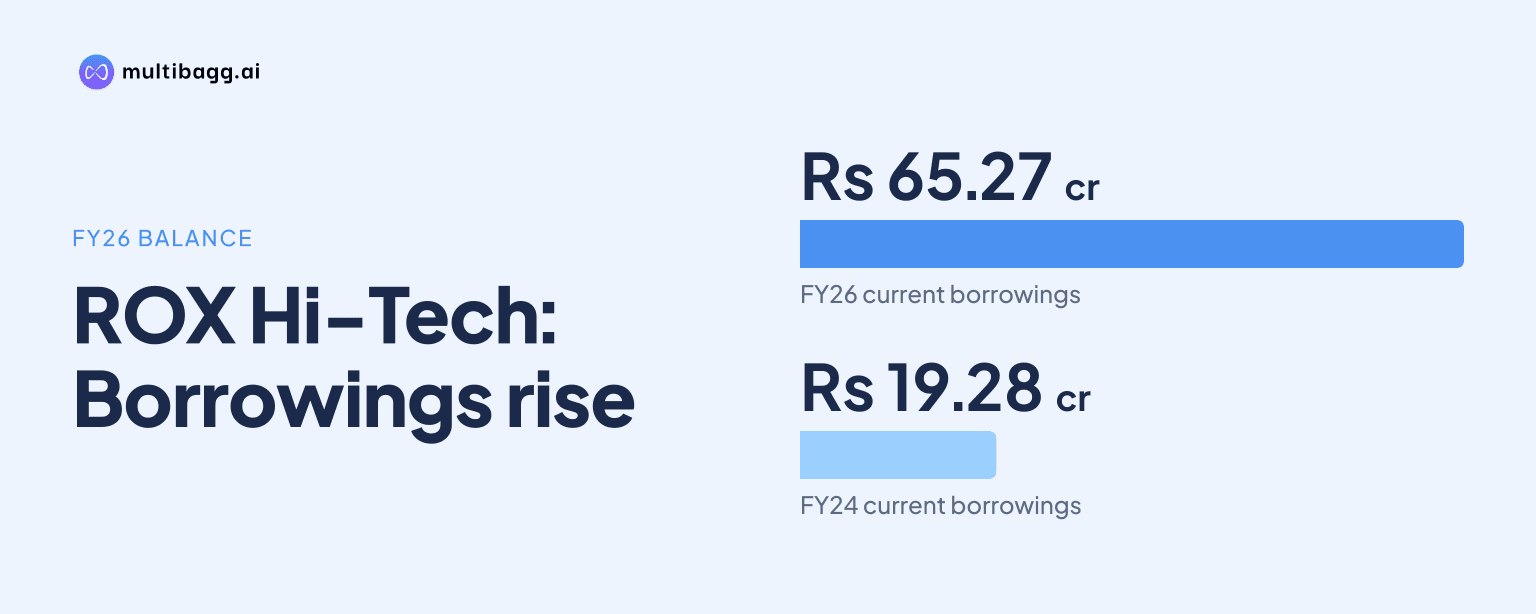
ROX Hi-Tech Limited reported current borrowings of Rs 65.27 crore in FY26, more than three times Rs 19.28 crore in FY24, as inventory days rose to 164 from 115. Receivable days, however, fell to 76 from 112 over the same two-year period, while the net working-capital cycle declined to 151 days.
Know ROX Hi-Tech inside out
Results, valuation, peers and who's buying, in one view.
How did ROX Hi-Tech’s borrowings change through FY26?
ROX Hi-Tech’s current borrowings increased to Rs 65.27 crore in FY26 from Rs 41.26 crore in FY25 and Rs 19.28 crore in FY24. The FY26 amount was Rs 24.01 crore above FY25 and more than three times the FY24 level. Current borrowings were the largest individual component of current liabilities in FY26, ahead of trade payables of Rs 37.39 crore.
Non-current borrowings followed a different path, declining to Rs 3.62 crore in FY26 from Rs 5.32 crore in FY25, while remaining above Rs 2.02 crore in FY24. The balance sheet separates borrowings by current and non-current classification, and the increase from FY24 to FY26 was concentrated in current borrowings.
ROX Hi-Tech’s reported debt-to-equity ratio increased to 0.52 times in FY26 from 0.43 times in FY25 and 0.23 times in FY24. Net worth increased at the same time, reaching Rs 131.67 crore in FY26 versus Rs 109.48 crore in FY25 and Rs 92.52 crore in FY24. The ratio therefore rose despite growth in the reported equity base.
How did ROX Hi-Tech’s current assets and liabilities change?
ROX Hi-Tech’s current assets rose to Rs 211.26 crore in FY26 from Rs 165.73 crore in FY25 and Rs 132.83 crore in FY24. Inventories accounted for part of that change, rising by Rs 17.34 crore year on year to Rs 69.18 crore. Other current assets also increased to Rs 59.07 crore from Rs 18.66 crore in FY25.
Trade receivables moved in the opposite direction, falling to Rs 43.42 crore in FY26 from Rs 55.91 crore in FY25 and Rs 53.86 crore in FY24. Cash and bank balances were Rs 27.24 crore in FY26, nearly unchanged from Rs 27.45 crore in FY25, but above Rs 17 lakh in FY24.
ROX Hi-Tech’s current liabilities increased to Rs 112.33 crore in FY26 from Rs 86.47 crore in FY25 and Rs 56.43 crore in FY24. Alongside the rise in current borrowings, trade payables rose to Rs 37.39 crore from Rs 28.89 crore in FY25 and Rs 27.17 crore in FY24. Short-term provisions were Rs 6.41 crore, compared with Rs 4.97 crore and Rs 7.86 crore respectively.
The balance sheet shows total assets and total equity and liabilities at Rs 249.74 crore in FY26, compared with Rs 204.17 crore in FY25 and Rs 151.46 crore in FY24. Fixed assets were Rs 32.95 crore in FY26 versus Rs 33.35 crore in FY25, whereas current assets increased by Rs 45.53 crore. The reported expansion was therefore concentrated in current balance-sheet items rather than fixed assets.
Got a follow-up? Ask IRIS
How did ROX Hi-Tech’s working-capital cycle move?
ROX Hi-Tech’s inventory days increased to 164 in FY26 from 137 in FY25 and 115 in FY24. The 49-day increase from FY24 coincided with inventories rising to Rs 69.18 crore from Rs 42.13 crore. The presentation does not identify a product, customer or procurement reason for the higher inventory holding period.
Receivable days declined to 76 in FY26 from 144 in FY25 and 112 in FY24. The 68-day decline from FY25 coincided with trade receivables falling by Rs 12.49 crore to Rs 43.42 crore. This movement partly offset the increase in inventory days in the reported working-capital cycle.
Payable days increased to 88 in FY26 from 76 in FY25 and 74 in FY24. The reported net working-capital cycle consequently fell to 151 days from 170 days in FY25, despite inventory days reaching 164. The FY26 cycle was also two days below the 153 days reported for FY24.
How did ROX Hi-Tech’s earnings and finance costs change?
ROX Hi-Tech’s total income increased to Rs 210.63 crore in FY26 from Rs 189.19 crore in FY25 and Rs 176.50 crore in FY24. Earnings before interest, tax, depreciation and amortisation, or EBITDA, declined to Rs 30.51 crore from Rs 31.21 crore in FY25 and Rs 32.23 crore in FY24. The reported EBITDA margin declined to 14.48% from 16.49% and 18.26%, respectively.
Finance costs rose to Rs 6.54 crore in FY26 from Rs 4.60 crore in FY25 and Rs 3.16 crore in FY24. Profit before tax declined to Rs 22.26 crore from Rs 25.55 crore and Rs 28.39 crore over those years. The presentation reports both the increase in finance costs and higher current borrowings, but does not state a cause for the finance-cost change.
Profit after tax, or PAT, was Rs 17.64 crore in FY26, down from Rs 19.32 crore in FY25 and Rs 21.24 crore in FY24. PAT margin declined to 8.37% from 10.21% and 12.04%, while earnings per share fell to Rs 7.72 from Rs 8.46 and Rs 9.30, respectively.
ROX Hi-Tech reported total income of Rs 144.36 crore in H1 FY27, compared with Rs 105.83 crore in H1 FY26. EBITDA was Rs 20.47 crore versus Rs 13.64 crore, and finance costs were Rs 3.87 crore versus Rs 2.95 crore. The supplied presentation does not provide an H1 FY27 balance sheet or updated working-capital-day measures.
Conclusion
ROX Hi-Tech’s FY26 disclosures show current borrowings rising from Rs 19.28 crore in FY24 to Rs 65.27 crore as inventories increased from Rs 42.13 crore to Rs 69.18 crore and inventory days reached 164. Lower receivable days and higher payable days offset part of that inventory increase, reducing the net working-capital cycle to 151 days from 170 days in FY25.
The next disclosures should show whether inventory days, current borrowings and finance costs change alongside H1 FY27 operating results. ROX Hi-Tech reported H1 FY27 PAT of Rs 11.94 crore against Rs 8.10 crore in H1 FY26, but the presentation does not disclose a borrowing target, inventory target or a plan for the working-capital cycle.