










Signoria uses Herble Prints to integrate fabric printing
Key highlights
- Signoria owns 60% of Jaipur-based fabric-printing subsidiary Herble Prints.
- Herble Prints recorded approximately Rs 16.60 crore of sales in FY 2026–27 up to 30 September 2026.
- Herble Prints sold across 19 states and union territories, with Rajasthan contributing 63.87% of revenue.
- Herble Prints opened a Jaipur showroom on 2 January 2026 with more than 300 designs plus colours.
powered by IRIS
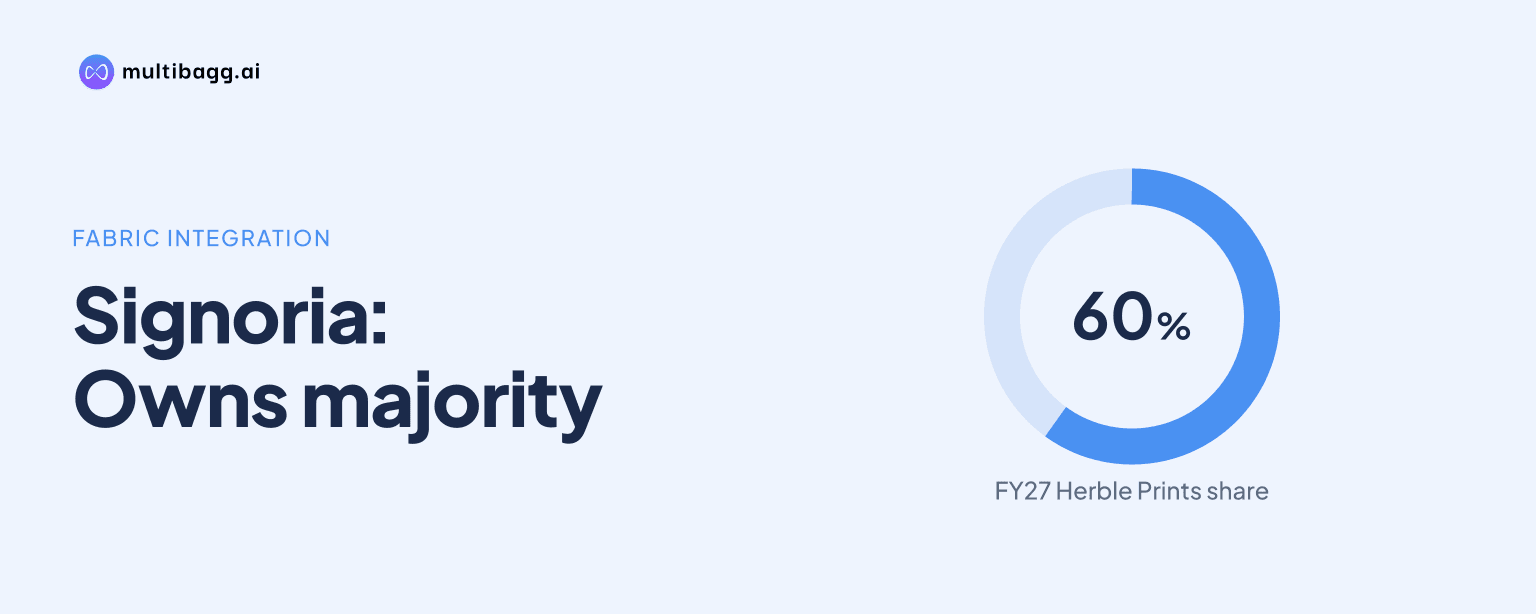
Signoria Creation Limited is using its 60%-owned fabric-printing subsidiary, Herble Prints, to coordinate printing with garment manufacturing; Herble Prints generated Rs 16.60 crore of sales across 19 states and union territories in FY 2026–27 up to 30 September 2026, while management says the arrangement can speed design development and reduce reliance on outside capacity.
Know Signoria Creation inside out
Results, valuation, peers and who's buying, in one view.
What is Herble Prints’ role in Signoria’s operations?
Herble Prints is Signoria’s dedicated fabric-printing subsidiary, in which Signoria holds a 60% stake. Incorporated in 2019 and based in Jaipur, Rajasthan, the company prints rayon, cotton and other fabrics, with a stated specialisation in traditional Sanganeri designs. Its role is to support access to printed fabrics, new-print and design development, quality control and supply-chain coordination for Signoria’s garment operations.
The group structure places Herble Prints alongside Signoria Fashions Private Limited, a garment-trading subsidiary in which Signoria owns 40%. The ownership levels matter because Herble Prints is the only subsidiary described as providing printing and dyeing of cloth, whereas Signoria Fashions is described as trading garments. This assigns the printing unit a distinct position between fabric sourcing and finished-garment manufacturing.
How does Signoria’s vertical integration affect production planning?
Signoria says its association with Herble Prints gives it greater control over an important production stage by bringing fabric printing and garment manufacturing into closer coordination. Management identifies improved quality consistency, faster development of new designs and better execution timelines as intended outcomes. The mechanism disclosed is direct coordination with a dedicated printing unit rather than reliance solely on external printing capacities for relevant requirements.
The arrangement is also intended to let Signoria customise fabric designs for garment collections and respond more efficiently to changing fashion trends. Herble Prints’ Sanganeri-print capability complements the garment portfolio through distinctive printed fabrics, while the 60% subsidiary relationship supports production-planning coordination. These are management’s stated operational objectives, not quantified cost savings or a disclosed timetable for savings.
What is Herble Prints’ sales footprint across India?
Herble Prints recorded approximately Rs 16.60 crore of total domestic sales in FY 2026–27 up to 30 September 2026 and sold across 19 states and union territories. Rajasthan accounted for 63.87% of total revenue, making it materially larger than Gujarat, the next-largest disclosed market at 13.50%. Kerala ranked third at 8.26%, followed by West Bengal at 4.07% and Maharashtra at 2.23%.
The geographic data shows that Herble Prints has a pan-India sales presence but a revenue base concentrated in its home state. Rajasthan’s 63.87% share was about 4.7 times Gujarat’s 13.50% share, based on the percentages disclosed in the presentation. For Signoria, the 19-state-and-union-territory footprint provides an external market for printed fabric in addition to the subsidiary’s role in the group’s manufacturing ecosystem.
Got a follow-up? Ask IRIS
What products and facilities does Herble Prints operate?
Herble Prints supplies printed fabrics to garment manufacturers, wholesalers and textile traders, using rayon, cotton and a range of other fabrics. On 2 January 2026, it opened a display showroom at H1-32, RIICO Industrial Area, Mansarovar, Sanganer, Jaipur 302020. The location holds ready stock of more than 300 designs plus colours for manufacturers across India.
The showroom is a product-display and customer-access point rather than a disclosed production-capacity expansion. Its listed functions include fabric swatch displays, print-roll displays, a printed collection, design showcases and a display studio. Those features fit the subsidiary’s stated task of developing new prints and designs, which Signoria identifies as part of its integration with garment manufacturing.
What financial context frames the Herble Prints integration?
Signoria reported consolidated, or C, revenue from operations of Rs 34.9427 crore for the period ended 30 September 2026, with profit after tax of Rs 3.1429 crore. For the year ended 31 March 2026, it reported consolidated revenue from operations of Rs 49.3039 crore and profit after tax of Rs 4.3807 crore. The presentation labels the first period as a September reporting date and the second as a March year-end, so the two periods are not like-for-like in duration.
Within that financial context, Herble Prints’ Rs 16.60 crore of sales up to 30 September 2026 represents a separately presented subsidiary-sales figure, not a disclosed measure of intra-group revenue or contribution to consolidated profit. The presentation does not state how much of its sales went to Signoria, what portion was sold externally, or the subsidiary’s standalone earnings. It does state that Herble Prints aims to expand capacity, improve process efficiency, introduce innovative design ranges, adopt sustainable printing practices and upgrade technology.
Conclusion
Signoria’s 60% ownership of Herble Prints places a Jaipur-based fabric-printing operation within its wider textile and garment structure. The subsidiary brings Sanganeri-print expertise, rayon and cotton printing, a showroom with more than 300 designs plus colours, and Rs 16.60 crore of sales across 19 states and union territories through 30 September 2026. Management’s stated rationale is closer control of printing, design development, quality coordination and production planning.
The next points to watch are Herble Prints’ stated capacity-expansion, process-efficiency, technology-upgrade and design-range plans. The presentation does not disclose the planned investment, additional capacity, delivery schedule, standalone profitability or the share of subsidiary sales supplied to Signoria, leaving those measures necessary to assess how the intended integration develops.