










Signoria plans 535,000-piece expansion at 95% utilisation
Key highlights
- Signoria reports 95% utilisation, or 828,609 pieces, of its 865,000-piece annual manufacturing capacity.
- Signoria proposes adding 535,000 annual pieces, which would raise capacity to 1,400,000 pieces if implemented.
- Signoria reported H1 FY27 consolidated revenue of Rs 34.9487 crore and PAT of Rs 3.1429 crore.
- Kurti, Pant and Dupatta generated Rs 18.277 crore, or 52.31%, of product-wise revenue until 30 September 2026.
powered by IRIS
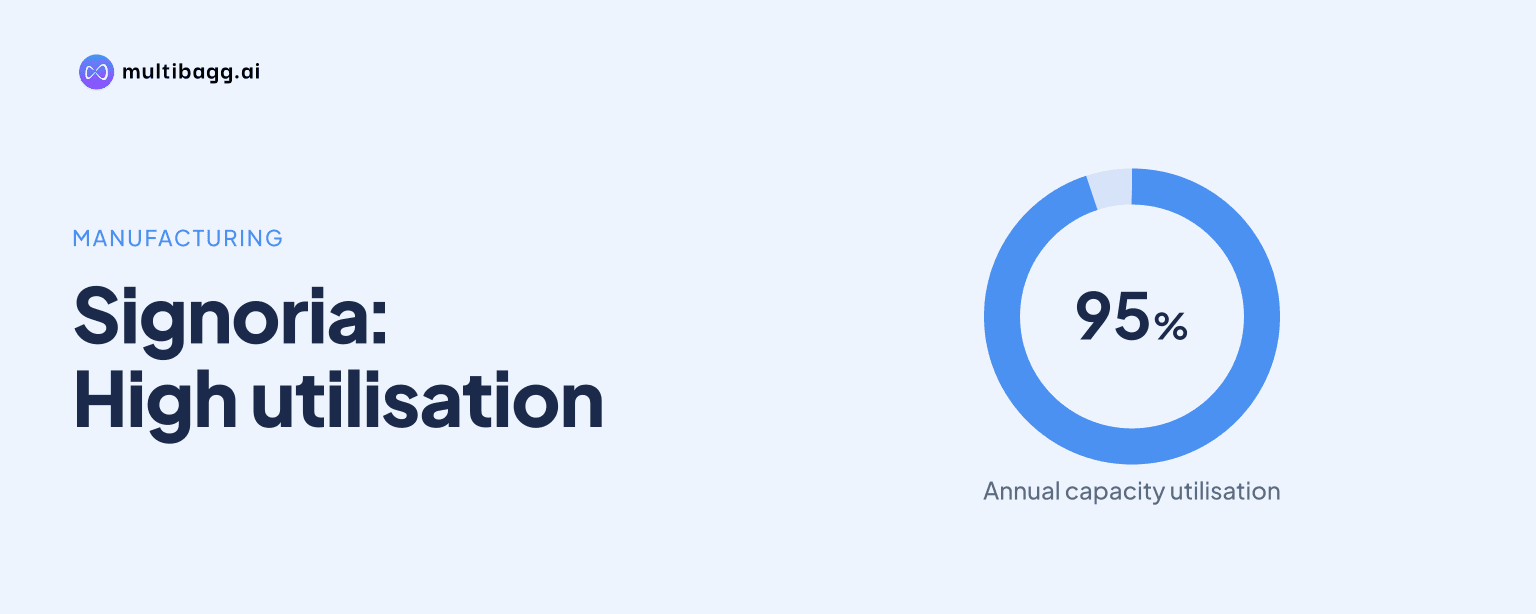
In H1 FY27, Signoria Creation Limited proposed adding 535,000 annual manufacturing pieces after reporting 95% utilisation, or 828,609 pieces, of existing annual capacity of 865,000 pieces. The proposal would take annual capacity to 1,400,000 pieces if implemented, although the presentation does not disclose a project cost, timetable or commissioning date.
Know Signoria Creation inside out
Results, valuation, peers and who's buying, in one view.
What is Signoria’s current manufacturing capacity and utilisation?
Signoria’s existing manufacturing capacity is 865,000 pieces per annum, and it reports utilisation of 95%, equivalent to 828,609 pieces, in its H1 FY27 investor presentation. The disclosed figures imply 36,391 pieces of unutilised annual capacity, while the proposed 535,000-piece addition is larger than that remaining capacity.
The 535,000-piece addition would raise annual capacity to 1,400,000 pieces if delivered. That represents an increase of about 61.85% from the existing 865,000-piece base, based on the company’s disclosed capacity figures, rather than a limited increase to the present manufacturing network.
Signoria describes its model as manufacturing-led, covering women’s ethnic and contemporary apparel including Kurtis, Anarkalis, suits and co-ord sets. Management says its in-house production, quality control, product development and manufacturing-capacity utilisation support control over quality, design execution, production timelines and costs, but it does not quantify the financial effect of these mechanisms.
The company’s historical daily-capacity disclosures differ in basis from its H1 FY27 annual-capacity disclosure. Signoria reports daily production capacity of 500 pieces in 2019, 2,000 pieces in 2022, 6,500 pieces in 2024-25 and 10,000 pieces in 2025-26, after it installed an additional 150 machines; the presentation does not reconcile the 10,000-piece daily figure with annual capacity of 865,000 pieces.
How large is Signoria’s proposed capacity addition?
Signoria has proposed an annual capacity addition of 535,000 pieces under its “Capacity Expansion / Scaling for the Next Phase of Growth” disclosure. The presentation identifies this as a proposal, not as commissioned capacity, and does not provide a target date for putting the additional pieces into operation.
The H1 FY27 presentation does not disclose the proposed project’s capital expenditure, funding source, land or building location, machinery requirement, regulatory approvals, construction progress or expected commissioning date. It also does not provide a revenue forecast, order book or sales-volume target tied to the 535,000-piece proposal.
Signoria reports three manufacturing units, a facility area of 66,000 square feet and a team of more than 2,000 people. Its 2024-25 timeline states that it shifted to owned manufacturing premises, while presentation images identify Unit 1 as the main unit with a ground floor, six upper floors and two basement levels; no unit is specified for the proposed capacity.
The company’s production chain runs from design and procurement through layering, cutting, sewing, finishing, inspection, labelling, packaging and distribution. This process description explains the operational setting for the proposed addition, but it does not state whether the project would expand cutting, sewing, finishing or distribution capacity.
Got a follow-up? Ask IRIS
What sales mix currently supports Signoria’s manufacturing base?
Signoria reported consolidated H1 FY27 revenue of Rs 34.9487 crore, earnings before interest, tax, depreciation and amortisation (EBITDA) of Rs 6.0561 crore, and profit after tax (PAT) of Rs 3.1429 crore. The financial snapshot reports an EBITDA margin of 17.33% and a PAT margin of 8.99% for H1 FY27.
A separate product-wise revenue table for 2026-27 until 30 September 2026 reports total revenue of Rs 34.9427 crore, which is Rs 0.006 crore below the Rs 34.9487 crore H1 FY27 financial-snapshot figure. The presentation does not explain the difference between these two consolidated figures.
Kurti, Pant and Dupatta was the largest listed product category, contributing Rs 18.277 crore, or 52.31%, of the product-wise total to 30 September 2026. Fabrics ranked second at Rs 9.0677 crore, or 25.95%, followed by Dupatta at Rs 3.5203 crore, or 10.07%.
The company disclosed 228,029 pieces of Kurti, Pant and Dupatta sales and 980,885 metres of fabric sales for the period to 30 September 2026. These quantities cannot be directly compared with Signoria’s garment-piece manufacturing capacity because fabrics are measured in metres rather than pieces.
How does the proposal compare with Signoria’s recent growth?
Signoria’s revenue rose from Rs 27.1898 crore in 2024-25 to Rs 40.4527 crore in 2025-26, according to its corporate-evolution timeline. PAT increased from Rs 3.0185 crore to provisional PAT of Rs 3.2663 crore over the same periods, while daily production capacity increased from 6,500 pieces to 10,000 pieces.
The 2025-26 daily-capacity increase followed installation of an additional 150 machines, according to Signoria. The earlier 2022 expansion also involved installation of 150 machines and lifted daily capacity to 2,000 pieces, compared with 1,000 pieces in 2020 and 500 pieces at incorporation in 2019.
Rajasthan was Signoria’s largest reported state market in 2026-27, contributing Rs 13.509 crore, or 38.66%, of the Rs 34.9427 crore product-wise revenue total. Gujarat contributed Rs 4.8977 crore, or 14.02%, and Delhi generated Rs 3.9926 crore, or 11.43%; together, the three states accounted for 64.11% of reported revenue.
Signoria’s primary channel is offline wholesale distribution, with one to two wholesalers per state, orders placed through agents and direct trader communication, and factory visits every two to three months for product confirmation. Management also describes planned expansion into online portals and an owned business-to-business and business-to-consumer website, but does not quantify digital revenue, export revenue, orders or demand required for the proposed capacity.
Conclusion
Signoria’s 95% utilisation disclosure places its proposed 535,000-piece annual addition against an existing 865,000-piece manufacturing base that is reported as near current use. If implemented, the addition would bring annual capacity to 1,400,000 pieces, while the company’s H1 FY27 sales base was led by Kurti, Pant and Dupatta and had 64.11% of reported product-wise revenue in Rajasthan, Gujarat and Delhi.
The next point to watch is whether Signoria discloses the proposed addition’s capital expenditure, funding, project location, execution schedule and commissioning date, none of which appear in the H1 FY27 presentation. Management’s stated plans to expand into online portals and its own business-to-business and business-to-consumer website are also relevant because the presentation provides no sales target or order pipeline for the additional 535,000 pieces.