










Uniparts’ Top 10 Customers Reach 83% of H1 FY27 Sales
Key highlights
- Uniparts’ top 10 customers contributed 83% of H1 FY27 sales, up from 76% in FY25.
- Uniparts’ top five customers accounted for 69% of H1 FY27 sales, compared with 61% in FY25.
- Uniparts’ largest customer represented 28% of sales in both FY25 and H1 FY27.
- Four of Uniparts’ top five customers have been associated with the company for over 10 years.
powered by IRIS
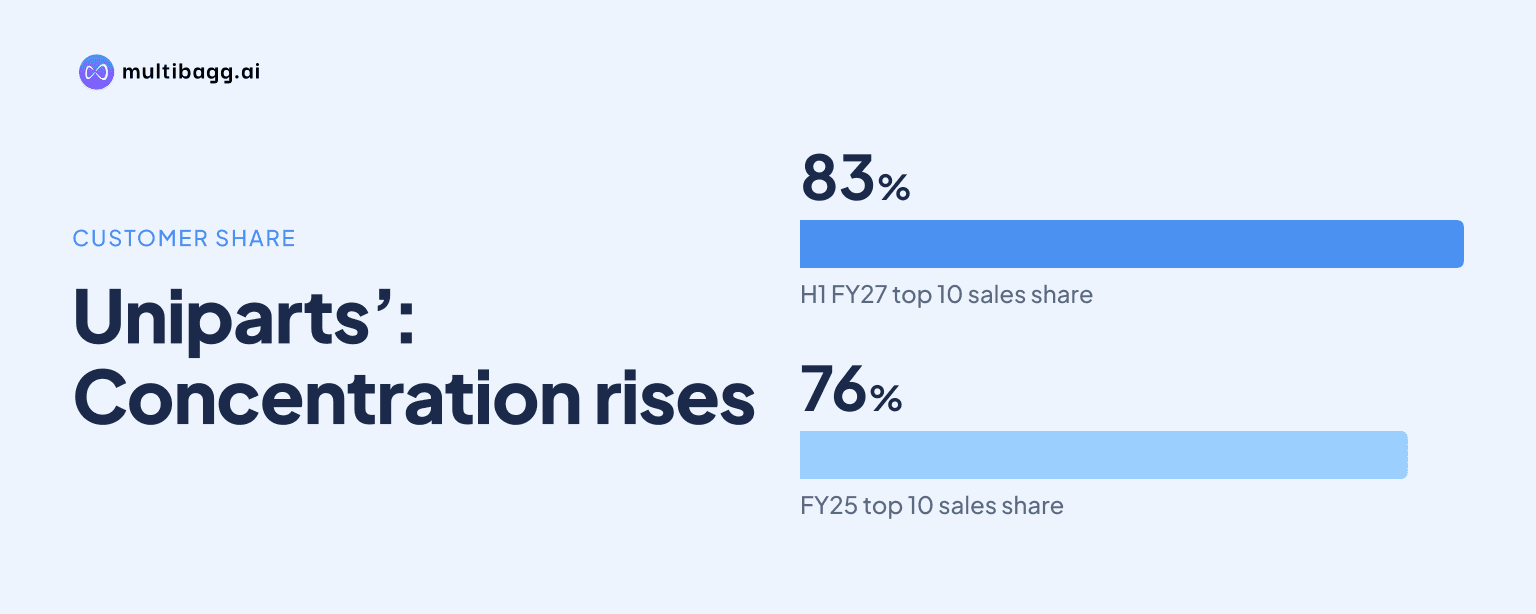
Uniparts Group’s top 10 customers accounted for 83% of H1 FY27 sales, up from 76% in FY25, while its largest customer’s contribution remained 28%. The disclosed change shows that sales became more concentrated among the broader group of major accounts, with the top five customers increasing their contribution to 69% from 61%.
Know Uniparts India inside out
Results, valuation, peers and who's buying, in one view.
How concentrated are Uniparts’ customer sales?
Uniparts’ top 10 customers contributed 83% of sales in H1 FY27, compared with 78% in FY26 and 76% in FY25. The top five customers represented 69% in H1 FY27, rising from 64% in FY26 and 61% in FY25, while the top customer accounted for 28% in H1 FY27.
The top-10 share increased by 7 percentage points between FY25 and H1 FY27, leaving 17% of H1 FY27 sales outside this customer group, versus 24% in FY25. The top-five share rose by 8 percentage points over the same periods, whereas the top customer returned to its FY25 contribution of 28% after accounting for 27% in FY26.
What changed from FY25 to H1 FY27?
Uniparts’ increase in concentration occurred across the wider top-five and top-10 customer groups rather than through a higher contribution from its single largest customer. The top 10 contribution rose in each disclosed period, from 76% in FY25 to 78% in FY26 and 83% in H1 FY27; the top five followed the same direction, increasing from 61% to 64% and then 69%.
The presentation does not identify the customers, disclose their individual purchase values, or explain the reasons for the movement from 76% to 83%. It does state that four of Uniparts’ top five customers have been associated with the company for more than 10 years, providing a disclosed measure of relationship duration among the largest accounts.
Which products and customers support Uniparts’ delivery model?
Uniparts says it serves all 10 leading global original equipment manufacturers, or OEMs, in agriculture and half of the leading 10 construction and forestry machinery, or CFM, players outside China. It describes itself as a preferred supplier of systems for tractors below 70 horsepower and for construction-equipment customers.
Precision machined parts accounted for 55% of H1 FY27 finished-goods sales, while three-point linkage, or 3PL, systems contributed 43%. The presentation describes 3PL as a tractor-specific system used to attach and detach implements, and precision machined parts as components for construction machinery, equipment and structures.
The disclosed 55% and 43% finished-goods contributions total 98%, although the presentation does not specify the composition of the remaining 2% or map product sales to individual major customers. For precision machined parts, Uniparts reports serving more than 125 customers across more than 25 countries, while describing its 3PL position as global market leadership in linkage systems for tractors below 70 horsepower.
Got a follow-up? Ask IRIS
How does Uniparts deliver products to major customers?
Uniparts uses local delivery, direct export and warehouse sales under its dual-shore delivery model. Local delivery involves manufacturing and delivery in the same geography, direct export involves products made in India for export worldwide, and warehouse sales involve stocked products available for customer offtake.
The network comprises seven manufacturing facilities, including six in India and one in the United States, and four warehouses. Two warehouses are in the United States, one is in Europe and one is in Mexico; the Indian manufacturing sites include three in Ludhiana, two in Noida and one in Visakhapatnam.
Warehouse sales are presented as enabling just-in-time delivery, customised packing and lot sizes, and lower inventory cycles for customers. Direct exports are presented as offering competitive pricing but having longer lead times and inventory cycles, while the company also cites a 400-kilonewton test-rig capability and customer-specific delivery.
What do Uniparts’ financial metrics show alongside concentration?
Uniparts reported revenue from operations of Rs 1,170.4 crore in FY26, compared with Rs 963.7 crore in FY25 and Rs 1,139.5 crore in FY24. Earnings before interest, tax, depreciation and amortisation, or EBITDA, rose to Rs 264.8 crore in FY26 from Rs 166.8 crore in FY25, and the EBITDA margin increased to 22% from 17%.
Profit after tax was Rs 158.3 crore in FY26, compared with Rs 88 crore in FY25 and Rs 124.7 crore in FY24. FY26 gross profit margin was 67%, up from 64% in FY25, while earnings before interest and tax margin rose to 18% from 12%.
The 83% customer-concentration figure covers H1 FY27, whereas the revenue and profit figures cover full financial years, so they are not like-for-like periods. For H1 FY27, the presentation reports return on capital employed of 30.2%, based on trailing-12-month figures, net cash of Rs 172.4 crore and debt-to-equity of 0.10 times; it does not link these metrics to customer concentration.
Conclusion
Uniparts’ disclosures show that a larger portion of sales came from major customers in H1 FY27: the top 10 accounted for 83%, up 7 percentage points from FY25, and the top five accounted for 69%, up 8 percentage points. The top customer remained at 28%, indicating that the reported shift was concentrated among other large accounts rather than a higher share from the single largest account.
The next disclosed development to watch is management’s plan to extend offerings into power take-off products, hydraulic cylinders and fabrication, alongside its long-term margin guidance of 20%. The presentation does not disclose a customer-concentration target, customer identities, or a plan to change the 83% top-10 sales contribution.