










Uno Minda plans 9 million annual four-wheeler alloy wheels
Key highlights
- Uno Minda's four-wheeler alloy-wheel capacity reached 6.3 million wheels a year in Q2 FY27.
- Uno Minda plans to raise four-wheeler alloy-wheel capacity by more than 40% to 9 million wheels a year.
- Uno Minda's two-wheeler alloy-wheel capacity rose from 8 million to 9 million wheels a year after four Bawal lines started.
- Uno Minda approved approximately Rs 1,415 crore of expansion projects in August 2026, including Rs 155 crore for Kharkhoda two-wheeler alloy wheels.
powered by IRIS
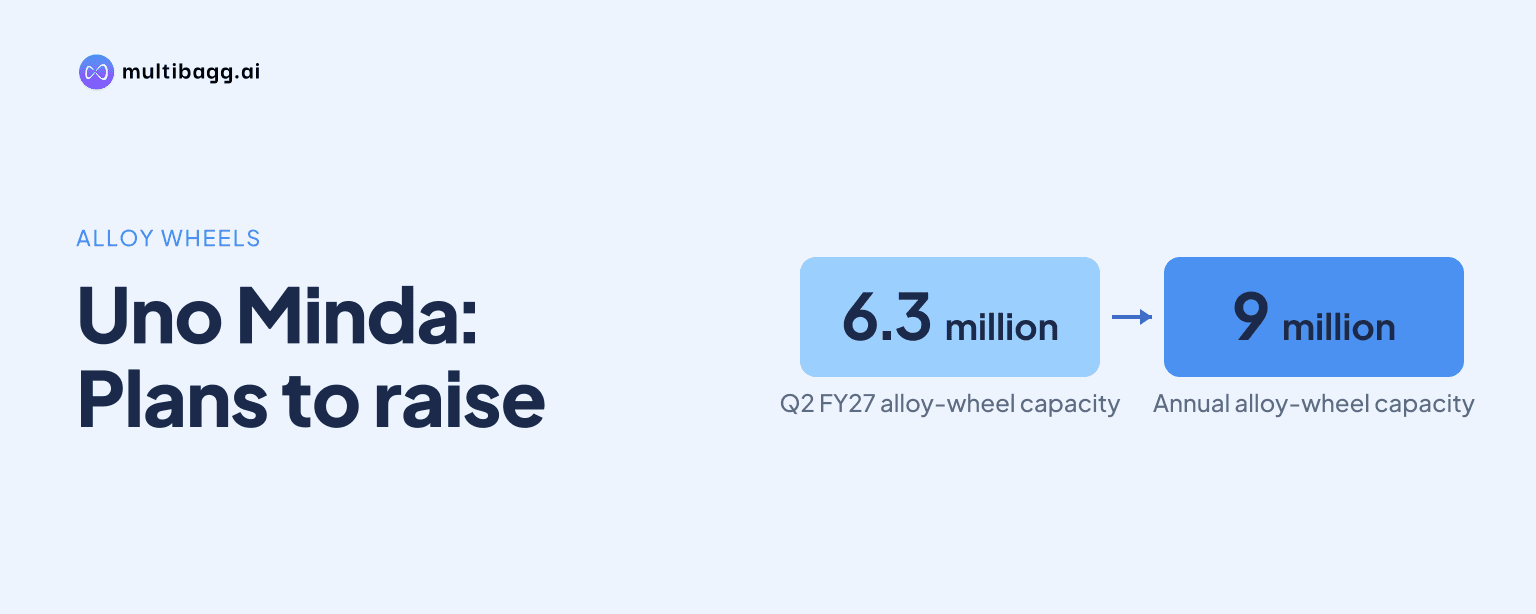
Uno Minda Limited reported four-wheeler alloy-wheel capacity of 6.3 million wheels a year in Q2 FY27 and plans to raise it by more than 40% to 9 million wheels annually through projects at CSN, Kharkhoda and Bawal. Its two-wheeler alloy-wheel capacity has already increased from 8 million to 9 million wheels annually.
Know Uno Minda inside out
Results, valuation, peers and who's buying, in one view.
How is Uno Minda expanding four-wheeler alloy-wheel capacity?
Uno Minda has increased aggregate installed four-wheeler alloy-wheel capacity to 6.3 million wheels a year through newly commissioned lines at Kharkhoda and debottlenecking at Bawal. Management said Bawal capacity rose by approximately 20% through operational-efficiency measures, while phase one of a 60,000-wheel line at Kharkhoda supported the quarterly ramp-up.
The four-wheeler alloy-wheel business generated Rs 763 crore of revenue in Q2 FY27. That business was the larger of Uno Minda's two alloy-wheel operations, with two-wheeler alloy-wheel revenue at Rs 396 crore, and both contributed to the casting vertical's 57% year-on-year revenue growth to Rs 1,441 crore.
Uno Minda plans to raise four-wheeler alloy-wheel capacity by more than 40% to 9 million wheels a year through ongoing expansion at CSN and remaining work at Kharkhoda and Bawal. Management did not specify capacity additions or commissioning dates for each remaining project, so the 9-million-wheel figure is a stated expansion objective rather than installed capacity.
What is changing in Uno Minda's two-wheeler alloy-wheel capacity?
Uno Minda raised two-wheeler alloy-wheel capacity from 8 million to 9 million wheels a year after commissioning four of six planned high-pressure die-casting, or HPDC, production lines at Bawal. The four operating lines added approximately 1 million units of annual capacity, while the Supa facility operated at higher utilisation as demand improved.
The two remaining Bawal HPDC lines are expected to take two-wheeler alloy-wheel capacity to 9.5 million wheels a year. Management said expansions at Kharkhoda and Hosur would then increase capacity to around 11.8 million wheels annually, representing an overall increase of almost 50% from the earlier 8-million-wheel base.
Two-wheeler alloy-wheel revenue was Rs 396 crore in Q2 FY27, compared with Rs 763 crore for four-wheeler alloy wheels. Management attributed the two-wheeler business's growth to improved demand and new manufacturing capacity, while indicating that ramp-up of the remaining Bawal lines should provide further support in coming quarters.
Which projects support Uno Minda's capacity programme?
Uno Minda's board approved four strategic expansion projects in August 2026 involving cumulative investment of approximately Rs 1,415 crore. The package comprises a greenfield aluminium die-casting plant at Hosur costing Rs 510 crore, extension and relocation of two-wheeler alloy-wheel capacity to Kharkhoda for Rs 155 crore, a Bengaluru moulding-facility expansion for Rs 80 crore, and a new CSN facility by the TGSIN joint venture for approximately Rs 670 crore.
The Rs 155 crore Kharkhoda project directly relates to the planned two-wheeler alloy-wheel increase. Management did not disclose its standalone wheel capacity, but identified Kharkhoda and Hosur expansions as the route from the post-Bawal 9.5-million-wheel level to around 11.8 million wheels annually.
The board also approved approximately Rs 85 crore of additional capital expenditure for the Bawal sunroof facility to serve incremental orders announced in recent quarters. Management expects the added sunroof capacity to be commissioned by Q2 FY28, while phase one of the main sunroof facility was expected to be commissioned around the end of FY27.
Got a follow-up? Ask IRIS
How are new facilities affecting Uno Minda's casting results?
Uno Minda said capacity expansion and ramp-up across four-wheeler alloy wheels, two-wheeler alloy wheels and aluminium die casting drove the casting vertical's 57% year-on-year growth to Rs 1,441 crore in Q2 FY27. Management also noted that the reported growth reflected higher underlying raw-material prices, separating price effects from volume and capacity effects.
Aluminium die-casting revenue increased 65% year on year to Rs 282 crore, supported by capacity enhancement at Bawal and Hosur, incremental business wins, and a higher share of business with existing customers. The comparison with alloy-wheel revenue of Rs 1,159 crore combined shows that alloy wheels remained the larger part of the Rs 1,441 crore casting vertical during the quarter.
Uno Minda's consolidated revenue rose 38% year on year to Rs 6,655 crore in Q2 FY27, while earnings before interest, tax, depreciation and amortisation, or EBITDA, increased 33% to Rs 733 crore. Depreciation rose by Rs 5 crore year on year to Rs 178 crore, which management primarily attributed to capitalisation of phase one of the Kharkhoda four-wheeler alloy-wheel facility.
In response to an analyst question, management estimated that aluminium commodity prices accounted for roughly Rs 260 crore to Rs 270 crore of business impact during the quarter. Management said commodity-price changes are generally intended to be passed through to customers, while noting share gains in parts of the two-wheeler alloy-wheel and casting businesses.
What will Uno Minda need to execute next?
Uno Minda has 16 projects that are under ramp-up, recently commissioned or under execution across its business portfolio. Management said the alloy-wheel programme forms part of a wider strategy focused on market-share gains, higher content per vehicle, value-added products and localisation of advanced technologies through FY27 and beyond.
The expansion programme is being pursued while net debt stood at Rs 2,415 crore as of September 2026, compared with Rs 2,179 crore on March 31, 2026. Operating cash flow was Rs 711 crore in H1 FY27, free cash flow after sustaining capital expenditure was Rs 404 crore, and project capital expenditure was Rs 500 crore for the half year.
Conclusion
Uno Minda's Q2 FY27 disclosures show that alloy-wheel expansion is moving from announced investment to operating capacity. Four-wheeler capacity reached 6.3 million wheels a year after Kharkhoda commissioning and Bawal debottlenecking, while two-wheeler capacity reached 9 million following the first four Bawal HPDC lines. The company plans eventual capacity of 9 million four-wheeler wheels and around 11.8 million two-wheeler wheels annually.
The next operating markers are commissioning of the final two Bawal two-wheeler lines, ramp-up at existing sites, and execution of the August 2026 Rs 1,415 crore project package. Management has not provided dates for the 9-million four-wheeler-wheel target or the around 11.8-million two-wheeler-wheel target, leaving project timing and utilisation as the key matters to watch.