










V-Mart network reaches 613 as Tier 2 stores rise 38% in YTD FY'27
Key highlights
- V-Mart’s store network increased by 80 year on year to 613 stores in YTD FY’27.
- Tier 2 store count rose 38% to 87, the fastest growth among reported city tiers.
- Unlimited monthly sales per square foot increased 15% to Rs 681 in YTD FY’27.
- Total retail space grew 14% to 5.2 million square feet while total sales per square foot rose 5% to Rs 709.
powered by IRIS
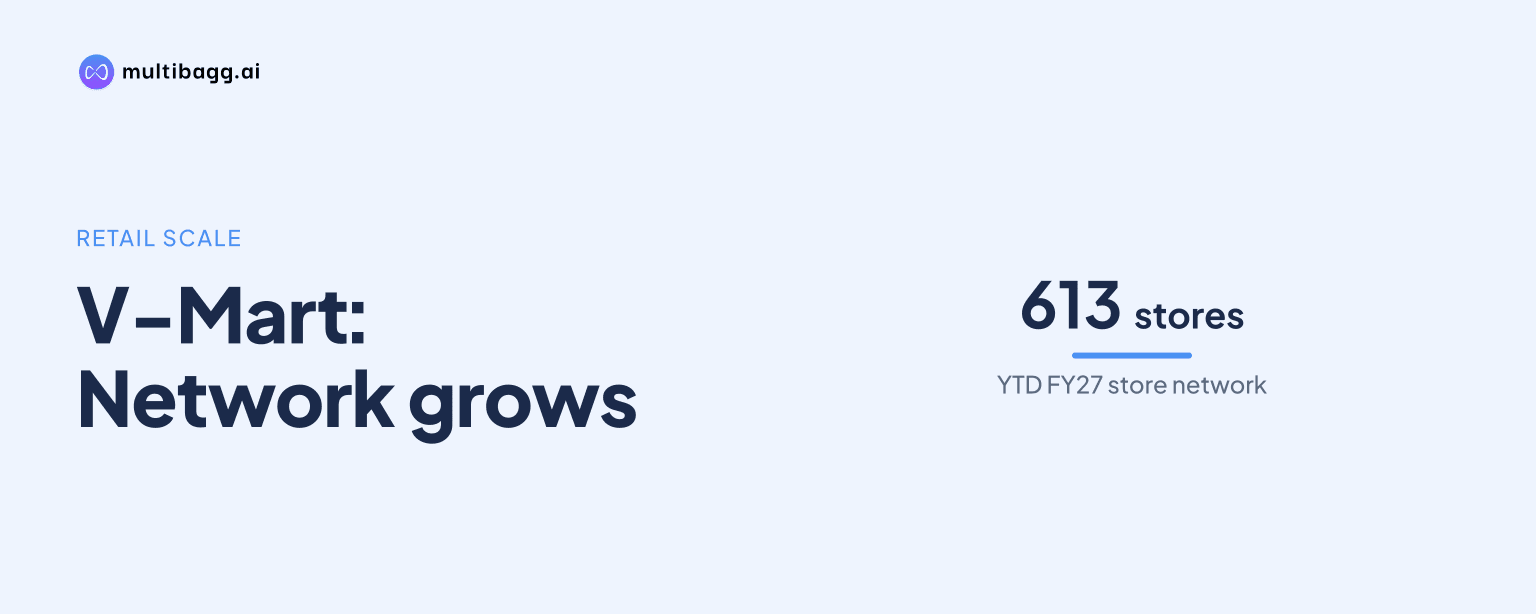
V-MART RETAIL LIMITED’s network reached 613 stores in YTD FY’27, 80 more than in YTD FY’26, as Tier 2 outlets increased 38% to 87 and Unlimited sales per square foot rose 15% to Rs 681 a month. Overall sales per square foot increased 5% to Rs 709 while retail space grew 14% to 5.2 million square feet.
Know V-Mart Retail inside out
Results, valuation, peers and who's buying, in one view.
How quickly did V-Mart’s store network grow?
V-Mart’s store network grew 15% year on year, from 533 locations in YTD FY’26 to 613 in YTD FY’27. The comparison indicates a net increase of 80 stores across the reported network. The YTD FY’27 highlights separately reported 38 store openings and two closures.
Retail space increased at nearly the same rate as store count, rising 14% from 4.6 million square feet to 5.2 million square feet. V-Mart format space grew 16% from 3.7 million square feet to 4.3 million square feet, while Unlimited space was reported at 0.9 million square feet in both periods, despite 7% growth on an unrounded basis.
The presentation states that new stores delivered higher sales per square foot than mature stores during YTD FY’27. It does not disclose separate sales-per-square-foot figures for new and mature locations, so the size of that productivity difference cannot be measured from the reported data.
Which city tier drove V-Mart’s network expansion?
Tier 2 recorded V-Mart’s fastest store-count growth, rising 38% from 63 stores in YTD FY’26 to 87 in YTD FY’27. The 24-store increase was smaller in absolute terms than Tier 3’s 31-store increase, but it was the largest percentage gain among the four reported city tiers.
Tier 3 remained V-Mart’s largest network segment with 317 stores, up 11% from 286 a year earlier. Tier 1 added 20 stores to reach 142, a 16% increase, while Tier 4 added five stores to 67, up 8%. The store base was therefore still concentrated in Tier 3, which accounted for 317 of the 613 total outlets.
Tier 2 also had the fastest reported sales-per-square-foot growth. Monthly Tier 2 sales per square foot increased 10% to Rs 716 from Rs 653, compared with a 5% increase in the total measure to Rs 709. Tier 1 retained the highest tier-level figure at Rs 722 a month after a 1% increase, while Tier 3 rose 4% to Rs 698 and Tier 4 rose 6% to Rs 703.
Got a follow-up? Ask IRIS
Did V-Mart improve sales productivity during expansion?
V-Mart improved total monthly sales per square foot by 5%, to Rs 709 in YTD FY’27 from Rs 678 in YTD FY’26, while total retail space expanded 14%. Sales per square foot measures monthly sales generated from each square foot of retail area, making it a reported productivity measure alongside network and space growth.
Unlimited delivered the largest format-level increase in sales per square foot, rising 15% from Rs 592 to Rs 681 a month. The V-Mart format increased 2%, from Rs 698 to Rs 715. Unlimited’s productivity remained below the V-Mart format’s Rs 715 level, although its year-on-year growth rate was higher.
Comparable-store demand also increased faster at Unlimited. Same-store sales growth, or SSSG, was 12% for Unlimited in YTD FY’27, compared with 5% for the V-Mart format and 6% for the total business. Unlimited same-store volume growth was also 12%, versus 4% for V-Mart and 5% overall.
Customer visits rose more quickly than transaction bills. Footfall increased 37% from 39 million to 53 million, while memo count, which represents transaction bills, increased 17% from 18 million to 21 million. Average transaction size rose 2% to Rs 1,002 overall; Unlimited’s average transaction size declined from Rs 1,643 to Rs 1,636.
What do revenue, margins and inventory show?
V-Mart reported revenue from operations of Rs 2,041.8 crore in YTD FY’27, up 21% from Rs 1,692.1 crore in YTD FY’26. V-Mart format revenue increased 19% to Rs 1,674.2 crore, while Unlimited revenue increased 29% to Rs 356.4 crore. LimeRoad net merchandise value, or NMV, rose 37% to Rs 52 crore.
Total earnings before interest, tax, depreciation and amortisation, or EBITDA, increased 25% to Rs 246.7 crore, with the margin rising to 12.1% from 11.7%. Unlimited EBITDA grew 40% to Rs 54.2 crore and its margin rose from 14.1% to 15.2%, while V-Mart format EBITDA increased 18% to Rs 197.6 crore and its margin moved from 11.9% to 11.8%.
Profit after tax increased 25% to Rs 30.9 crore from Rs 24.7 crore, while the reported profit-after-tax margin remained 1.5% in both YTD FY’26 and YTD FY’27. Revenue mix was unchanged, with apparel at 79%, non-apparel at 10% and fast-moving consumer goods, or FMCG, at 11% in both periods.
Inventory days of sales declined by seven days to 90 from 97. Apparel inventory days fell from 101 to 93, non-apparel declined from 101 to 94, and FMCG reduced from 67 to 60 days. Provision for aged inventory including shrinkage remained 0.9% in each period.
Conclusion
V-Mart’s YTD FY’27 figures show that a network increase of 80 stores occurred alongside higher monthly sales per square foot and a 14% increase in retail space. Tier 2 had the fastest outlet growth at 38% and the largest tier-level productivity improvement at 10%, while Unlimited delivered the fastest format-level sales-per-square-foot growth at 15%, revenue growth at 29% and EBITDA growth at 40%.
The next reporting point to watch is whether the 38 openings and two closures disclosed for YTD FY’27 continue to support network growth and sales-per-square-foot performance. V-Mart has said new stores generated higher sales per square foot than mature stores, but has not quantified that gap, leaving new-store productivity, Tier 2 sales per square foot and Unlimited’s 12% same-store sales growth as unresolved operating measures.