










Vaibhav Global aims to cut digital payback within 3 months
Key highlights
- Vaibhav Global currently targets customer-acquisition payback within 6 months and aims for 3 months over the long term.
- The Shopify migration reduced quarterly revenue by an amount equal to approximately 2.8% of growth.
- Lab-grown diamonds accounted for about 12% of Vaibhav Global's Q2 revenue.
- Management said gross margin rose from 62% to around 64% to 65%.
powered by IRIS
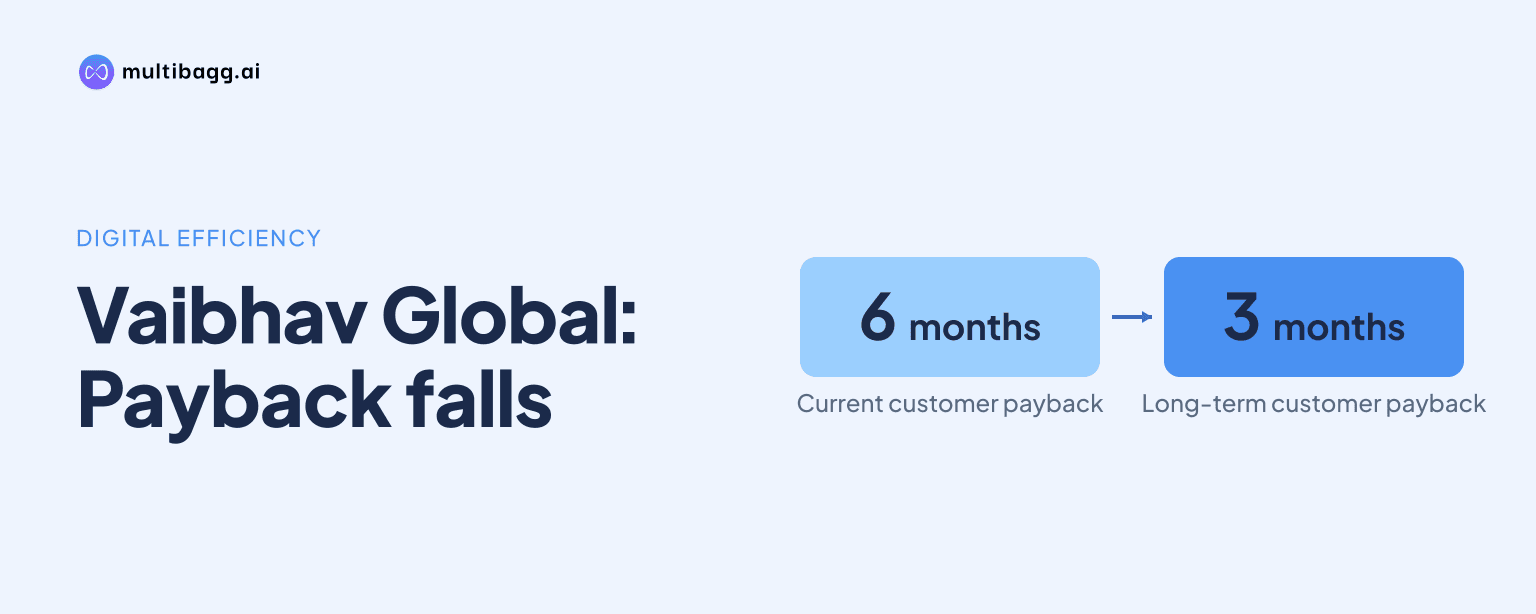
Vaibhav Global currently seeks to make a digitally acquired customer profitable within six months and aims to reduce that period to one quarter, or three months, as it shifts from television retail to personalised online marketing. Management said the Shopify migration is largely complete, leaving customer-acquisition efficiency as the central execution priority.
Know Vaibhav Global inside out
Results, valuation, peers and who's buying, in one view.
Why is Vaibhav Global moving from television to digital?
Vaibhav Global is moving to digital because management sees customer attention shifting from television towards social media, search and online video platforms. Management said attrition in television households was a main reason for its Shopify investment. It intends to reach shoppers through Facebook, Instagram, Meta, TikTok, Google, Bing, gaming applications, AppLovin and over-the-top, or OTT, media rather than depend on a single broad television broadcast.
The change is intended to alter how Vaibhav Global addresses customers, not just where it advertises. Management said television permits one message to a wide audience, while digital tools can tailor messages to individual shoppers using artificial intelligence-led creative. Its primary demographic remains women aged above 40, largely Caucasian, in the United States, United Kingdom and Germany. Management said this cohort is growing, with more discretionary income and time, while its digital strategy is designed to meet that group on newer media platforms.
Vaibhav Global described the move as its latest business-model transition after shifts from gemstones to jewellery, brick-and-mortar retail to television retail, and a narrower jewellery range to multiple product categories. Management does not describe an immediate exit from television. Instead, it aims to retain the ability to present products through television while building a digital-first customer funnel that can test messages, products and audiences more precisely.
What is Vaibhav Global's digital customer-payback target?
Vaibhav Global currently wants the cost of acquiring a customer to be recovered within six months, while management's longer-term target is one quarter, or three months. Management said it does not want acquisition spending to create a profitability burden in the current quarter or the following two quarters. It evaluates such spending alongside gross margin, return on invested capital and earnings before interest, tax, depreciation and amortisation.
Management said the three-month threshold has not yet been reached and did not give a date for achieving it. It said some customers may already meet the target, but a large part of digital acquisition involves new customers from online platforms. The distinction matters: six months is the current payback discipline described by management, whereas three months is an operating objective that it expects new tools on the Shopify platform to help it approach.
The payback target links product selection to marketing economics. Management said it measures gross contribution per minute of television airtime and per square inch of digital screen space. It also uses return on advertising spend to decide which product categories receive exposure. Under this process, a product that produces better contribution can receive more digital placement, while acquisition costs must still be recovered through the customer's subsequent purchases.
How will Shopify change Vaibhav Global's digital execution?
Shopify is intended to let Vaibhav Global test products more quickly, scale successful items and use personalised creative across its six brands. Management said the migration was largely complete and that the customer-experience issues associated with moving to the new platform were behind it. The remaining task is to assess more applications in Shopify's ecosystem that can improve customer engagement and customer reach.
The migration had a near-term cost. Management quantified revenue lost during the quarter because of the Shopify migration at approximately 2.8% of growth. It identified the platform transition as the main factor behind reduced growth expectations, with the United Kingdom warehouse consolidation and economic conditions in that market also contributing. The comparison is between a completed disruption in the quarter and the faster testing and targeting management expects to obtain in subsequent quarters.
Management said the upgraded platform allows new products to be tested rapidly and successful products to be expanded through artificial intelligence-led creative. It expects this process to support digital growth across all six brands and expressed confidence in achieving 9% to 11% growth in the next financial year. That expectation is management's view, and it remains subject to consumer conditions, political developments, metal prices, inflation and currency movements that management said are outside its control.
Got a follow-up? Ask IRIS
Can Vaibhav Global retain its television advantage online?
Vaibhav Global says its vertical sourcing and storytelling model can be retained across websites, social livestreams, OTT channels and product-detail pages. Management described its television advantage as showing customers the journey from sourcing gemstones through design and manufacturing to direct sale. It said the same product story can be conveyed through cable television, digital video, a social platform or a website.
The operating model includes sourcing gemstones and fabrics, using partners to convert fabrics into dresses, and manufacturing jewellery in its own factory. Management said this vertical structure remains relevant regardless of the marketing platform. In its view, digital distribution changes the precision of customer targeting, while the product-development and sourcing capabilities that supported television retail stay in place.
Customer migration from television will not be uniform. Management said some established television shoppers have received free Roku devices or Fire TV Sticks to enable web viewing, but many do not shift. At the same time, Vaibhav Global said it can access new customers in the same broad demographic through search, social media, gaming apps, AppLovin and OTT. The execution test is therefore both retaining selected television shoppers and acquiring new digital customers within the six-month payback threshold.
Which products and margins support Vaibhav Global's digital plan?
Vaibhav Global plans to use product testing and return on advertising spend to determine which items receive digital screen space. Management identified colour gemstones, natural diamonds, plain-metal jewellery and lifestyle products as categories it monitors. This mechanism differs from relying mainly on a fixed television schedule because it can adjust product exposure as customer response and contribution change.
Lab-grown diamonds accounted for about 12% of Q2 revenue, according to management, and had displaced natural diamonds to a large extent. Management said it has seen some signs of natural-diamond demand returning after buying closeout natural diamonds and converting them into jewellery. It gave no forecast for the eventual lab-grown diamond mix, saying category allocation will follow product demand and advertising-return data.
Management also said gross margin increased from 62% to around 64% to 65% despite substantial increases in platinum, gold and silver prices over the previous couple of years. It aims to maintain a 64% to 65% range while responding to market conditions and metal-price movements. That margin range is relevant to the digital plan because it affects how much contribution is available to recover customer-acquisition spending.
Conclusion
Vaibhav Global's digital-first transition is defined by a measurable customer-economics goal: reducing acquisition-cost payback from its current six-month threshold to three months. Management believes Shopify, faster product testing, personalised messaging and return-on-advertising-spend measurement can improve targeting while preserving the vertical sourcing and product-storytelling capabilities built in television retail.
The next milestones are management's planned use of additional Shopify applications, progress in repeat buying and evidence that acquisition costs are falling across the six brands. Management has not set a date for three-month payback, while the United Kingdom warehouse consolidation was still continuing. Its future updates should show whether those actions support the stated 9% to 11% next-financial-year growth expectation and the 64% to 65% gross-margin aim.