










Vaibhav Global FY30 target excludes India, allows acquisition
Key highlights
- Vaibhav Global’s FY30 target is Rs 5,000-5,500 crore.
- India is not included in Vaibhav Global’s FY30 target calculation.
- Management expects six existing brands in the US, UK and Germany to provide most FY30 growth.
- Vaibhav Global aims to reduce customer-acquisition payback from 6 months to 3 months.
powered by IRIS
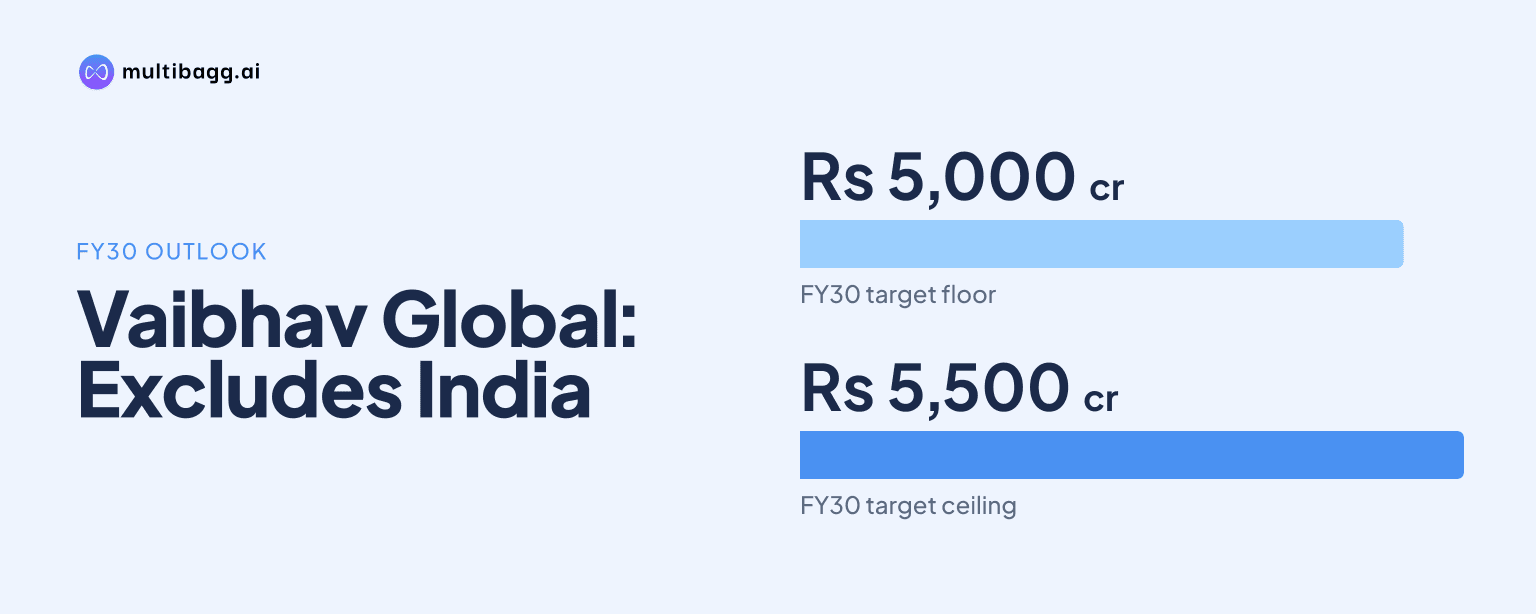
Vaibhav Global Limited said its Rs 5,000-5,500 crore FY30 revenue target excludes an India launch, with most growth expected from its six current brands in the US, UK and Germany and only limited potential contribution from a digital acquisition in the plan.
Know Vaibhav Global inside out
Results, valuation, peers and who's buying, in one view.
What supports Vaibhav Global’s FY30 revenue target?
Vaibhav Global said the Rs 5,000-5,500 crore FY30 target is largely an organic-growth plan based on its six existing brands in the US, UK and Germany. Management said a possible e-commerce acquisition had been included only “to a small extent,” rather than as the principal driver of the FY30 ambition.
Vaibhav Global did not assign a revenue figure or geography to a potential acquisition. Management said it would first seek to make all six brands robustly growing in e-commerce before pursuing such an opportunity. The target therefore depends chiefly on executing the digital transition in the current brand base, rather than on entering a new national market or completing an identified transaction.
Management’s near-term growth expectation is lower than the longer-range FY30 ambition. It said it expects 9% to 11% growth in the next financial year, while current guidance had been adjusted to 7% to 9% from 9% to 11%. The comparison indicates that the FY30 plan assumes recovery after recent operational disruptions rather than extending the current guidance unchanged through FY30.
Is an India launch included in Vaibhav Global’s FY30 plan?
No. Vaibhav Global explicitly said it has not included an India launch in the Rs 5,000-5,500 crore FY30 target. Management described India as being on the cards and said it may launch there in coming years, but gave no date, investment amount, revenue estimate or operating format.
Vaibhav Global set a condition before moving into another country: Germany must first reach robust profitability. Management also said a new-market entry creates initial losses, so it wants the existing six brands to maintain robust growth before using them to support a launch. That sequencing separates India from the current FY30 target calculation.
Germany is both an existing growth market and a gating item for expansion. Vaibhav Global said Germany’s customer base is larger than the UK’s, while its finance executive disclosed significant German losses expected to be set off over a period extending beyond FY28. The executive said the sustainable tax rate should be 18% to 20% over the next two to three years, supported by German loss offsets and foreign tax credit benefits.
Got a follow-up? Ask IRIS
How will digital growth drive Vaibhav Global’s existing brands?
Vaibhav Global said the six brands should benefit from the new digital platform through faster product testing, personalised artificial-intelligence, or AI, creative and more targeted customer acquisition. Management said digital growth should be substantial in coming quarters across all six brands and cited this as the basis for its 9% to 11% growth expectation for the next financial year.
Vaibhav Global’s immediate economics target is to recover customer-acquisition cost within one quarter, or three months. Management said acquisition profitability is currently covered within six months, so meeting the target would halve the payback period. It gave no deadline, saying only that it aims to get there in the near future as it uses more tools available through the platform.
Management contrasted digital distribution with the older television model. Television delivered one broad broadcast, while digital channels can tailor messages to individual customers through AI tools, according to Vaibhav Global. It said its vertical model, from gemstone or fabric sourcing through jewellery manufacturing or partner conversion to direct sales, remains applicable across cable, over-the-top platforms, social-media livestreams and product-detail pages.
Product selection is governed by measured returns rather than a fixed category allocation. Vaibhav Global said it evaluates gross contribution per minute of television airtime or per square inch of digital screen space, as well as return on advertising spend. Lab-grown diamonds accounted for around 12% of Q2 revenue and had displaced natural diamonds to a large extent, although management gave no forecast for the category’s eventual share.
What could delay Vaibhav Global’s growth plan?
Vaibhav Global said the Shopify migration was the major factor behind its revised 7% to 9% guidance, with UK warehouse consolidation and the UK economic environment also contributing. Management said the earlier 9% to 11% outlook reflected visibility at that time, but reduced the range despite current growth of 9% because foreign-exchange benefits seen in the prior two quarters may not recur at the same level.
The UK faced two company-specific disruptions: the Shopify migration and the consolidation of four warehouses into one during the last quarter. Management said the transition was still continuing after inventory had moved to the larger site, which also houses two studios. It additionally cited UK cost-of-living pressure and lower economic growth than the US as external headwinds.
Management also included potential US midterm-election contention as a non-major guidance factor because it could draw viewer attention away from programming. It identified supply-chain and customer-reach platforms, customer experience, product availability and trend monitoring as matters within its control. Economic and political conditions, metal prices and inflation were identified as external factors.
The FY30 target consequently depends on more than digital adoption. Vaibhav Global must complete the platform transition, improve acquisition payback from six months toward three months, restore UK operating continuity after the four-to-one warehouse move and bring Germany to robust profitability. The timing, size and location of any digital acquisition remain unresolved.
Conclusion
Vaibhav Global’s Rs 5,000-5,500 crore FY30 objective is principally a plan to scale the six brands it already operates in the US, UK and Germany. India is not embedded in the target, and any inorganic contribution is limited to a possible e-commerce acquisition rather than a specified deal, leaving the stated ambition mainly dependent on organic digital expansion.
The next items to watch are Vaibhav Global’s 7% to 9% current guidance, its 9% to 11% expectation for the next financial year, and progress toward recovering customer-acquisition costs within three months rather than six. Management has also made robust German profitability a prerequisite for a new-country entry, while it has not disclosed the timing, geography or value of a possible digital acquisition.