










Vaibhav Global Limited's UK Revenue Fell 7% in Q2 FY27
Key highlights
- VGL’s UK revenue declined 7% in constant currency in Q2 FY27, although reported revenue rose 2.3% to Rs 257.2 crore.
- VGL spent Rs 36 crore consolidating four UK warehouses and two studios into one site.
- VGL said the Shopify migration reduced quarterly revenue growth by about 2.8 percentage points.
- Europe excluding the UK grew 8% in constant currency, while B2B revenue rose 32.4% to Rs 70.9 crore.
powered by IRIS
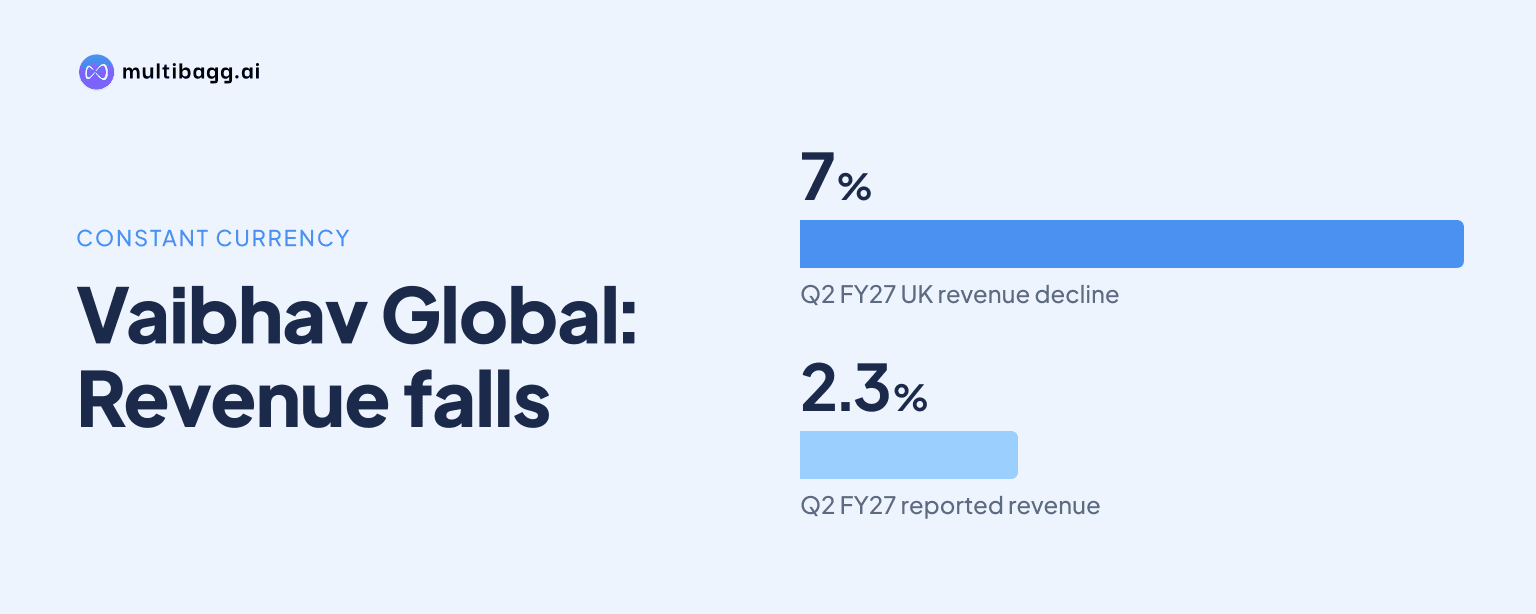
Vaibhav Global Limited’s UK revenue fell 7% in constant currency in Q2 FY27 as a Shopify migration, a Rs 36 crore warehouse consolidation that temporarily took inventory offline, and weaker consumer sentiment converged. Reported UK revenue rose 2.3% to Rs 257.2 crore because of currency translation.
Know Vaibhav Global inside out
Results, valuation, peers and who's buying, in one view.
Why did VGL’s UK business underperform in Q2 FY27?
VGL’s UK business underperformed because operational disruption coincided with weaker discretionary spending. Management identified three factors: migration to Shopify Enterprise, temporary product unavailability while four warehouses and two studios moved to one site, and softer consumer sentiment. Together, these factors resulted in a 7% constant-currency revenue decline, despite reported revenue increasing 2.3% to Rs 257.2 crore.
The UK result contrasted with VGL’s other reported markets. Europe excluding the UK delivered 8% constant-currency growth and 18.3% reported growth to Rs 110 crore, while US revenue declined 4.1% in constant currency but rose 4.3% in rupee terms to Rs 500 crore. Management said the rupee weakened about 9% against the US dollar during the quarter.
The consumer backdrop added a demand-side constraint to the execution issues. UK inflation reached 3.5% in September, driven by higher fuel costs, while non-food retail sales were almost flat. Management said consumer confidence then recorded its sharpest monthly fall since 2020 in October, as households held back before the autumn budget.
How did VGL’s warehouse consolidation affect UK sales?
VGL’s warehouse consolidation affected UK sales by making some products temporarily unavailable during the move to a single location. The company consolidated four UK warehouse sites and two studios into one headquarters during Q2 FY27. Management described the sales effect as modest but specifically included unavailable inventory among the reasons for the UK’s 7% constant-currency decline.
The project required Rs 36 crore of capital expenditure and was the main component of Rs 63 crore of capex discussed on the call. Group net cash stood at Rs 186 crore on September 30, 2026, compared with Rs 279 crore in March 2026. Management attributed the reduction mainly to seasonal inventory build-up and UK warehouse-migration capital expenditure.
The operational rationale is future efficiency rather than immediate sales growth. Chief Financial Officer Nitin Panwad said the single site should improve operational efficiency and order clubbing over coming years. That planned benefit did not remove the Q2 constraint, when inventory was offline and the available product range was reduced.
Inventory also increased ahead of the festive season. Management said inventory was roughly Rs 100 crore higher than at the same point a year earlier, reflecting festive readiness and an uncertain global environment. It expects inventory days to moderate in Q3 and Q4 towards its previous range of about 200 to 220 days.
Got a follow-up? Ask IRIS
What did VGL’s Shopify migration do to digital sales?
VGL’s Shopify migration reduced near-term traffic and conversion while the new retail websites stabilised. The company completed the migration of all retail websites to Shopify Enterprise in Q2 FY27, creating one platform across its six retail brands. Management said stabilisation took longer than planned and affected all four business units making the transition.
Management estimated that the migration reduced quarterly revenue growth by about 2.8 percentage points. Digital revenue was Rs 367 crore, up 5.6% year on year in rupee terms but marginally lower in constant currency, while digital represented 44% of revenue. Digital’s share of business-to-consumer, or B2C, revenue also declined by around 3 percentage points from Q1 FY27.
The platform is intended to replace separate legacy systems with a common technology base. Management said a feature developed once can be deployed across markets, while first-party data from television and digital channels can support personalisation, repeat purchases and customer lifetime value. It also cited integration with marketing technology and artificial-intelligence tools for advertising creative, product descriptions and search-engine optimisation content.
These are management’s planned benefits rather than Q2 financial results. The stated near-term goal is to restore digital growth after migration completion and raise digital’s share to 50% of B2C revenue by Q4 FY27. Management also expects lower long-term technology costs than under the prior platform and faster launches of brands, categories and geographies.
Can VGL’s margins offset the UK turnover pressure?
VGL’s gross-margin improvement partly offset turnover pressure, but it did not prevent a decline in quarterly operating profitability. Group gross margin rose 197 basis points to 65.5% in Q2 FY27 from 63.5% in Q2 FY26, supported by vertical integration, in-house brands and lab-grown diamonds. Lab-grown diamonds represented 12% of total retail revenue, compared with about 10% a year earlier.
Earnings before interest, tax, depreciation and amortisation, or EBITDA, fell 13.5% to Rs 76.2 crore, and the margin declined to 8.1% from 10.0% a year earlier. Management attributed the reduction principally to retail sales deleverage during the UK and platform transitions. It said Shopify and UK warehouse migration accounted for 100 basis points of pressure, while lower foreign-exchange gains accounted for a further 30 basis points.
Other business lines provided relative support. B2B revenue increased 32.4% to Rs 70.9 crore, while Europe excluding the UK recorded 11.5% unit growth. In the US, units rose 4.8%, but average selling price declined 8.4% as customers shifted towards lower-priced products.
For the first half, group revenue increased 9.7% to Rs 1,855.4 crore and EBITDA rose 9.6% to Rs 178.3 crore, producing a 9.6% margin. Profit after tax increased 15.2% to Rs 98.1 crore. Management reduced its FY27 revenue-growth outlook as the transition effects and consumer conditions may continue to affect performance.
Conclusion
VGL’s UK result reflected three simultaneous pressures rather than demand alone: Shopify disruption reduced traffic and conversion, the Rs 36 crore consolidation temporarily constrained inventory availability, and a 3.5% September inflation rate coincided with lower consumer confidence. The 7% constant-currency UK decline stood apart from 8% constant-currency growth in Europe excluding the UK and 32.4% B2B revenue growth.
The next measures to watch are management’s stated priorities of improving UK operating efficiency, customer acquisition and repeat purchases in the second half of FY27. Management now expects FY27 revenue growth of 7% to 9%, down from 9% to 11%, and EBITDA margin broadly in line with FY26; it continues to target a 50% digital share of B2C revenue by Q4 FY27 and a return to 9% to 11% revenue growth in FY28.