










Valencia Beverages & Superwater Private Limited Runs at 75% Capacity
Key highlights
- VBSW operated Unit 1 at about 75% of its 24 lakh-bottle monthly effective capacity throughout H1 FY2026-27.
- VBSW’s 198,000-case order book includes 107,000 own-brand cases and 91,000 co-packing cases.
- Raw-material and packaging costs were about 40–45% above pre-conflict levels in H1 FY2026-27.
- Medchal-Malkajgiri groundwater fell 4.99 metres year on year to 12.80 metres below ground level in October 2026.
powered by IRIS
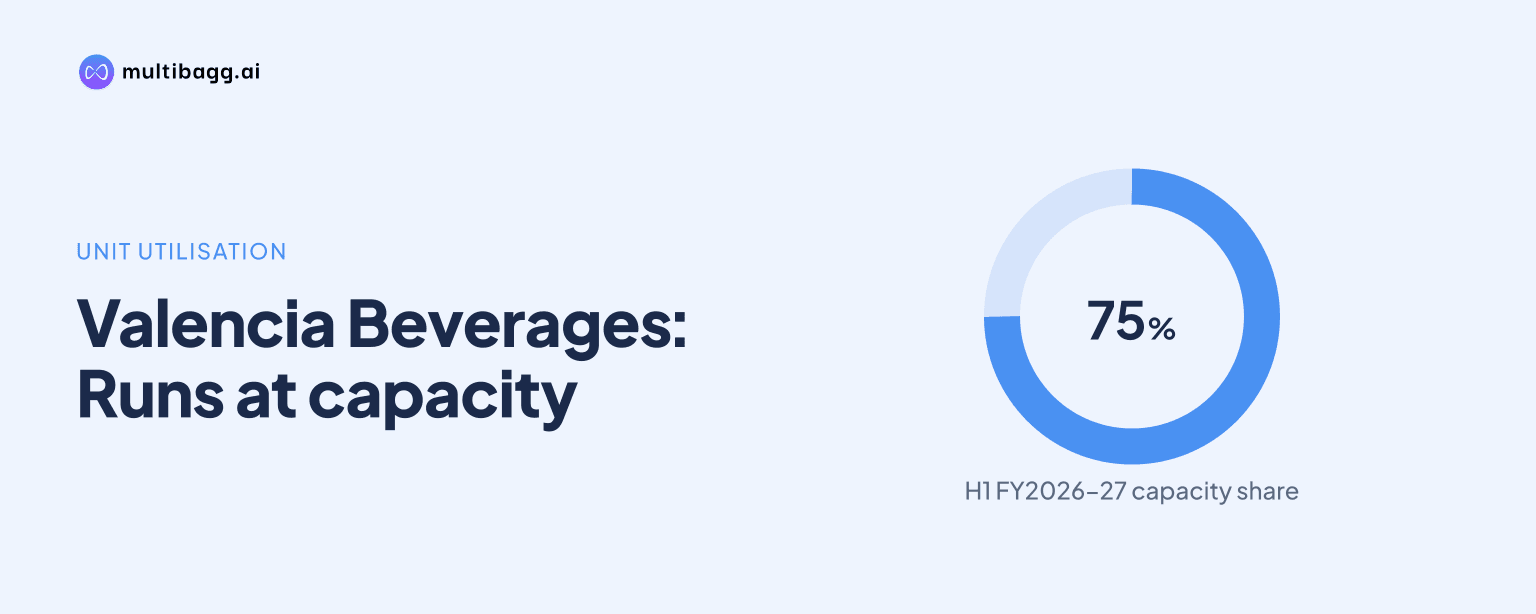
Valencia Beverages & Superwater Private Limited operated both Hyderabad production units at about 75% of effective capacity in H1 FY2026-27, despite input and packaging costs standing 40–45% above pre-conflict levels and water constraints around Cherlapally. The business reported a 198,000-case order book, including 107,000 own-brand cases.
Know Valencia Nutrition inside out
Results, valuation, peers and who's buying, in one view.
How full are VBSW’s Hyderabad plants?
VBSW ran Unit 1, its carbonated soft drinks (CSD) facility, at about 75% of its effective capacity of 24 lakh bottles per month throughout H1 FY2026-27 and said it remained at that level on 12 November 2026. The company identified Unit 1 as its stable operating base during the period of higher raw-material and packaging costs.
VBSW commercially commissioned Unit 2, its juice line, in July 2026 after earlier trial runs to validate formulations and process parameters. The line operated at about 75% of effective capacity during the last three months of the update, rather than throughout the half-year. Management said own-brand products receive priority on Unit 2, while co-packing uses remaining capacity and helps cover fixed costs.
The two plants are located in Cherlapally, Hyderabad, but represent different production stages and categories. Unit 1’s 75% measure covers the full first half, whereas Unit 2’s figure follows its July 2026 commissioning and ramp-up. VBSW therefore reported comparable utilisation levels but over different operating periods.
What is in VBSW’s 198,000-case order book?
VBSW reported a Bounce Super Drinks order book of 198,000 cases, equivalent to about 4,400 cases per day, with own brands accounting for about 54% of volume. Its own-brand products include Bounce, Bounce Juice and Vitalize, while co-packing represents production undertaken for other customers.
Unit 1 holds 124,000 cases, compared with 74,000 at Unit 2, making the CSD facility responsible for roughly 63% of the disclosed order book. Unit 1’s 70,000 own-brand cases exceed its 54,000 co-packing cases, while Unit 2 has an equal 37,000-case split between the two categories.
Management said it intends to reduce co-packing at Unit 2 as own-brand demand grows. The stated model is to use third-party orders to keep spare capacity productive and support fixed-cost coverage, while increasing proprietary beverage volumes over time.
Got a follow-up? Ask IRIS
How did higher input costs affect VBSW’s operations?
VBSW said raw-material and packaging costs were about 40–45% above pre-conflict levels during H1 FY2026-27. It attributed the increase mainly to crude-oil-linked polyethylene terephthalate (PET) and packaging inputs, as well as higher ethanol prices, and said packaging costs increased further from May.
Management said the cost movement reduced margins to some extent, but the update did not disclose revenue, profit or margin figures for VBSW. It said customer supply was prioritised through the period and claimed market share increased as some competitors could not absorb higher costs or maintain uninterrupted supply; no market-share figure was provided.
VBSW expanded into Maharashtra, which management described as an entry into Central India, and placed products at turf facilities in Pune and Mumbai. It also commissioned a 38 millimetre, wide-neck hot-fill PET line rated at 150 bottles per minute and introduced 78 stock keeping units across its PET juice and hydration portfolio. The company said its product table covers 24 drinks and flavours in 200 millilitre, 250 millilitre, 300 millilitre and 500 millilitre packs.
How serious is the water risk at VBSW’s Cherlapally plants?
Water availability is VBSW’s most significant operating challenge in FY2026-27, although the company said both plants continued at about 75% capacity. Telangana recorded 615.5 millimetres of rainfall against a normal 740.6 millimetres during the June-to-September 2026 southwest monsoon, a 17% deficit.
Hyderabad recorded 458.2 millimetres of rainfall against a normal 627.2 millimetres for the water year through September 2026, a 27% deficit. In Medchal-Malkajgiri district, where Cherlapally is located, groundwater stood at 12.80 metres below ground level in October 2026, down 4.99 metres year on year.
Across Hyderabad, groundwater fell from 11.58 metres below ground level in September 2026 to 12.59 metres in October 2026. VBSW said authorities shut a number of borewells in the Cherlapally area as groundwater declined, reducing water available to industrial users, including its facilities.
VBSW’s response is to expand in-house water storage so both units can build reserves when supply is available and draw on them during shortages. Management expects conditions to remain tight through the dry months until the 2027 monsoon and said it will monitor groundwater levels and government directives. The update does not state the storage capacity, project cost, completion date or an alternative water source.
Conclusion
VBSW maintained reported utilisation of about 75% at both Hyderabad plants while managing two operating pressures: raw-material and packaging costs 40–45% above pre-conflict levels, and reduced local water availability. Its 198,000-case order book is weighted modestly toward own brands at 107,000 cases, while Unit 1 carries 124,000 cases against Unit 2’s 74,000.
The next issue to watch is delivery of the planned water-storage expansion before the 2027 monsoon, as management expects dry-season conditions to remain tight. VBSW’s stated H2 FY2026-27 priorities are to expand own-brand volumes at Unit 2, manage margins as input prices change and secure water supply for uninterrupted operations.