










Gufic uses formulary depth to expand hospital injectables
Key highlights
- AWABAC moved from introduction to established use within two quarters of launch, according to Gufic's Q2 FY27 update.
- In-house manufactured brands formed the majority of Sparsh business in Q2 FY27.
- Gufic disclosed seven complex anti-infective drug classes for its hospital platform pipeline.
- Indore had received 203 State Food and Drug Administration product approvals and completed 40 technology transfers by Q2 FY27.
powered by IRIS
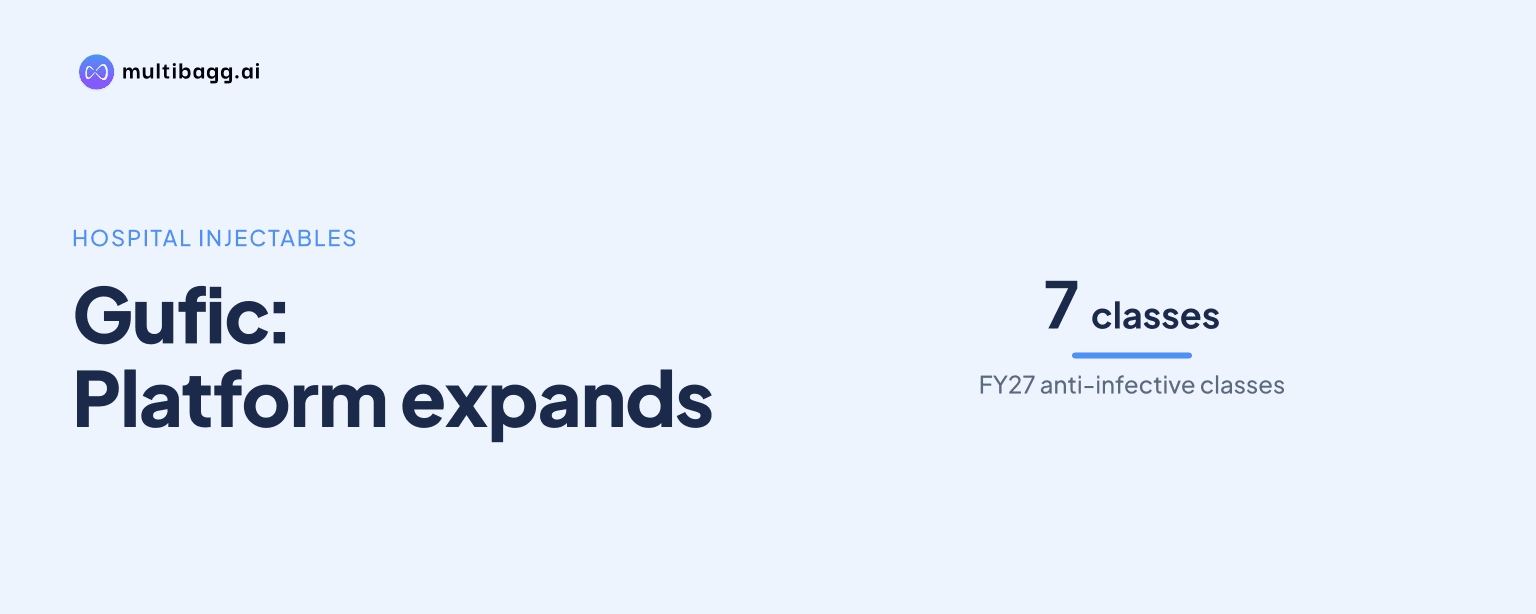
In Q2 FY27, Gufic Biosciences Limited said it was expanding hospital injectables through formulary depth, own-manufactured brands and differentiated delivery formats, while disclosing seven complex anti-infective drug classes for its platform pipeline. AWABAC had reached established use within two quarters, and in-house brands were the majority of Sparsh business.
Know Gufic BioSciences inside out
Results, valuation, peers and who's buying, in one view.
How is Gufic expanding critical-care hospital accounts?
Gufic is widening hospital coverage by increasing molecule-class share in accounts it already serves. Its Critical Care Cluster focuses on anti-microbials, immunology and cardiac critical care, and management describes a hospital-first model intended to build intensive-care and formulary presence rather than pursue a broad product rollout.
AWABAC is the immediate test of that approach. Gufic describes AWABAC as India’s first monobactam and beta-lactamase inhibitor combination, and said in Q2 FY27 that it had moved from introduction to established use within two quarters of launch. The company reported widening acceptance across corporate, tertiary and secondary-care networks, marking a change from initial launch activity to use within hospital accounts.
Gufic also reported a rank improvement in a key echinocandin antifungal class, attributing the gain to deeper use within accounts already served. Its formulary-engagement programme uses infectious-disease, transplant and critical-care scientific forums, with discussions on invasive fungal disease, antimicrobial stewardship and sepsis awareness.
Why is Gufic prioritising formulary depth over portfolio breadth?
Gufic is prioritising formulary depth because management wants current launches to become hospital franchises before additional niche products are introduced. Regulatory and market-readiness work continues on hospital anti-infective and supportive-care assets, but the presentation says these will follow the current launch rather than dilute it. AWABAC’s progression over two quarters is therefore a disclosed operating measure of execution.
The approach extends beyond prescribers to the staff administering hospital injectables. Gufic introduced HEAL, a structured learning initiative for nursing professionals, to build handling and administration practice at the point of care. In Sparsh, the company said training remained focused on nursing and catheterisation-laboratory teams that handle the format in use.
Customer segmentation is another part of the model. Gufic rebuilt and rationalised customer lists across cardiology, infectious disease and critical care, then extended the exercise to orthopaedic surgeons before a planned joint-care introduction. That sequence links account selection with the products the company says are in preparation for Sparsh.
How does Sparsh use own manufacture and delivery formats?
Gufic is using Sparsh to increase the contribution of internally manufactured brands and specialised administration systems in hospitals and nursing homes. In Q2 FY27, management said in-house manufactured brands formed the majority of Sparsh business. The presentation links this mix directly to use of Gufic’s own manufacturing capacity, supply reliability and the margin-quality effect cited by management.
The dual-chamber bag is Sparsh’s principal differentiated delivery format. Gufic said the bag continued to gain acceptance at leading tertiary and corporate institutions across a widening national account base, with clinical positioning anchored on a DMM-grade active. The company also said newer brands were contributing a growing share while receivables remained inside standard trade terms.
A Mumbai key-account pilot targets smaller nursing homes, which Gufic describes as an under-served segment. Management intends the model to be replicated in other metropolitan markets if applicable. Alongside the pilot, the company continued market development in the North-East and Jammu & Kashmir, showing that account expansion combines a new customer segment with selected geographic development.
Got a follow-up? Ask IRIS
What hospital products is Gufic preparing next?
Gufic has disclosed seven complex therapy classes for its hospital platform, concentrated on severe and resistant infections. They are a novel beta-lactam and beta-lactamase inhibitor combination, an advanced carbapenem combination, a next-generation echinocandin, a broad-spectrum tetracycline derivative, an acid-stable fluoroquinolone, a siderophore-cephalosporin and a respiratory-targeted fluoroquinolone.
The disclosed manufacturing requirements differ by molecule. Gufic says the beta-lactam combination requires precise blending, stabilisation and consistent potency across two agents, while the carbapenem combination must preserve individual compound activity and minimise cross-reactivity. The next-generation echinocandin requires stringent stability controls to prevent degradation and maintain bioavailability, according to the presentation.
Some products also involve more than a conventional injectable format. The broad-spectrum tetracycline derivative is described as a tablet-and-injectable formulation, while the respiratory-targeted fluoroquinolone is planned in tablet and injectable forms. Separately, Sparsh lists a chondroprotective agent, a thrombolytic, a first-of-its-kind cyclic lipopeptide presentation in India and total parenteral nutrition as products in preparation, without launch dates.
What manufacturing progress supports Gufic’s hospital strategy?
Gufic’s manufacturing platform covers lyophilised injectables, liquid vials, ampoules, microspheres, novel drug-delivery systems and depot formats. At Indore, media fills for all four lines were completed between July 2024 and October 2024, validating sterility through aseptic process simulations. The facility had received 203 State Food and Drug Administration approvals by the Q2 FY27 update.
The Indore approval count increased from 145 in Q1 FY26, covering April to June 2025, to 203 by Q3 FY26, covering October to December 2025. Gufic also reported 40 completed technology transfers from Navkar and 27 products under development. In Q2 FY27, output across all four Indore lines rose over Q1 FY27, according to the company.
Regulatory work remains in progress. Gufic said its first United States Food and Drug Administration dossier had been filed and its site registered, triggering a pre-approval inspection that concluded with three observations being addressed. An European Union audit was completed and a compliance report submitted, while certification was still awaited in FY27.
Conclusion
Gufic’s hospital-injectables plan combines deeper formulary use, internally manufactured brands and delivery formats with a pipeline of seven complex anti-infective classes. The disclosed evidence is operational: AWABAC reached established use within two quarters, Sparsh in-house brands became the majority of division business, and Indore reached 203 State Food and Drug Administration product approvals.
Next, management’s disclosed milestones include replication of the Mumbai nursing-home pilot in other metros, preparation of Sparsh products such as total parenteral nutrition, and progress on niche anti-infective assets. At Indore, investors can watch the response to three United States Food and Drug Administration observations and the pending European Union certification during FY27.