










Gufic shifts women's health toward evidence-led power brands
Key highlights
- Zenova’s non-injectable prescription-led brands now form the substantial majority of business, meaningfully higher than a year earlier.
- Gufic plans three Zenova product introductions in FY27, including an osteoarthritis chondroprotective injectable.
- A research article on Ferticare’s immunomodulator in recurrent implantation failure was published in Q2 FY27.
- Ferticare plans a microbiome-focused probiotic combination and an antioxidant addition for Q3.
powered by IRIS
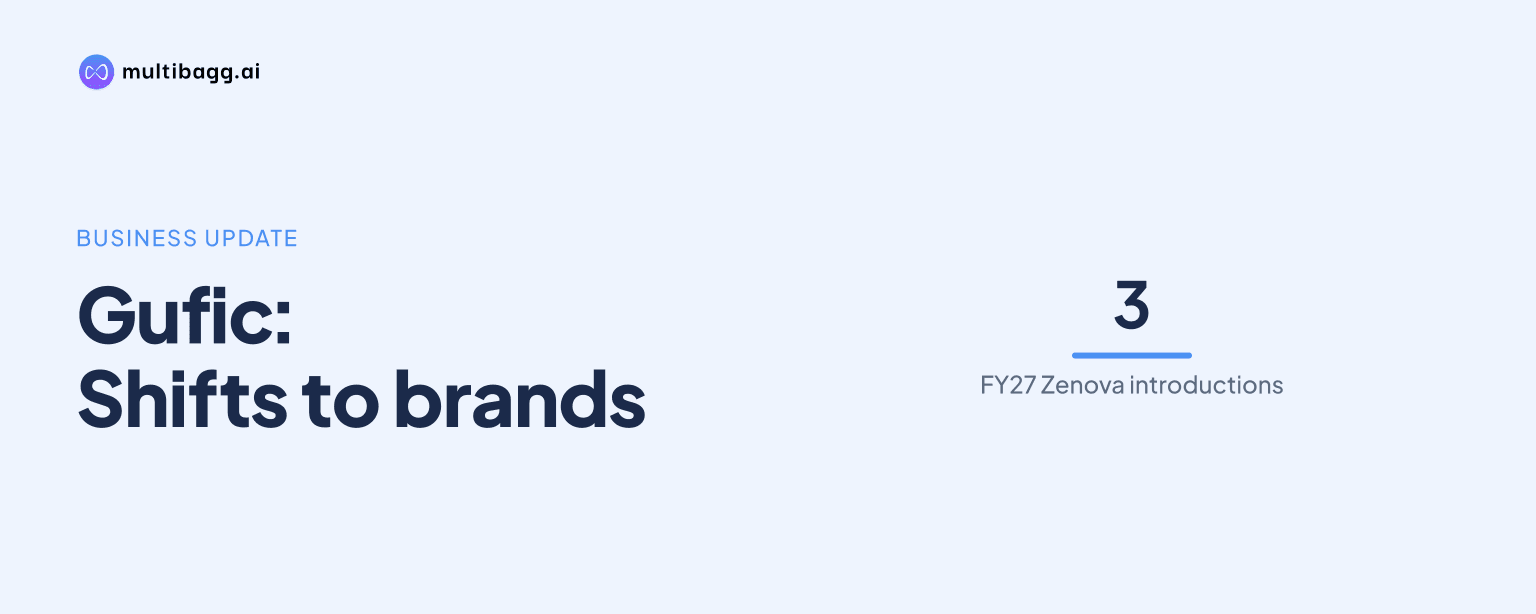
In Q2 FY27, Gufic Biosciences Limited shifted its women’s health platform toward evidence-led fertility treatment and prescription-led brands, with three Zenova introductions planned in FY27. Ferticare is targeting a wider share of IVF treatment activity through reproductive immunology and stimulation products, while Zenova is deliberately reducing reliance on injectables.
Know Gufic BioSciences inside out
Results, valuation, peers and who's buying, in one view.
What is Gufic’s women’s health strategy in Q2 FY27?
Gufic’s Q2 FY27 strategy is to deepen fertility-clinic participation through clinical evidence and product breadth, while making Zenova more dependent on prescription-led power brands across gynaecology and orthopaedics. The platform covers assisted reproductive technology, including in-vitro fertilisation, or IVF, as well as immunology and ortho-gynae therapy areas.
For Ferticare, Gufic states that evidence and clinic wallet share take priority over centre count. The cluster is therefore seeking a wider role in IVF clinics through products used in recurrent implantation failure, ovarian stimulation and poor-responder treatment, rather than presenting expansion in the number of centres as its stated operating objective.
Zenova follows a different mechanism within the same platform. Gufic says non-injectable, prescription-led brands now account for the substantial majority of Zenova’s business, meaningfully higher than a year earlier. Management characterises the lower injectable dependence as a planned mix decision, rather than an indication of lower demand.
How is Gufic widening Ferticare’s presence in IVF treatment?
Gufic is widening Ferticare’s IVF presence by positioning products at several stages of treatment, including recurrent implantation failure, poor-responder care and stimulation cycles. Guficin Alpha retains what Gufic calls clear market leadership in recurrent implantation failure and is gaining acceptance among premium IVF centres, in a category the division says it effectively created.
The Puregraf group has deepened its presence in corporate IVF chains, with improving quality perception among senior clinicians, according to Gufic. Supergraf is being built in the poor-responder segment, while Unogem is used in stimulation cycles. These brands support the stated aim of increasing Ferticare’s share of activity within clinics already served.
Formats and planned additions are part of that expansion. A pre-filled syringe presentation of Cetroc... was introduced in Q2 FY27, while a microbiome-focused probiotic combination and an antioxidant addition are planned for Q3. Gufic does not disclose revenue, pricing, treatment-cycle volumes or market-share data for these products.
What clinical evidence supports Gufic’s fertility strategy?
Gufic supports its Ferticare strategy with a published research article on its immunomodulator in recurrent implantation failure, released clinical practice recommendations and ongoing observational studies on Puregraf. These are the specific evidence-related milestones disclosed in the Q2 FY27 presentation for the reproductive immunology and stimulation portfolio.
The Puregraf observational studies remain under way, according to Gufic. The presentation does not provide study design, patient numbers, endpoints, results or expected completion dates, so it does not establish a clinical outcome from the studies at this stage.
Gufic also held a mentor-mentee programme and an expert consensus meeting on implantation failure during the period. Engagement with Indian and international reproductive medicine societies accompanied those events, linking medical education activity to the division’s focus on reproductive immunology and implantation failure.
Got a follow-up? Ask IRIS
Why is Gufic reducing Zenova’s injectable dependence?
Gufic is reducing Zenova’s injectable dependence to move the division toward a prescription-led, value-oriented product mix across gynaecology and orthopaedics. Management says this is a portfolio decision, not a demand signal, and identifies non-injectable prescription brands as the substantial majority of Zenova’s business in Q2 FY27.
The year-on-year comparison disclosed by Gufic is qualitative but clear: non-injectable prescription-led brands represent a meaningfully larger share than they did a year earlier. The presentation does not disclose the percentage mix in either period, so the magnitude of the change cannot be calculated from the available information.
Power brands grew well ahead of Zenova overall and now contribute the larger part of divisional business, according to Gufic. Fertiforce-M and Fertiforce-F form a meaningful fertility adjacency, while DD1 SR, Sallaki Max and Gufibis gained traction across gynaecology and orthopaedics. Stretchnil grew steadily during the reported period.
What women’s health products is Gufic planning for FY27?
Gufic plans three Zenova introductions in FY27: an in-licensed chondroprotective injectable for osteoarthritis, a brand for the metabolic-ovarian segment and a pre-filled neurotropic vitamin injectable. The chondroprotective product is described as having an established international record, but the presentation does not identify the product, licensor or launch quarter.
The metabolic-ovarian brand is built on what Gufic describes as emerging clinical nomenclature. The planned neurotropic vitamin product is injectable, showing that Zenova’s strategy is not the elimination of injectables but a reduced dependence on them within a prescription-led portfolio.
Ferticare has two Q3 additions planned alongside Zenova’s FY27 programme: a microbiome-focused probiotic combination and an antioxidant product. Gufic does not disclose regulatory status, price points, revenue targets or precise launch dates for either Q3 addition or the three Zenova introductions.
Conclusion
Gufic’s Q2 FY27 women’s health strategy combines two portfolio changes. Ferticare is seeking a broader role in IVF treatment through recurrent implantation failure, stimulation and poor-responder products supported by published, recommended and ongoing clinical work. Zenova, meanwhile, is shifting its business mix toward non-injectable prescription-led power brands that management says are growing ahead of the division.
The next disclosed milestones are the two Ferticare additions planned for Q3 and Zenova’s three introductions planned in FY27. Investors can also watch for details or results from the ongoing Puregraf observational studies, because Gufic has not yet disclosed their design, timing or clinical findings.