










Gufic targets peptide self-reliance with 17 clinical studies
Key highlights
- Gufic reports 17 clinical studies in Q2 FY27, including 5 ongoing trials and 12 pipeline studies.
- Gufic’s depot-injection pipeline names 5 programmes, including GnRH and somatostatin formats.
- Gufic says its Selvax holding reached 16,85,350 shares after a 3,78,350-share tranche on April 29, 2026.
- SVX-2001 reported a 68.4% clinical-benefit rate in a Phase I canine soft-tissue sarcoma study.
powered by IRIS
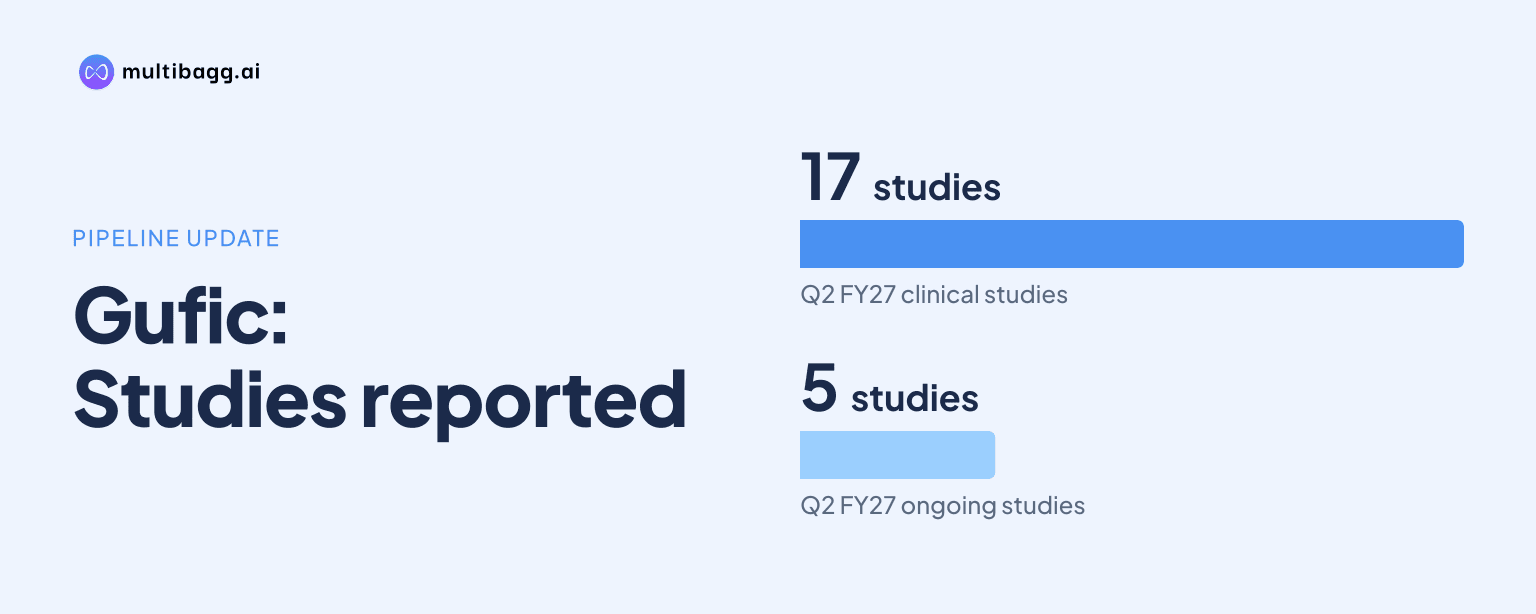
Gufic Biosciences Limited is building active pharmaceutical ingredient (API) capability for peptides and novel drug-delivery formats while running or planning 17 clinical studies in the second quarter of fiscal year 2027 (Q2 FY27), comprising five ongoing trials and 12 pipeline studies. The programme spans depot injections, liposomal antifungals and an early-stage immuno-oncology rights position that Gufic says is not a near-term revenue lever.
Know Gufic BioSciences inside out
Results, valuation, peers and who's buying, in one view.
How is Gufic pursuing peptide and critical API self-reliance?
Gufic is developing peptide and critical APIs in-house to reduce its stated dependence on Chinese supply chains for complex molecules. Its peptide work includes gonadotropin-releasing hormone (GnRH) agonist depots, somatostatin analogues and GnRH agonist microspheres. The presentation links this programme with India’s pharmaceutical supply-chain resilience push, while positioning internal capability as a manufacturing differentiator for complex products.
The API programme extends beyond peptides into several therapeutic categories. Gufic identifies Amphotericin B, Caspofungin and Voriconazole as antifungal APIs for in-house development, alongside low-molecular-weight heparin, unfractionated heparin and a synthetic factor Xa inhibitor in anticoagulants. It also lists a tetracycline-class antibiotic for domestic and export supply, progestins supporting the Ferticare franchise, cyclopeptide hormones supporting its gonadotropin and GnRH platform, and future beta-3 adrenergic agonist and antidiabetic work.
The projects have different stated roles in the portfolio. Antifungal, anticoagulant and tetracycline-class API work is directed at complex manufacturing and supply independence, whereas progestins and cyclopeptide hormones support named product platforms. Gufic does not disclose an API launch date, production volume or spending figure for these categories in its Q2 FY27 presentation, so the disclosed evidence describes development intent rather than commercial output.
Which novel drug-delivery formats is Gufic developing?
Gufic has identified four novel drug-delivery system formats: dual-chamber intravenous bags, dual-chamber syringes, depot injections using microspheres, and liposomal formulations. Dual-chamber intravenous bags are already commercially launched through a Technoflex collaboration and are described as a first-in-India anti-infective format. Their stated mechanism is to eliminate reconstitution errors and limit contamination, with Gufic identifying them as a trigger for expansion of its Sparsh total addressable market.
Dual-chamber syringes remain at the development stage, with multiple products in the pipeline. Gufic says the format is intended to streamline reconstitution, enable precise dosing and maintain sterility. Unlike the launched bag format, the presentation does not specify the number of syringe products, their therapeutic areas or their intended launch timing, making their commercial contribution less defined at Q2 FY27.
Depot injection work covers five listed programmes: a partial-agonist long-acting injectable, an antagonist long-acting injectable, a GnRH agonist depot, a GnRH agonist microsphere and a somatostatin analogue. Gufic says monthly or quarterly dosing could improve compliance and reduce nursing burden. In a separate format, its lipid-complex polyene antifungal liposomal formulation is backed by a signed United States and European Union block deal; the company describes lower toxicity than conventional therapy and a higher therapeutic index as the intended clinical characteristics.
Got a follow-up? Ask IRIS
What do Gufic’s 17 clinical studies cover?
Gufic’s disclosed clinical portfolio totals 17 studies, made up of five ongoing clinical trials and 12 pipeline studies. The five active trials cover reproductive immunology involving Guficin Alpha, botulinum toxin under Aesthederm, gonadotropin under Puregraf, wound healing, and a Phase III biosimilar programme. The split shows that the current studies include marketed-franchise adjacencies as well as a later-stage biosimilar effort.
The 12 pipeline studies broaden the development agenda into novel drug-delivery formats, women’s-health adjacencies including endometriosis and polycystic ovary syndrome, antifungals, central-nervous-system long-acting injectables and antivirals. The presentation provides no trial identifiers, enrolment figures, clinical endpoints or expected completion dates for the 17-study group. As a result, the disclosed count is a measure of programme breadth, not an indication of probability of approval or commercial timing.
The portfolio also distinguishes clinical work from upstream formulation and API projects. For example, the five depot-injection programmes are described as a product pipeline, while the clinical-study list groups long-acting injectable work within the 12 planned studies without assigning a count to each format. That distinction matters because Gufic has not said that every peptide API or delivery-format project had entered human studies by Q2 FY27.
What is Gufic’s immuno-oncology position with Selvax?
Gufic holds India and partial European rights to Selvax’s SVX programme, which it characterises as a staged animal-to-human immuno-oncology option rather than a near-term revenue source. The presentation describes the holding as a long-term scientific option and reports a total shareholding of 16,85,350 Selvax shares after an April 29, 2026 tranche of 3,78,350 shares. It does not give a human-trial start date or revenue forecast for the programme.
SVX-1001 has completed a murine-model study with preclinical proof of concept, while SVX-2001 has a commercialisation-roadmap arm and a Phase I dog study in soft-tissue sarcomas. Gufic reports a 68.4% clinical-benefit rate in that canine study, comprising 25% complete remission and 42% stable disease. These results are from dogs, not people, and the presentation does not state that they establish human clinical efficacy.
SVX-3001 is in advanced cell-line development, with intellectual property filed and entry into the international patent phase stated as the next step. Gufic reports more than 80% clearance in a preclinical mesothelioma model and a 100% cure result versus 0% for the comparator in pancreatic adenocarcinoma models. Those are preclinical model results, while the company’s stated objective is conversion of immunologically “cold” tumours into “hot” tumours.
Conclusion
Gufic’s research and development agenda combines nearer-stage work in commercially launched dual-chamber bags and a signed liposomal-antifungal block deal with earlier work in peptide APIs, depot products and 17 clinical programmes. The comparison across stages is clear: five trials are already ongoing, 12 studies remain in the pipeline, and the Selvax assets range from completed murine work to cell-line development rather than human oncology trials.
The next disclosed items to watch are progress in the five ongoing trials, movement of the 12 pipeline studies into defined clinical stages, and further development of GnRH, somatostatin and long-acting injectable formats. For Selvax, the stated milestones are international patent-phase progression for SVX-3001 and the longer animal-to-human pathway, while Gufic continues to frame the programme as a long-horizon option rather than a near-term sales driver.