










Vascon H1 profit halves as execution shortfall cuts earnings
Key highlights
- Vascon’s standalone H1 FY27 profit after tax declined to Rs 15.05 crore from Rs 33.55 crore in H1 FY26.
- H1 FY27 EPC revenue was Rs 398 crore, down from Rs 427 crore, although Q2 FY27 EPC revenue recovered to Rs 255 crore.
- Vascon’s real-estate loss before tax widened to Rs 10 crore in H1 FY27 from Rs 7 crore a year earlier.
- Net debt was Rs 155.72 crore at 30 September 2026, compared with Rs 91.41 crore at 31 March 2026.
powered by IRIS
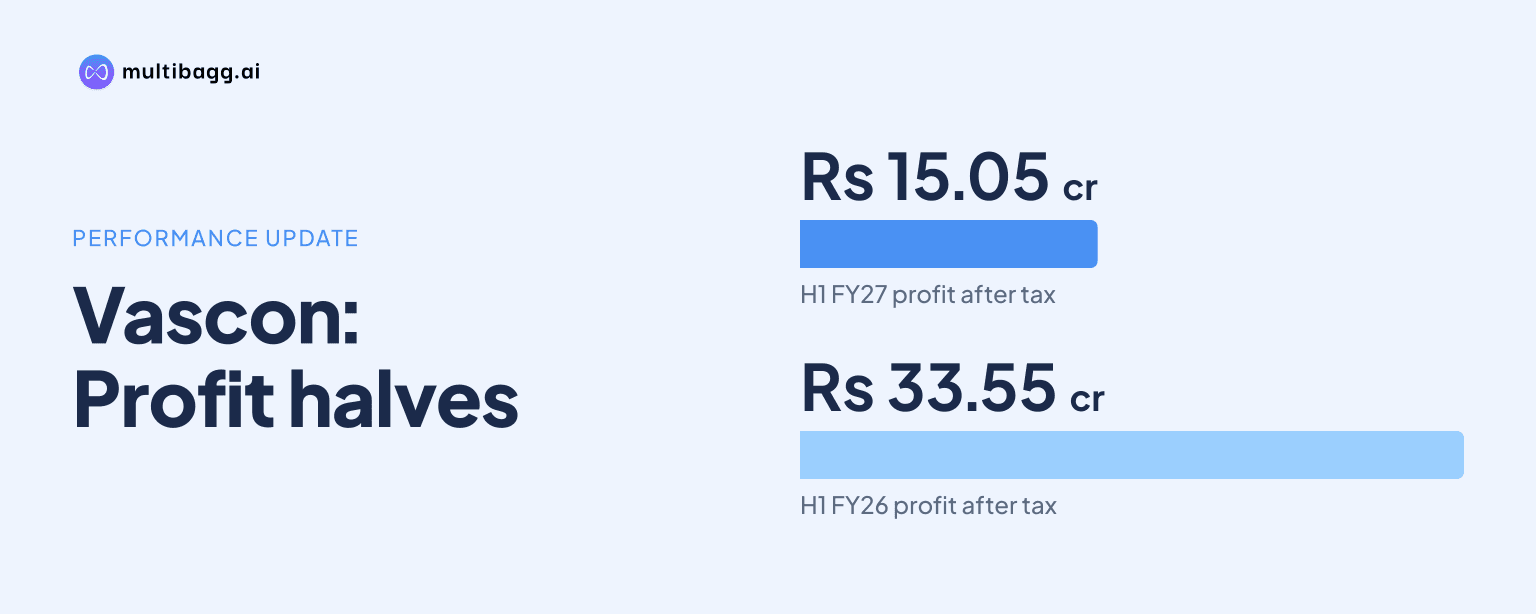
Vascon Engineers reported standalone profit after tax of Rs 15.05 crore in the first half (H1) of financial year 2027 (FY27), down from Rs 33.55 crore in H1 FY26, after revenue fell to Rs 402.80 crore and the real-estate segment recorded a Rs 10 crore loss before tax.
Know Vascon Engineers inside out
Results, valuation, peers and who's buying, in one view.
Why did Vascon’s H1 FY27 profit decline?
Vascon’s H1 FY27 standalone profit after tax fell by Rs 18.50 crore to Rs 15.05 crore, while profit before tax declined to Rs 19.82 crore from Rs 42.09 crore in H1 FY26. Revenue from continuing operations decreased by Rs 43.50 crore to Rs 402.80 crore, and total income declined to Rs 413.08 crore from Rs 471.17 crore.
The first-half comparison also included lower other income and no gain from investment sales in FY27. Other income was Rs 10.28 crore in H1 FY27, compared with Rs 24.87 crore a year earlier, while the segment presentation records Rs 17 crore of profit on sale of investment in H1 FY26 and none in H1 FY27.
What caused Vascon’s EPC revenue shortfall in H1 FY27?
Vascon said the engineering, procurement and construction (EPC) execution shortfall in H1 FY27 was primarily caused by cash-flow constraints on two major government projects during the first quarter (Q1). EPC revenue was Rs 152 crore in Q1 FY27 before rising to Rs 255 crore in the second quarter (Q2), as fund inflows gradually improved and project progress recovered.
EPC revenue for H1 FY27 was Rs 398 crore, down from Rs 427 crore in H1 FY26, while segment EBITDA rose to Rs 41 crore from Rs 39 crore. The EPC EBITDA margin was 10% in H1 FY27 versus 9% in the previous first half, and Vascon said projects awarded in earlier years were nearing completion and generated relatively lower revenue in Q1 FY27.
New EPC orders had not contributed significantly to revenue by H1 FY27, according to Vascon, which expects them to contribute meaningfully from Q3 FY27 onward. Management is targeting Rs 1,500 crore to Rs 2,000 crore of new EPC orders in FY27 and said Rs 1,250 crore had already been secured; this is an order-intake target rather than reported H1 revenue.
How did the real-estate segment affect Vascon’s earnings?
Vascon’s real-estate segment reported a loss before tax of Rs 10 crore in H1 FY27, widening from a Rs 7 crore loss in H1 FY26. Segment revenue fell to Rs 5 crore from Rs 19 crore, while total costs declined to Rs 16 crore from Rs 29 crore in the prior-year half.
The real-estate EBITDA loss increased to Rs 8 crore from Rs 4 crore, and the reported EBITDA margin was negative 128%, compared with negative 18% in H1 FY26. Finance cost was Rs 2 crore in both periods, while other administrative expense increased to Rs 8 crore from Rs 7 crore, exceeding the segment’s Rs 6 crore of total income.
Vascon’s stated response is to optimise debt funding for the real-estate segment to enhance liquidity and financial flexibility. It also plans to accelerate completion of ongoing projects to support revenue and profitability alongside upcoming launches, although the presentation gives no dates, sales values or completion targets for individual projects.
Got a follow-up? Ask IRIS
Did the second quarter improve Vascon’s operating performance?
Vascon’s Q2 FY27 standalone revenue rose to Rs 250.92 crore from Rs 225.39 crore in Q2 FY26, while profit after tax increased to Rs 13.12 crore from Rs 11.62 crore. EBITDA was Rs 23.48 crore versus Rs 19.95 crore, with EBITDA margin unchanged at 9% in both quarters.
The sequential movement in EPC revenue was more pronounced, rising to Rs 255 crore in Q2 FY27 from Rs 152 crore in Q1 FY27. Real-estate revenue moved in the other direction, declining to Rs 1 crore in Q2 FY27 from Rs 5 crore in Q1 FY27, making the quarterly recovery an EPC-led development.
Finance costs rose to Rs 4.91 crore in Q2 FY27 from Rs 3.07 crore in Q2 FY26. For H1, finance cost was Rs 10.96 crore compared with Rs 8.03 crore a year earlier, while standalone EBITDA declined by Rs 19.74 crore to Rs 33.21 crore.
What does Vascon’s September 2026 debt position show?
Vascon reported total debt of Rs 351.16 crore at 30 September 2026, up from Rs 298.60 crore at 31 March 2026. Cash and bank balances plus fixed deposits totalled Rs 195.44 crore, down from Rs 207.19 crore, resulting in net debt of Rs 155.72 crore compared with Rs 91.41 crore at March-end.
Fixed deposits accounted for Rs 152.46 crore of the September cash-and-bank total, including Rs 134.62 crore of lien fixed deposits. The debt table lists Rs 107.21 crore from Aditya Birla Capital, Rs 85.97 crore from the listed bank group and Rs 38.86 crore from Vivriti Capital, together amounting to Rs 232.04 crore.
Vascon also disclosed Rs 760 crore of sanctioned working-capital limits, of which Rs 409 crore was utilised and Rs 351 crore remained unutilised. Vascon said the unutilised limit can support Rs 3,000 crore of additional orders, which is management’s stated execution-capacity assessment rather than reported revenue or an announced order book.
Conclusion
Vascon’s H1 FY27 results show that the Q2 revival in EPC work did not offset a weak Q1, lower first-half revenue and a larger real-estate loss. Standalone profit after tax of Rs 15.05 crore was less than half the Rs 33.55 crore reported in H1 FY26, while the prior period also included Rs 17 crore of profit on sale of investment in the segment disclosure.
The next disclosed milestones are meaningful revenue contribution from new projects from Q3 FY27 onward and progress toward the Rs 1,500 crore to Rs 2,000 crore FY27 EPC-order target, after Rs 1,250 crore was secured. Readers should also watch whether real-estate debt optimisation and accelerated project completion change the segment’s Rs 8 crore H1 FY27 EBITDA loss, alongside net debt of Rs 155.72 crore at September 2026.