










Veegaland says NRIs deliver 48%-50% of Kerala home sales
Key highlights
- Veegaland said NRI buyers account for 48% to 50% of its sales.
- Amora had 68% of its units booked within four months as of 30 September.
- Q2 FY27 revenue rose 28.66% year on year to Rs 106.34 crore.
- Veegaland said average selling price increased from Rs 8,539 in June to Rs 9,286 in September.
powered by IRIS
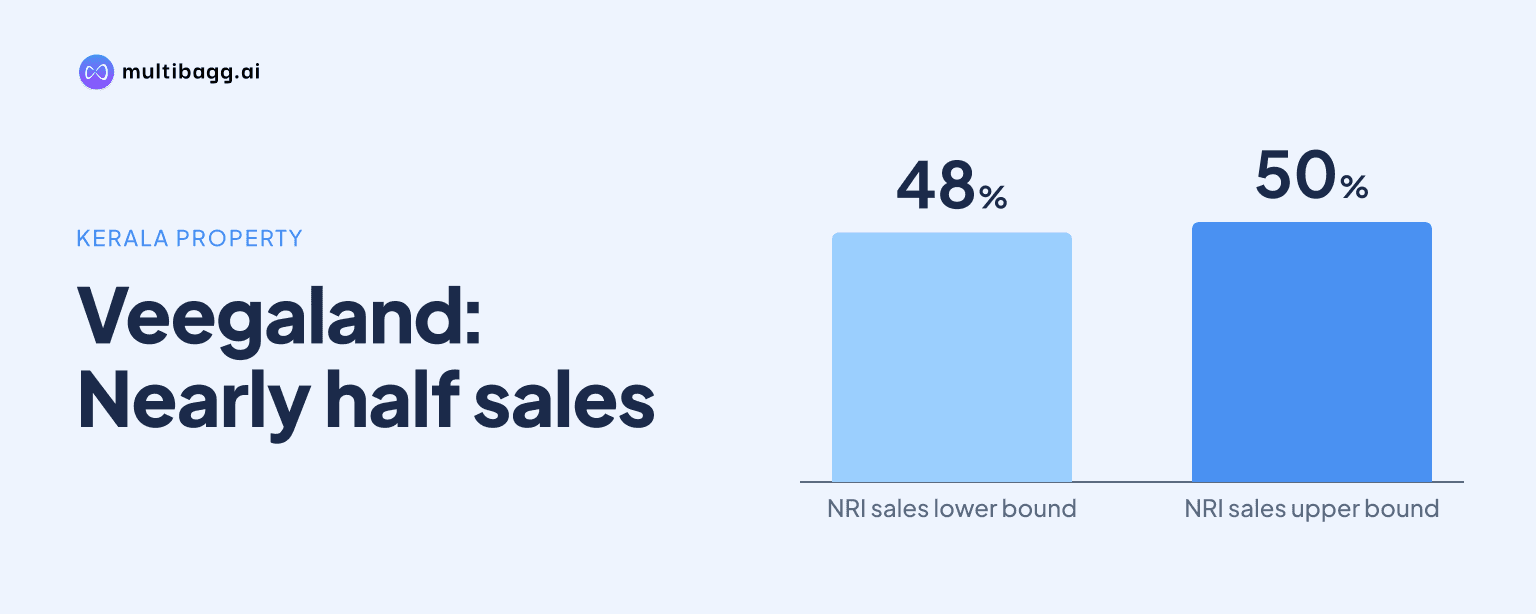
Veegaland said non-resident Indian, or NRI, buyers accounted for 48% to 50% of its sales in the FY27 earnings call, with management linking an unusually strong Q1 FY27 to Middle East conflict-related demand. Management said some Malayalis based in the region are seeking at least one residence in Kerala amid geographic uncertainty.
Know Veegaland Developers inside out
Results, valuation, peers and who's buying, in one view.
How important are NRI buyers to Veegaland sales?
NRI buyers contribute 48% to 50% of Veegaland sales, according to management, making overseas Malayalis a major demand source for its premium and Luxe Series apartments. The company said its target buyers are professionals and business individuals with either the liquidity or housing-credit access to purchase higher-value homes.
Management said premium housing is generally a higher-volume, lower-ticket-size business than its Luxe Series products. Luxe Series projects are lower-volume and higher-margin, it said, while demand is present across mid-premium, premium and luxe housing rather than being confined to one customer category.
Veegaland placed its NRI exposure in the context of Kerala remittances. Management said India received about Rs 1,55,000 crore of NRI remittances in the previous year and that Kerala received 20% of that amount. The company did not disclose NRI sales in rupee terms, the number of NRI buyers, or their mix by city or project.
Why does Veegaland connect Middle East tensions with home demand?
Veegaland said it is seeing Malayalis living in the Middle East choose to own at least one residence in Kerala because of uncertainty in that geography. This was management's market observation, not a quantified estimate of sales caused by the conflict, and the company did not identify individual countries or buyer numbers.
Management said the trend affected its normal seasonal sales pattern in FY27. Veegaland typically sees Q2 and Q3 as its fastest-selling quarters, while Q1 and Q4 are usually slower, but it said Q1 FY27 recorded higher sales because it believes Middle East conflict-related demand increased purchases.
The usual Q2 and Q3 sales pattern is linked to NRI travel, management said. Buyers often visit their hometowns during vacation and festival periods and make final housing choices while physically present in Kerala. Collections do not follow the same seasonal pattern because billing is linked to construction milestones under the Real Estate Regulatory Authority, or RERA, framework.
What evidence did Veegaland give of housing demand?
Veegaland cited its Amora project in Kochi, where 68% of units were booked within four months as of 30 September. Management attributed demand to the project location and proximity to the metro, while also citing construction quality and its delivery record.
The company said its average selling price increased from Rs 8,539 in June to Rs 9,286 in September, an increase of Rs 747. Management also described the current selling price as about Rs 9,200, compared with about Rs 4,000 in 2013-14, but the transcript did not specify the measurement basis for these figures.
Management identified additions at Kochi's InfoPark and Trivandrum's TechnoPark as local housing-demand drivers. It also cited economic activity associated with the Vizhinjam port development and its logistics belt, saying activity in Trivandrum had improved over the past year alongside higher real-estate realisations.
Veegaland said it had 12 ongoing projects and three upcoming projects. Its portfolio included two projects in Thrissur, two in Kozhikode and three in Trivandrum, with the remaining projects in Kochi; its land bank was about 6.4 acres, mainly in Kochi with some locations in Kozhikode.
Got a follow-up? Ask IRIS
How have demand and product mix affected Veegaland's results?
Veegaland reported Q2 FY27 revenue from operations of Rs 106.34 crore, up 28.66% from Rs 82.66 crore in Q2 FY26. Earnings before interest, tax, depreciation and amortisation, or EBITDA, including other income, rose 77% to Rs 22.78 crore, while profit after tax, or PAT, increased 92% to Rs 15.99 crore.
EBITDA margin increased by 550 basis points to 20.90% in Q2 FY27 from 15.40% a year earlier, while PAT margin rose by 470 basis points to 14.70%. Management said revenues from Luxe Series projects launched in H2 FY26 were being recognised and contributed to the margin outcome because these products carry higher margins at lower volumes.
For H1 FY27, Veegaland reported revenue of Rs 180.66 crore, up 45% from Rs 124.16 crore in H1 FY26. EBITDA including other income rose 96% to Rs 37.09 crore, and PAT rose 123% to Rs 25.71 crore; management said material prices remained under watch but had not caused a margin squeeze at that point.
What is Veegaland planning to launch next?
Veegaland said Fortune had received RERA approval and was already launched, while Sarovar and East Port were scheduled for launch in Q3 FY27. Management declined to forecast pre-sales for the three projects, which have an estimated gross development value, or GDV, of Rs 450 crore.
The company said its land-reserve projects could be launched within six to nine months, depending on project size, complexity and regulatory approvals. Management said almost all projects on land already held should begin by FY28, although it did not provide their GDV because unit count, product segment and pricing had not been finalised.
Veegaland said it had around Rs 1,080 crore of order value in its books, of which around Rs 500 crore had already been recognised as revenue. Management said the remaining around Rs 500 crore could be recognised through FY31 without further sales, while pre-sales of around Rs 174 crore in the quarter would add to the order book.
Conclusion
Veegaland's 48% to 50% NRI sales mix gives overseas Malayali demand a central role in its premium housing business. Management's view that Middle East uncertainty is prompting buyers to secure a Kerala residence is supported by an unusually strong Q1 FY27 and Amora's 68% booking level within four months, but the company has not quantified the sales directly attributable to that trend.
The next demand indicators are the Q3 FY27 launches of Sarovar and East Port, following Fortune's launch, and the conversion of land reserves within six to nine months. Management also plans to expand the number of projects and is evaluating new geographies, while its stated around Rs 500 crore of unrecognised order value could extend revenue visibility through FY31.