










Veegaland Developers Q2 PAT Rises 92% to ₹15.99 Crore
Key highlights
- Veegaland Developers' Q2 FY27 revenue rose 28.66% year-on-year to ₹106.34 crore.
- Q2 FY27 profit after tax increased 92.34% year-on-year to ₹15.99 crore.
- Pre-sales grew 37.56% to ₹174.34 crore and collections rose 88.22% to ₹125.22 crore.
- Veegaland reported a ₹1,086.79 crore order book and raised ₹210 crore through its IPO.
powered by IRIS
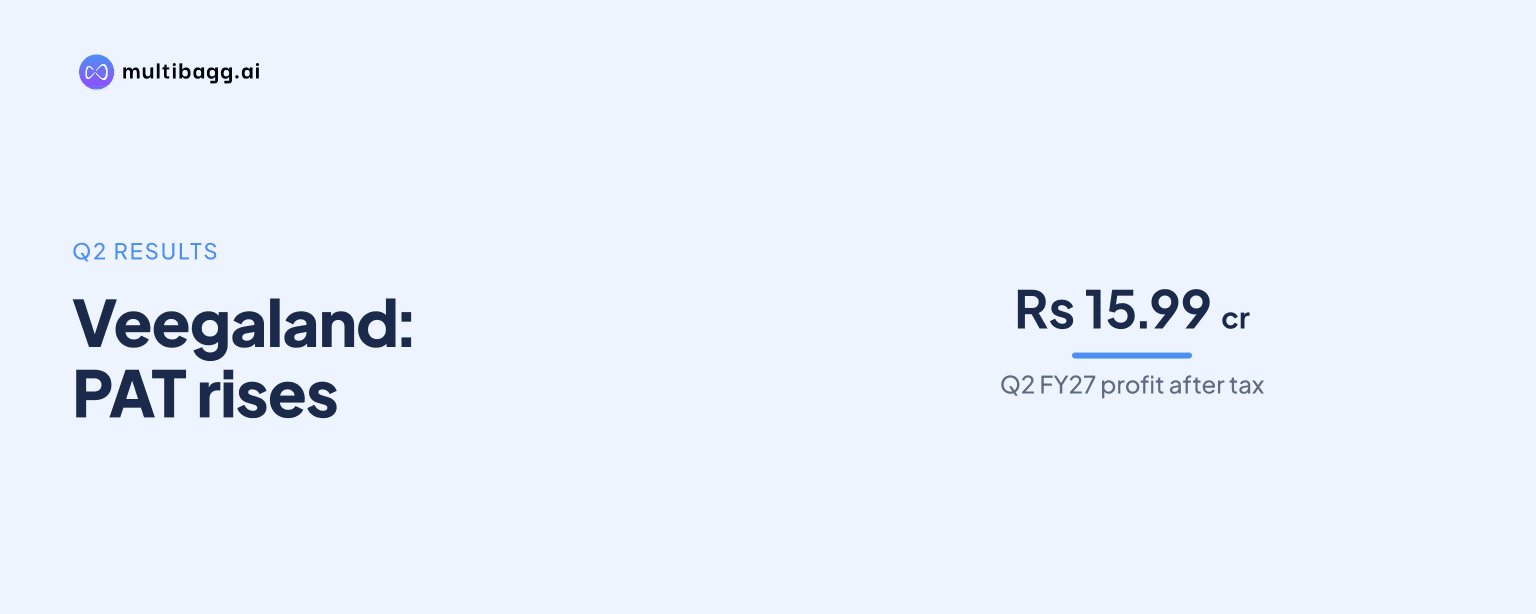
Veegaland Developers Limited reported Q2 FY27 profit after tax of ₹15.99 crore, up 92.34% year-on-year, while revenue from operations increased 28.66% to ₹106.34 crore. Higher EBITDA, an improved margin and growth in pre-sales supported the quarter, although management did not provide numeric forward guidance on its November 9 earnings call.
Know Veegaland Developers inside out
Results, valuation, peers and who's buying, in one view.
What did Veegaland Developers report in Q2 FY27?
Veegaland Developers reported year-on-year growth across revenue, profit, pre-sales and collections for the quarter ended September 30, 2026. Revenue from operations rose to ₹106.34 crore from the corresponding quarter a year earlier, while profit after tax increased to ₹15.99 crore.
EBITDA, including other income, rose 77.76% year-on-year to ₹22.78 crore. The EBITDA margin was 20.90%, compared with 15.4% in the prior-year period, an improvement of 550 basis points. Management linked the margin expansion partly to the product mix of its Lux series, cost efficiency and treasury or fixed-deposit income.
Pre-sales value increased 37.56% year-on-year to ₹174.34 crore. Collections grew 88.22% to ₹125.22 crore. These operating measures indicate that sales bookings and customer receipts both expanded faster than reported quarterly revenue.
How did Veegaland Developers perform in the first half?
Veegaland recorded H1 FY27 revenue from operations of ₹180.66 crore, a 45.51% increase year-on-year. EBITDA rose 96.10% and profit after tax increased 123.08% during the first half, according to the company’s investor presentation.
Management said the first quarter had been unusually strong relative to normal seasonal patterns. It attributed demand conditions partly to Middle East conflict-driven demand. In Q1 FY27, the company had reported revenue from operations of ₹74.3 crore, up 79.0% year-on-year, and net profit of ₹9.7 crore, up 203.1% year-on-year.
The Q2 result extended this first-half momentum, though quarterly revenue growth was lower than the Q1 rate cited by the company. The reported H1 revenue of ₹180.66 crore comprises the company’s first-quarter and second-quarter operating performance.
What did management say about demand and project visibility?
Veegaland said NRI demand remained strong despite tensions in the Middle East. Its Q2 pre-sales growth of 37.56% to ₹174.34 crore was the principal measure cited for ongoing demand visibility during the earnings call.
The company reported an order book of ₹1,086.79 crore, or about ₹1,080 crore in management commentary. Management also said around ₹500 crore of unrecognised revenue was visible through FY31. This represents revenue yet to be recognised from the existing project pipeline rather than a financial forecast.
Management did not provide numeric forward guidance and repeatedly declined to project future performance on the call. For investors, this makes the reported order book, pre-sales and stated revenue visibility the key disclosed reference points for assessing the development pipeline.
Got a follow-up? Ask IRIS
How will the IPO proceeds be used?
Veegaland raised ₹210 crore through its initial public offering. Management said the proceeds are earmarked for development of ongoing projects, land acquisition and general corporate purposes.
The IPO cash inflow was described as a one-off addition to cash resources, rather than operating income. It does not form part of revenue from operations or the quarterly pre-sales figure. Its stated deployment areas relate to project execution, potential land purchases and corporate funding requirements.
For a real-estate developer, funding availability can influence the timing of construction activity and the ability to add land inventory. However, the company did not quantify a land-acquisition pipeline, project-level spending programme or expected returns from the IPO-funded uses.
What does the Q2 FY27 result mean for investors?
The Q2 figures show that Veegaland delivered revenue growth alongside faster growth in EBITDA and profit after tax. Revenue increased 28.66%, while EBITDA including other income increased 77.76% and PAT grew 92.34%. The resulting margin expansion was supported by the Lux-series mix, cost efficiency and treasury income, according to management.
The difference between operating revenue, pre-sales and collections is relevant for evaluating the business. Revenue is recognised in accordance with project progress and accounting requirements, while pre-sales capture booking value and collections reflect customer receipts. Veegaland’s reported growth in each of these measures points to higher activity, but they are not interchangeable financial metrics.
The company’s decision not to issue numeric guidance limits visibility beyond the disclosed pipeline. Investors will therefore need to track subsequent pre-sales, collections, revenue recognition, margins and the use of IPO proceeds against the ₹1,086.79 crore order book and the stated ₹500 crore of unrecognised revenue visible through FY31.
Conclusion
Veegaland’s Q2 FY27 performance combined 28.66% revenue growth with a 92.34% rise in profit after tax to ₹15.99 crore. Stronger pre-sales, collections and EBITDA margin were the central operating indicators, while the company cited product mix, cost efficiency and treasury income as contributors to profitability.
The next points to watch are the conversion of the order book into recognised revenue, the pace of pre-sales and collections, and deployment of the ₹210 crore IPO proceeds for projects, land acquisition and corporate purposes. Management has not disclosed numeric forward guidance, but has said about ₹500 crore of unrecognised revenue is visible through FY31.