










Ventive solar plan targets 17 generator-free hours at Raaya
Key highlights
- Ventive expects Raaya to run generator-free for about 17 hours daily after its planned January 2027 solar installation.
- Maldives added diesel cost fell to about Rs 12 crore in Q2 FY27 from around Rs 20 crore in Q1 FY27.
- Ventive's Maldives revenue rose 20% year on year to Rs 213 crore in Q2 FY27.
- Maldives operating EBITDA increased 25% year on year to Rs 30 crore in Q2 FY27.
powered by IRIS
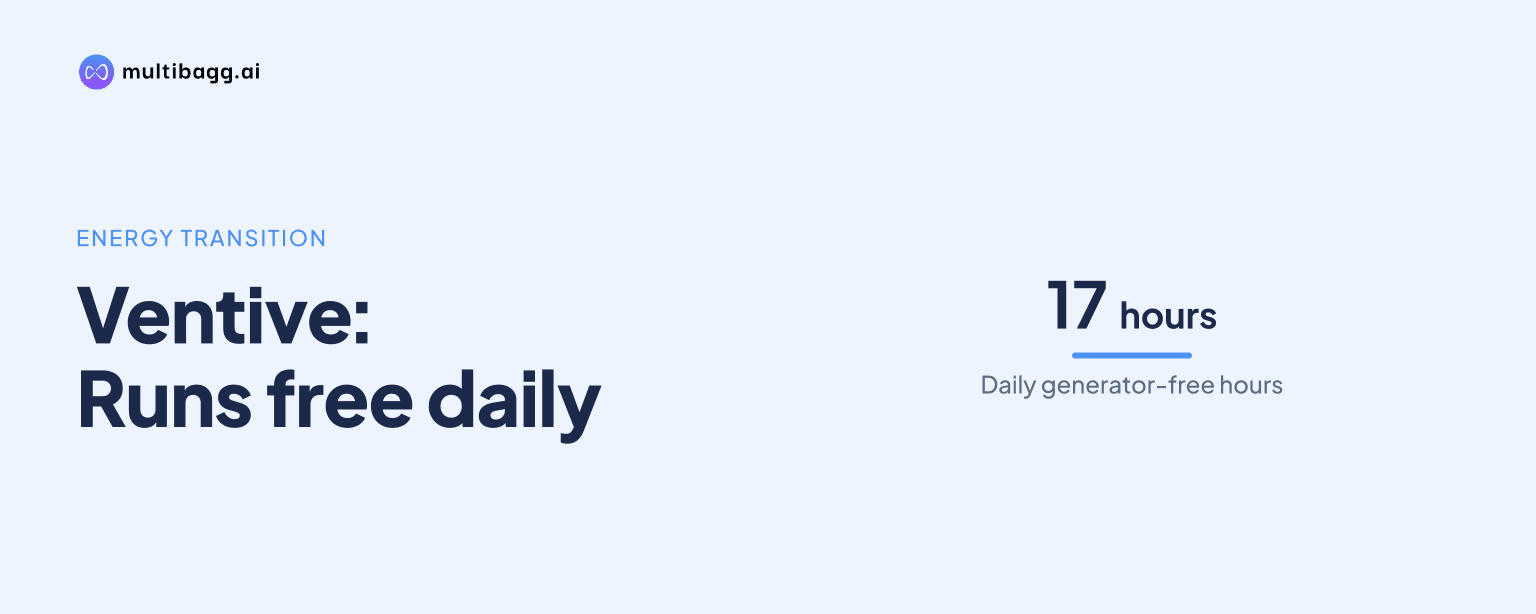
Ventive Hospitality Limited says its Raaya resort in the Maldives is expected to run generator-free for about 17 hours a day after a solar installation planned for January 2027, reducing dependence on diesel after added fuel costs reached about Rs 20 crore in Q1 FY27. The programme also covers Conrad and Anantara.
Know Ventive Hospitality inside out
Results, valuation, peers and who's buying, in one view.
How will Ventive reduce diesel use in the Maldives?
Ventive plans to use solar installations across Raaya, Conrad and Anantara to reduce the Maldives portfolio's dependence on diesel. Management said Raaya should operate without generators for around 17 hours each day and described it as the first Maldives resort expected to do so. The Raaya installation is planned for completion in January 2027.
The stated objective is to limit the earnings impact of a future fuel shock rather than rely only on lower market diesel prices. Management said the solar programme was progressing as planned and that a diesel shock such as the one in Q1 FY27 should not affect the business in the same way again. Ventive did not disclose solar capacity, capital expenditure or estimated annual savings.
Ventive is also pursuing operational measures alongside solar generation. Management cited energy-saving work in heating, ventilation and air-conditioning, or HVAC, systems and desalination plants, which it identified as energy-intensive areas. It also cited cluster purchasing, vendor-rate negotiations and seaplane arrangements as Maldives cost-management mechanisms.
What did diesel costs do to Ventive's Maldives profit?
Diesel costs remained above the prior-year level in Q2 FY27 even after retreating from their April-May peak. Management said diesel prices had fallen about 31% from that peak but were still 1.5 times the previous year's level. The added diesel cost was about Rs 12 crore in Q2 FY27, compared with around Rs 20 crore in Q1 FY27.
The Q1 FY27 fuel impact was material: Maldives earnings before interest, tax, depreciation and amortisation, or EBITDA, declined 32%, according to management. In Q2 FY27, the Maldives business returned to growth, with revenue rising 20% year on year to Rs 213 crore and operating EBITDA increasing 25% to Rs 30 crore. That recovery occurred while diesel remained elevated against the prior year.
The quarter-on-quarter margin comparison did not show a corresponding expansion. An analyst said the international-business EBITDA margin was 15% in Q1 FY27 and 14% in Q2 FY27, despite the stated fall in diesel prices from the peak. Management described the result as broadly flat and typical of a Maldives low season, while noting that the business had absorbed elevated fuel rates.
Got a follow-up? Ask IRIS
How did Ventive's Maldives operations recover in Q2 FY27?
Ventive's Maldives revenue rose 20% year on year to Rs 213 crore in Q2 FY27, while operating EBITDA increased 25% to Rs 30 crore. Total revenue per available room, or TRevPAR, increased 20% to Rs 45,000, and occupancy improved by 3 percentage points to 57% during what management called the off-season.
The improvement followed Q1 FY27, when fuel costs contributed to a 32% decline in Maldives EBITDA. Management attributed Q2 growth to occupancy, revenue per available room and commercial flexibility across three recently upgraded resorts serving different price points. It also said elevated airfares and lower year-to-date tourist arrivals had affected the season, while the portfolio still lifted occupancy.
The Maldives result contrasted with the wider Q2 FY27 group performance. Consolidated revenue increased 5% year on year to Rs 582 crore, while hospitality revenue grew 14% to Rs 423 crore. Operating EBITDA increased 11% to Rs 211 crore, but reported consolidated EBITDA declined 5% to Rs 242 crore because other income fell, including foreign-exchange gains, inter-corporate deposit interest and export incentives.
What is Ventive expecting in the second half?
Ventive expects the second half of FY27 to be its seasonally strongest period in both India and the Maldives, with the Maldives entering high season and diesel prices easing from their earlier peak. Management said business already on the books in the Maldives looked healthy but did not provide a Maldives revenue or margin forecast.
For the group, management said about 67% of forecast Q3 FY27 revenue was already on the books as of the November 3, 2026 call. It estimated mid-teen growth in both revenue and EBITDA for Q3, with occupancy above 70%. These are management estimates, and Ventive cautioned that forward-looking statements may differ materially from actual outcomes.
In India, management estimated H2 FY27 occupancy above 70% and average daily rate, or ADR, above Rs 14,500. India occupancy was 68% in Q2 FY27, up 2 percentage points year on year, and ADR rose 11% to Rs 12,629. India operating revenue increased 11% to Rs 207 crore and operating EBITDA rose 8% to Rs 80 crore, a 39% margin.
Ventive also has development activity that could affect future operations and capital use. AC by Marriott Whitefield is targeted to open in Q1 FY28 and Varanasi Marriott in Q3 FY28, adding about 360 keys. Management said timelines and budgets were being tracked and financing had reached financial closure, although the company was using more cash surpluses to fund the projects.
Conclusion
Ventive's solar programme is a direct response to Maldives fuel-cost pressure that was visible in Q1 FY27 and persisted in Q2 FY27. The fall in added diesel cost to about Rs 12 crore from around Rs 20 crore coincided with Maldives revenue growth of 20% and operating EBITDA growth of 25%, but diesel remained 1.5 times the prior-year level and international EBITDA margin was 14%.
The next operating milestone is the planned January 2027 completion of Raaya's solar installation, when management expects generator-free operation for about 17 hours a day. The other disclosed measures to watch are high-season Maldives demand, diesel prices and whether the Q3 FY27 management estimate for mid-teen revenue and EBITDA growth is met, with 67% of forecast revenue already on the books.