










Vertis says Rs 10,700 crore receivables hedge rate rises
Key highlights
- Vertis reported Rs 10,700 crore of repo-linked HAM annuity receivables versus Rs 8,000 crore of floating-rate debt at September 30, 2026.
- Vertis refinanced Rs 1,425 crore of floating-rate debt in Q2 FY '27, lowering portfolio borrowing cost by approximately 13 basis points.
- Vertis received seven annuity payments worth Rs 380 crore in Q2 FY '27, averaging 5.9 days ahead of due dates.
- Vertis declared Rs 3.25 per unit for Q2 FY '27, taking H1 distribution to Rs 6.50 per unit.
powered by IRIS
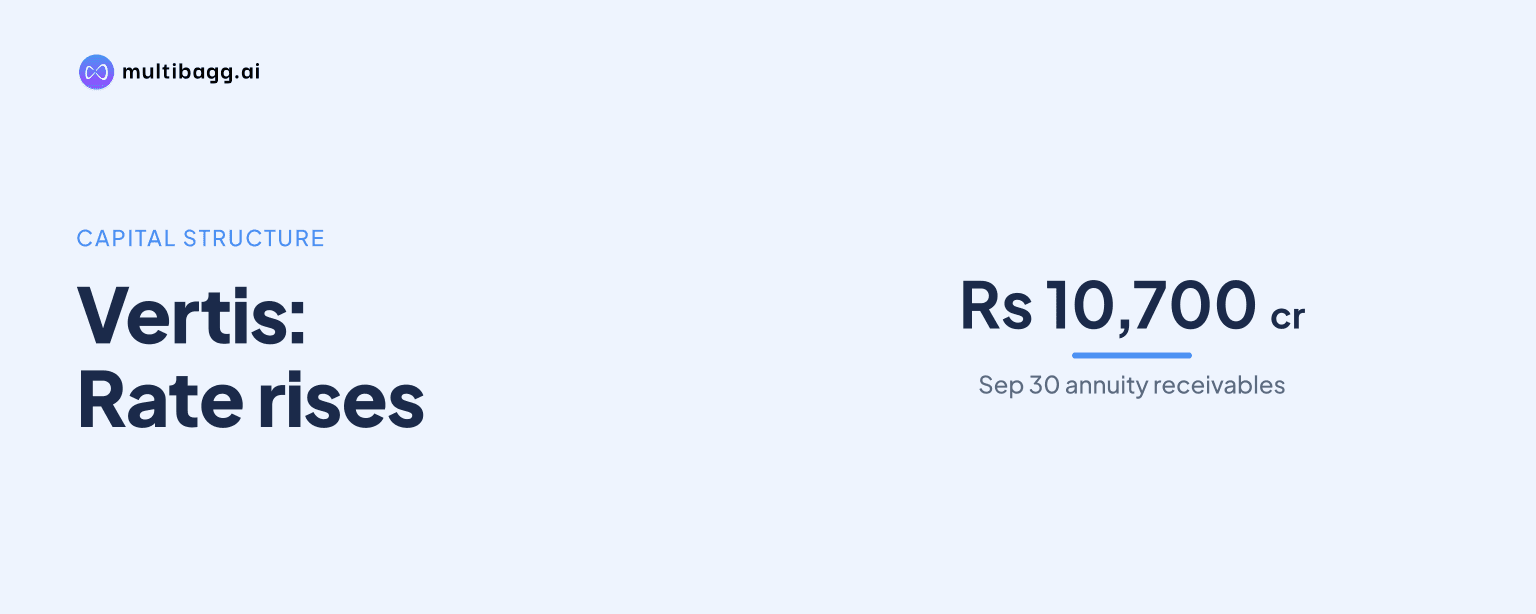
Vertis Infrastructure Trust said in Q2 FY '27 that Rs 10,700 crore of repo-linked hybrid annuity model, or HAM, receivables exceeded its Rs 8,000 crore floating-rate debt portfolio, creating a natural hedge that management expects to provide a slight net cash-flow advantage if repo rates increase.
Know Vertis Infrastructure Trust inside out
Results, valuation, peers and who's buying, in one view.
How does Vertis's interest-rate hedge work?
Vertis's hedge works because interest income on its HAM annuity receivables is linked to the repo rate while most of its borrowing is floating-rate. As of September 30, 2026, Vertis reported outstanding HAM annuity receivables of about Rs 10,700 crore, compared with a Rs 8,000 crore floating-rate debt portfolio. Management said approximately 73% of borrowings were linked to floating rates.
A repo-rate increase would raise funding costs on the floating-rate loans, but it would also lift interest income on the larger HAM receivable balance. Vertis therefore described the arrangement as a natural hedge that reduces, rather than eliminates, its sensitivity to interest-rate movements. The difference between the stated receivable and floating-debt balances was Rs 2,700 crore.
In a hypothetical 25-basis-point repo-rate increase, management estimated that the effect on borrowing cost could be about 16 to 17 basis points because only around two-thirds of facilities were floating-rate. It said interest income on the Rs 10,700 crore HAM balance would rise by 25 basis points in that illustration, leaving a slight net cash-flow advantage. Management stressed that these were rough, not precise, calculations.
What is Vertis's debt position after refinancing?
Vertis had approximately Rs 11,300 crore of outstanding debt at September 30, 2026, a net debt-to-assets under management, or AUM, ratio of 40.3%, and an average debt cost of about 7.3%. Management said the 7.3% figure included the 25-basis-point repo-rate increase in October 2026.
During Q2 FY '27, Vertis refinanced about Rs 1,425 crore of floating-rate debt through fixed-rate non-convertible debentures, or NCDs, combined with an interest-rate swap, or IRS. Management said this reduced portfolio borrowing cost by approximately 13 basis points and partly offset the October 2026 repo-rate increase. It described the IRS as the largest transaction of its kind in the InvIT segment.
The refinancing fixed the cost of only part of the debt base. In the analyst discussion, management described around one-third of facilities as fixed-rate and around two-thirds as floating-rate, compared with the formal presentation's 73% floating-rate figure. It said fixed-rate borrowings due for refinancing next year had existing costs not materially different from prevailing bond and capital-market rates.
Got a follow-up? Ask IRIS
What cash-flow evidence supports Vertis's annuity position?
Vertis received seven annuity payments totalling Rs 380 crore in Q2 FY '27, with receipts arriving an average 5.9 days ahead of their scheduled due dates. Management cited the timing of these payments as support for the predictability of contracted annuity cash flows. The quarterly collections are separate from the Rs 10,700 crore outstanding receivable balance used in the rate-hedge calculation.
At September 30, Vertis operated 27 assets across nine states and approximately 8,200 lane kilometres, with AUM of Rs 27,100 crore. Its AUM mix was 40% toll assets, 32% downside-protected toll assets and 28% HAM and annuity assets. The mix leaves the trust exposed both to contracted annuity receipts and to traffic-linked revenue.
Traffic increased 11.3% year on year in Q2 FY '27 and 10.2% in H1, against the 4.1% growth assumption in the valuation report. Toll revenue rose 13.3% in Q2 excluding NTEPL six-laning compensation, while revenue growth including that compensation was 21.2%. NTEPL recorded 15% traffic growth, according to management.
Vertis declared a Rs 3.25-per-unit distribution for Q2 FY '27, taking H1 distribution to Rs 6.50 per unit. Cumulative distributions since the InvIT's formation in August 2022 reached Rs 63.59 per unit. Management said it was not providing distribution guidance for the financial year, so the interest-rate hedge is not a forecast of future distributions.
What could limit Vertis's protection from higher rates?
The hedge covers the relationship between repo-linked HAM interest income and floating borrowing costs, but it does not address every cash-flow variable. Vertis said some fixed-rate facilities will require refinancing next year. Management said the effect on overall borrowing cost would be very marginal even if refinancing occurred at higher rates, while allowing for some pricing difference.
Major maintenance costs are another consideration outside the repo-rate mechanism. Management said current valuation figures assume bitumen prices of Rs 80,000 for the remaining part of FY '27 and FY '28. Some major-maintenance works were pushed into H2 and FY '28 as bitumen prices stayed elevated, although management said maintenance cannot be deferred indefinitely because road quality must remain acceptable.
Asset and regulatory factors can also affect cash flows. Vertis said traffic at Vadodara-Halol and STPL-NI was affected by diversion following the opening of competing roads, though their combined AUM contribution was limited and the impact was included in the valuation report. Net asset value was Rs 106.43 per unit at September 30, compared with Rs 107.39 per unit in June 2026, partly due to a tax-rate change for entities under the new regime.
Conclusion
Vertis's disclosed balance sheet structure pairs a Rs 10,700 crore repo-linked HAM receivable balance with Rs 8,000 crore of floating-rate debt, while its Rs 1,425 crore refinancing reduced borrowing cost by about 13 basis points. The result, according to management's hypothetical analysis, is that a repo-rate increase can lift annuity interest income by more than the associated rise in floating borrowing costs.
Investors can next watch refinancing of fixed-rate facilities due next year, major-maintenance spending through FY '28 under the Rs 80,000 bitumen-price assumption, and annuity collection timing. Management also said NTEPL six-laning, originally expected by January 2026, may take another 18 to 24 months, while compensation had been received through September 2026 and was expected to continue in full until completion.