










Vertis traffic growth tops valuation assumption in Q2 FY '27
Key highlights
- Vertis reported 11.3% year-on-year traffic growth in Q2 FY '27, against a 4.1% valuation assumption.
- Toll revenue increased 13.3% in Q2 FY '27 excluding six-laning compensation and 21.2% including it.
- Vertis received seven annuity payments totalling Rs 380 crore, averaging 5.9 days before their due dates.
- Vertis refinanced Rs 1,425 crore of debt and said the transaction reduced borrowing cost by about 13 basis points.
powered by IRIS
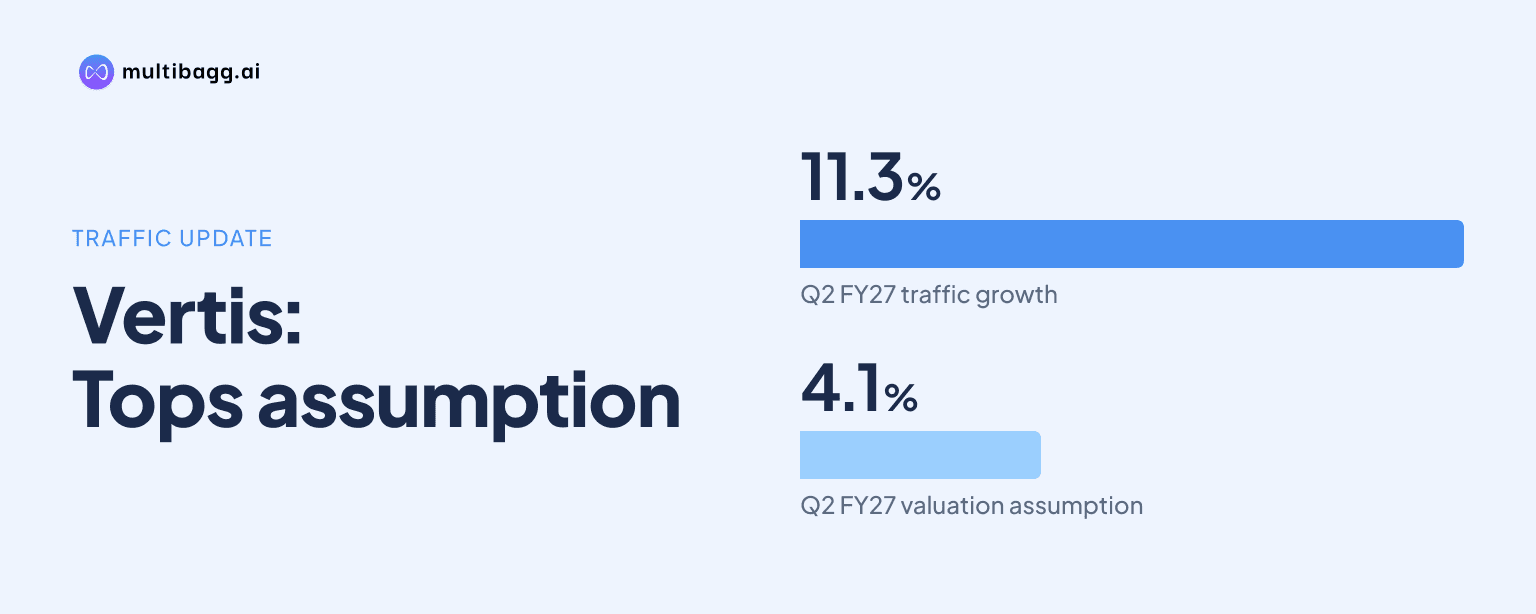
Vertis Infrastructure Trust reported 11.3% year-on-year traffic growth in Q2 FY '27, 7.2 percentage points above the 4.1% growth assumed in its valuation report, while toll revenue rose 13.3% excluding six-laning compensation. First-half traffic growth was also 10.2%, above the same valuation assumption.
Know Vertis Infrastructure Trust inside out
Results, valuation, peers and who's buying, in one view.
Why did Vertis traffic growth exceed its valuation assumption?
Vertis recorded 11.3% year-on-year traffic growth in Q2 FY '27 against the 4.1% growth used in the valuation report. The 7.2-percentage-point difference means reported portfolio traffic growth for the quarter was higher than management's cited valuation assumption. Traffic growth in H1 FY '27 was 10.2%, which was also above 4.1%.
Toll revenue rose 13.3% year on year in Q2 FY '27 and 12% in H1 FY '27, excluding compensation related to delayed six-laning work at an asset identified by management as NTEPL. Including that compensation, revenue growth was 21.2% in Q2 and 19.4% in H1. The difference between the two revenue measures reflects the effect of compensation receipts during the construction delay.
Which Vertis assets drove traffic growth in Q2 FY '27?
Vertis said NTEPL recorded 15% traffic growth in Q2 FY '27, driven by long-distance cargo movement in the automobile, pharmaceutical and defence sectors. Management also identified GEPL, UTPL and BN as special purpose vehicles, or SPVs, with double-digit traffic growth, although it did not provide individual growth rates for those three assets.
Ahmedabad-Mehsana and STPL-Tada Nellore also recorded encouraging performance, which Vertis linked to industrial and commercial activity. The portfolio had 27 operational assets across nine states and about 8,200 lane kilometres as of September 30, 2026, providing exposure across multiple traffic corridors.
Assets under management, or AUM, stood at Rs 27,100 crore on September 30, 2026. Toll assets represented about 40% of AUM, downside-protected toll assets represented 32%, and hybrid annuity model, or HAM, and annuity assets represented 28%. Management did not disclose quarterly revenue by those three categories.
Where did Vertis face traffic-diversion risks?
Vertis said Vadodara-Halol and STPL-NI were affected by traffic diversion after competing roads were commissioned. Management said the effect had been incorporated in the valuation report but occurred earlier than expected. It described the two projects' combined AUM contribution as limited, without giving a monetary amount or percentage.
The earlier timing could affect toll collections before the point assumed in the valuation exercise. Even with those two assets affected, Vertis reported 11.3% traffic growth and 13.3% toll-revenue growth excluding six-laning compensation in Q2 FY '27.
Vertis also handed back two SPVs during H1 FY '27. The Bangalore Elevated concession period ended and the site was physically handed back to the National Highways Authority of India, or NHAI, in September 2026, while the Shillong asset was handed back in Q1 FY '27 after its vesting certificate was received.
Got a follow-up? Ask IRIS
How dependable were Vertis annuity receipts in Q2 FY '27?
Vertis received seven annuity payments totalling Rs 380 crore in Q2 FY '27, an average 5.9 days before their scheduled due dates. Management said the timing supported the predictability of contracted cash flows from HAM and annuity assets, which accounted for 28% of AUM at September 30, 2026.
Annuity receivables were about Rs 10,700 crore, compared with floating-rate debt of Rs 8,000 crore. Vertis said interest income on HAM annuity receivables is linked to the repo rate, while about 73% of borrowings are floating rate, creating what management described as a natural hedge against interest-rate movements.
Vertis declared a distribution of Rs 3.25 per unit for Q2 FY '27, taking the H1 FY '27 distribution to Rs 6.50 per unit. Cumulative distribution since the August 2022 listing reached Rs 63.59 per unit, supported by toll collections and annuity realisation, according to management.
What did Vertis do to manage borrowing costs?
Vertis refinanced Rs 1,425 crore of floating-rate debt in Q2 FY '27 through fixed-rate non-convertible debentures, or NCDs, combined with an interest-rate swap, or IRS. Management said the transaction reduced portfolio borrowing cost by about 13 basis points, partly offsetting the 25-basis-point repo-rate increase in October 2026.
Outstanding debt was about Rs 11,300 crore on September 30, 2026, net debt to AUM was 40.3%, and the average cost of debt was about 7.3%. Vertis called the refinancing the largest IRS transaction in the InvIT segment, but did not disclose the maturity, fixed coupon or swap terms on the call.
Net asset value, or NAV, was Rs 106.43 per unit on September 30, 2026, compared with Rs 107.39 per unit in June 2026. Management said the decline was partly due to a tax-rate change for entities using the new regime and that revised tax assumptions were already reflected in the September valuation exercise.
What should readers monitor after Vertis's Q2 FY '27 update?
Vertis said NTEPL six-laning, which had been expected to finish by January 2026, was delayed after work stopped and NHAI invited revised bids. Management said the replacement contract had recently been awarded and could take another 18 to 24 months to complete. It said compensation had been received from January through September 2026 and that it expected full compensation until completion.
The Ministry of Road Transport and Highways introduced annual local passes from November 1, 2026, at Rs 1,500 for eligible rural residents and Rs 3,000 for eligible urban residents living within 20 kilometres of a fee plaza. Vertis said it awaited clarity on compensation for concessionaires for any potential revenue effect. Detailed operating guidelines also remain awaited for Multi-Lane Free Flow tolling.
Conclusion
Vertis's Q2 performance combined portfolio traffic growth above its valuation assumption with 13.3% toll-revenue growth excluding six-laning compensation and Rs 380 crore of early annuity receipts. The reported result included 15% traffic growth at NTEPL and double-digit growth at several SPVs, while diversion affected Vadodara-Halol and STPL-NI earlier than management had expected.
The next disclosed operating milestone is the estimated 18-to-24-month completion period for NTEPL six-laning and the continuation of NHAI compensation during the delay. The pending Multi-Lane Free Flow procedures and a possible concessionaire-compensation mechanism for the local-pass programme will also determine the practical revenue effects on toll assets.