










Vikram Solar plans 15 GWh BESS capacity by March 2030
Key highlights
- Vikram Solar marks 7.5 GWh of BESS capacity for April 2027 and 15 GWh for March 2030.
- Vikram Solar’s roadmap schedules commercial BESS operations for Q1 FY28.
- The planned utility BESS container stores 5 MWh and has 2.5 MW charge and discharge capability.
- VION has more than 3,000 retail touchpoints and more than 500 distributors.
powered by IRIS
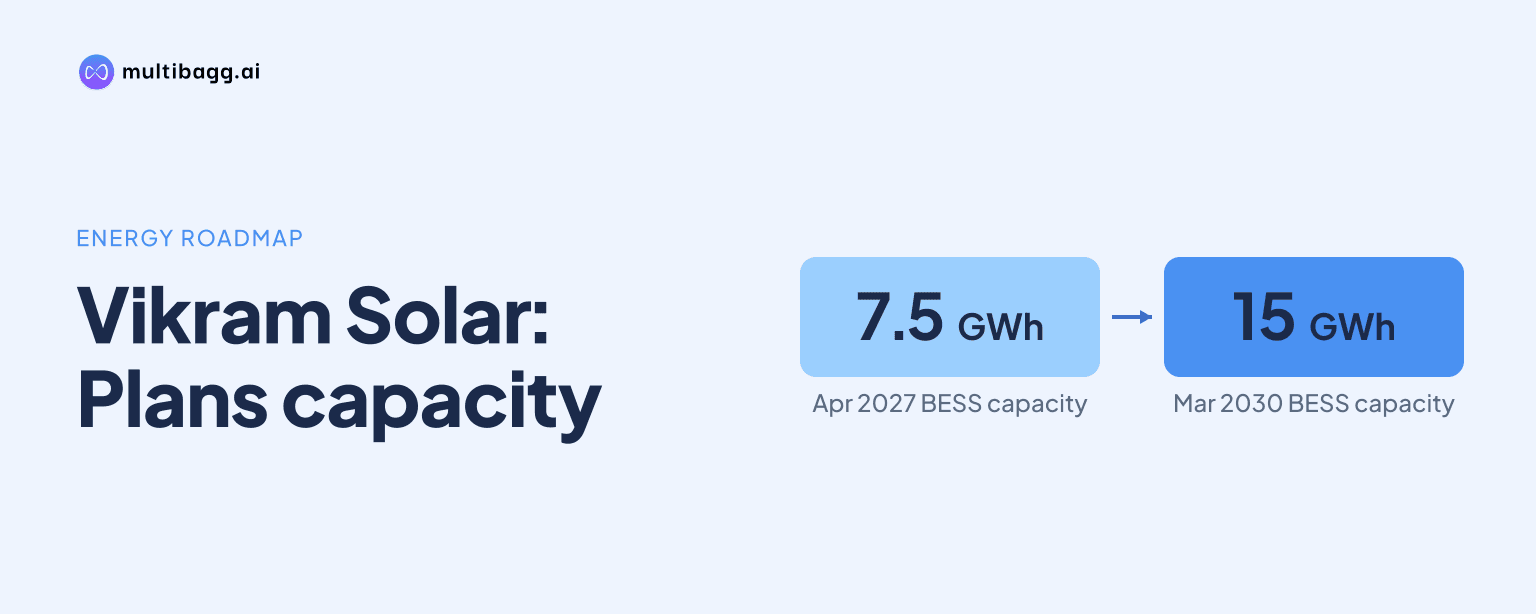
Vikram Solar Limited plans 7.5 gigawatt-hours (GWh) of battery energy storage system (BESS) operations from April 2027 and 15 GWh by March 2030, while its roadmap schedules commercial operations in the first quarter (Q1) of FY28 after equipment receipt, plant launch, first rollout and certification.
Know Vikram Solar inside out
Results, valuation, peers and who's buying, in one view.
When will Vikram Solar start battery storage operations?
Vikram Solar marks 7.5 GWh for April 2027 and 15 GWh for March 2030, setting out a phased expansion of its BESS manufacturing capability. The commercial roadmap separately identifies equipment receipt in Q3 FY27, plant launch, first rollout and certification in Q4 FY27, commercial operations in Q1 FY28, and cell manufacturing live in FY30. The April 2027 marker and the Q1 FY28 label are both shown in the presentation.
The move from 7.5 GWh to 15 GWh represents a planned doubling of BESS capacity between the two capacity markers. The FY30 cell-manufacturing milestone is relevant to Vikram Solar’s stated approach because it says upcoming cell manufacturing, together with in-house research and development (R&D), is intended to provide end-to-end control. The presentation does not provide investment spending, order commitments, plant location or revenue expectations for the storage plan.
What battery storage products will Vikram Solar make?
Vikram Solar plans two BESS formats: a 5 megawatt-hour (MWh) utility container and a 261 kilowatt-hour (kWh) commercial and industrial (C&I) cabinet. The utility product is a 20-foot, liquid-cooled lithium iron phosphate (LFP) container rated for 2.5 megawatts (MW) of charge and discharge power. It carries an IP55 ingress-protection rating, which the presentation lists alongside its power and storage specifications.
The smaller C&I cabinet has 261 kWh of storage, liquid cooling and a 125 kilowatt (kW) alternating-current (AC) rating at 400 volts. Vikram Solar lists efficiency of at least 86% and an IP54 ingress-protection rating for this product. The two formats differ substantially in energy capacity: the 5 MWh utility container stores roughly 19 times the 261 kWh cabinet’s rated energy, positioning the portfolio across utility and C&I requirements rather than as a single product line.
The product roadmap links these systems to in-house R&D and future cell production, rather than describing a completed vertically integrated battery supply chain today. Vikram Solar’s FY30 milestone says cell manufacturing will be live, whereas commercial BESS operations are scheduled earlier, in Q1 FY28. That sequencing indicates the initial BESS launch is planned before the disclosed battery-cell manufacturing milestone.
Got a follow-up? Ask IRIS
How does VION give Vikram Solar an existing storage presence?
Vikram Solar already sells energy-storage-related products through VION, a battery brand with more than 3,000 retail touchpoints, more than 500 distributors and coverage across more than 250 active districts. The network also has 15 stock-keeping units (SKUs) and a sales and service team of more than 80 people. These figures describe a distribution base already in the market before the proposed 7.5 GWh BESS operations milestone.
VION’s current portfolio includes home uninterruptible power supply (UPS) batteries ranging from 1.28 kWh to 15.36 kWh, with a 60-month warranty on the VION LFP 12160/12320 models. It also includes 52.2 kWh to 104.4 kWh advanced-chemistry cell modules that are liquid-cooled, IP67-rated and operate at about 165 volts direct current. Its e-rickshaw battery packs range from 5 kWh to 7.5 kWh, use LFP chemistry, carry an IP67 rating and have a 36-month warranty.
The VION portfolio is smaller in unit energy than Vikram Solar’s proposed 5 MWh utility container, while its advanced-chemistry modules reach 104.4 kWh and its UPS products start at 1.28 kWh. The presentation therefore shows products across household, mobility and module applications alongside the planned utility and C&I systems. It does not state that VION’s 3,000-plus retail touchpoints will distribute the utility BESS container or the C&I cabinet.
How does BESS fit Vikram Solar’s manufacturing integration plan?
Vikram Solar presents storage as an adjacency to its solar manufacturing integration programme. Its integrated-platform chart lists 15.5 gigawatts (GW) of operational module capacity across four plants, 9 GW of solar-cell capacity at Gangaikondan in Q4 FY27, and 9 GW of ingot and wafer capacity in FY29–30. The same chart identifies a planned 15 GWh BESS container capability by FY30 under PowerHive.
At the Gangaikondan site, Vikram Solar says a 9 GW tunnel oxide passivated contact (TOPCon) solar-cell facility is on track for commercial production in March 2027. Its milestones show infrastructure ready in November 2026, first cell out in December 2026, sequential commissioning and trial runs in January 2027, and commercial production in March 2027. Separately, the site’s expansion table lists 6 GW of module capacity in FY27 and FY29–30, 9 GW of cell capacity in both periods, and 9 GW of ingot-wafer capacity in FY29–30.
Vikram Solar says co-locating wafer, cell and module capacity is designed to share utilities and overheads, avoid inventory in transit and retain margins at each stage. For storage, it cites utility, C&I and public-sector demand for solar-plus-storage solutions, as well as solar, wind and round-the-clock power use cases. These are Vikram Solar’s stated reasons for integration; the presentation does not quantify how much of the planned 15 GWh capacity would serve each customer segment.
Conclusion
Vikram Solar’s disclosed storage plan is a staged expansion from a 7.5 GWh marker in April 2027 to 15 GWh by March 2030. The proposed product range combines a 5 MWh utility container with a 261 kWh C&I cabinet, while VION provides an existing battery portfolio, more than 500 distributors and more than 3,000 retail touchpoints. The strategy places BESS alongside the company’s 15.5 GW module platform and planned 9 GW cell and wafer capacities.
The next disclosed milestones are equipment receipt in Q3 FY27, plant launch, first rollout and certification in Q4 FY27, and commercial BESS operations in Q1 FY28. Investors following execution can also watch the separate March 2027 solar-cell production target and the FY30 battery-cell manufacturing target, because Vikram Solar links future cell production to its intended end-to-end storage control.