










Vikram Solar targets March 2027 production at 9 GW cell plant
Key highlights
- Vikram Solar targets March 2027 commercial production from its 9 GW TOPCon cell plant.
- Infrastructure readiness is scheduled for November 2026 and first-cell output for December 2026.
- Vikram Solar’s DCR volume rose 71% from 76 MW in Q1 FY27 to 130 MW in Q2 FY27.
- The Gangaikondan site combines 6 GW of module capacity with planned 9 GW cell and 9 GW ingot-and-wafer capacity.
powered by IRIS
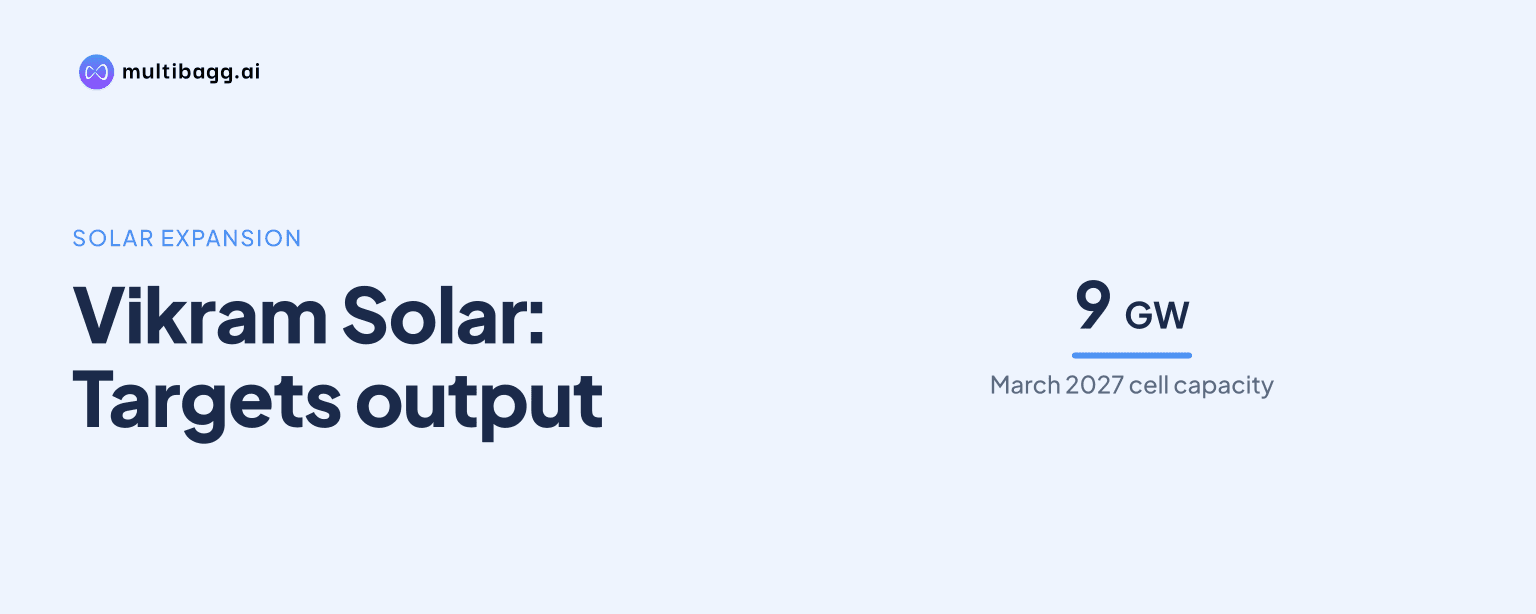
Vikram Solar Limited targets March 2027 commercial production from its 9 GW TOPCon cell manufacturing facility at Gangaikondan, following infrastructure readiness in November 2026, first-cell output in December 2026 and commissioning trials from January 2027. The planned facility is intended to shift supply from procured DCR cells to in-house cells.
Know Vikram Solar inside out
Results, valuation, peers and who's buying, in one view.
When will Vikram Solar’s 9 GW cell plant start production?
Vikram Solar plans to start commercial production at its 9 GW TOPCon cell plant in March 2027. The company describes the Gangaikondan project as progressing according to plan, with the commercial start following a sequence of construction, initial output and trial-run milestones from November 2026.
The timetable sets infrastructure readiness for November 2026 and the first cell out for December 2026. Sequential commissioning and trial runs are scheduled from January 2027, before the March 2027 commercial-production target. The schedule distinguishes first-cell output from commercial production at the facility.
Vikram Solar also lists the solar-cell facility as a Q4 FY27 development in its solar-to-storage roadmap. March 2027 is therefore a disclosed target, rather than confirmation that the 9 GW plant has begun producing cells.
Why is Vikram Solar building its own cell capacity?
Vikram Solar is building 9 GW of cell capacity to support DCR demand with in-house production rather than only purchased cells. For FY27, it says it has secured 1 GW of procured DCR cells to serve its distribution segment while the Gangaikondan plant remains under construction.
The FY27 procurement plan differs from the stated FY28 role for the new plant. Vikram Solar says its own cells are intended to cater to commercial and industrial, or C&I, and independent power producer, or IPP, orders in FY28. That would move the company from procured DCR cells for distribution in FY27 to internally made cells for these order categories after production begins.
DCR volume rose 71% from 76 MW in Q1 FY27 to 130 MW in Q2 FY27. DCR’s share of Vikram Solar’s total volume increased from 7.5% to 22% over the same period, and the company says DCR demand has moved to TOPCon technology.
Vikram Solar presents DCR-market development in three phases: residential demand through PM Surya Ghar and PM-KUSUM, followed by C&I moving to DCR, then utilities. The company labels the later-stage timing as an indicative industry view subject to policy notification, rather than a confirmed schedule for utility demand.
Got a follow-up? Ask IRIS
How will the Gangaikondan site combine modules, cells and wafers?
Vikram Solar plans Gangaikondan as a co-located site with 6 GW of ramped-up module capacity, a 9 GW cell plant under construction and a 9 GW ingot-and-wafer plant for which ground has been broken. Its FY29–30 expansion plan retains 6 GW of module capacity while listing 9 GW each of cell and ingot-and-wafer capacity.
The proposed configuration links ingot and wafer production, cell manufacturing and module assembly at the same site. Vikram Solar says the arrangement is designed to keep wafer, cell and module margins in-house, instead of relying on externally supplied inputs at these stages.
The company also cites shared utilities and overheads across the three plants as a mechanism for lower cost per watt. It says co-location removes inventory in transit between plants and provides one quality system from ingot through module, connecting the site design to working-capital handling and production control.
What does Vikram Solar expect from backward integration?
Vikram Solar says the Gangaikondan site is intended to create a domestic wafer-to-module supply chain that is ready for ALMM and DCR requirements. It identifies in-house cells and wafers, alongside the 6 GW module line and planned 9 GW upstream capacities, as the basis for this positioning.
The company lists port proximity, road access, skilled and semi-skilled manpower, and state and central incentives among the strategic advantages of Gangaikondan. It also cites a Tamil Nadu memorandum of understanding covering power and infrastructure, but the presentation does not quantify the financial effect of those advantages.
Backward integration sits within a wider plan that includes battery energy storage systems, or BESS. Vikram Solar has outlined 7.5 GWh of BESS capacity for April 2027 and 15 GWh by March 2030, with commercial operations scheduled for Q1 FY28 and BESS cell manufacturing described as live in FY30.
For solar operations, the nearer transition is from 1 GW of procured DCR cells in FY27 to the planned 9 GW cell plant in FY28. Vikram Solar’s distribution volume rose from 145 MW in Q1 FY27 to 259 MW in Q2 FY27, while the company says distribution earns higher realisation than its other sales channels. The presentation does not disclose a revenue or margin forecast for the cell plant.
Conclusion
Vikram Solar’s March 2027 target makes the 9 GW TOPCon cell plant the next disclosed step in its manufacturing-integration plan. The facility is positioned between a 6 GW module operation at Gangaikondan and a planned 9 GW ingot-and-wafer line, while the company continues to use 1 GW of procured DCR cells for its FY27 distribution requirement.
The next scheduled checkpoints are infrastructure readiness in November 2026, first-cell output in December 2026 and sequential commissioning and trial runs from January 2027. Progress against those milestones will indicate whether Vikram Solar remains on schedule for March 2027, while the FY29–30 ingot-and-wafer plan remains necessary for the fully integrated site described by management.