










Viyash Scientific targets Rs 150 crore annual capex for two years
Key highlights
- Viyash expects annual capex of around Rs 150 crore for each of the next two years.
- Viyash spent about Rs 60 crore on capex in H1 FY27 and expects Rs 140 crore to Rs 150 crore for FY27.
- Animal-health R&D has increased almost threefold, and formulation R&D capacity has doubled.
- Net debt declined from Rs 166 crore in March 2026 to Rs 26 crore on September 30, 2026.
powered by IRIS
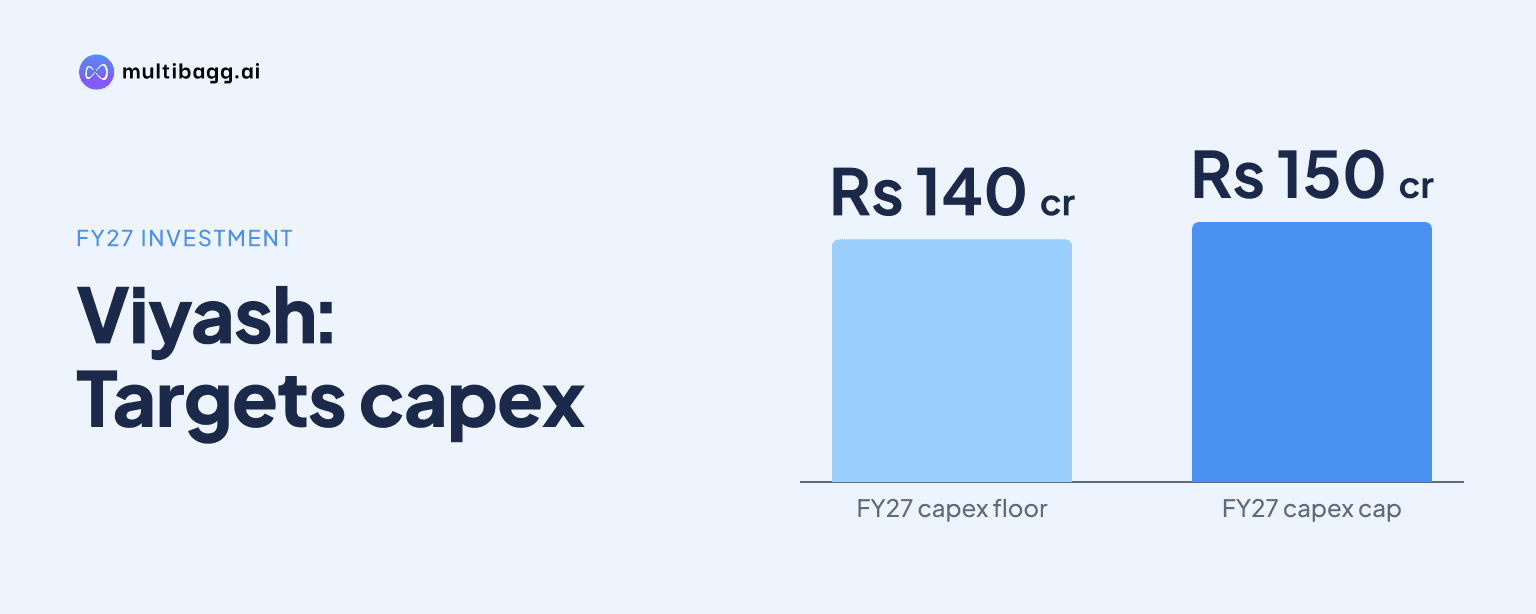
Viyash expects capital expenditure of about Rs 150 crore annually for the next two years, centred on companion-animal research and manufacturing, after spending about Rs 60 crore in H1 FY27. Management said the programme will include growth and operational spending while partnerships, including in Turkey, are intended to limit unnecessary infrastructure investment.
Know Viyash Scientific inside out
Results, valuation, peers and who's buying, in one view.
What capex has Viyash planned through the next two years?
Viyash has indicated capex of around Rs 150 crore a year for the next two years, with the current FY27 total expected at Rs 140 crore to Rs 150 crore. Management made the indication after saying first-half spending was about Rs 60 crore, meaning the FY27 run rate implies more spending in the second half than in the first six months.
The current plan is below the Rs 150 crore to Rs 170 crore level management initially discussed for the next two to three years. Management said it is now optimising the programme and that spending could decline from the current estimate, rather than pursuing capacity additions solely to report a larger volume of installed infrastructure.
The Rs 150 crore annual indication covers both growth capex and operational capex, rather than a companion-animal-only construction budget. That distinction matters because Viyash is also expanding oncology finished-dose capabilities and has described multiple investment areas, while companion-animal development was the principal strategic focus discussed alongside the capex plan.
How will Viyash use capex for companion animals?
Viyash plans to direct companion-animal investment to research, dosage-form technology and repurposed manufacturing capacity. Management said animal-health research and development, or R&D, has risen almost threefold from its initial level, while formulation R&D capacity has doubled to support technologies including soft chews, hard tablets and spot-on products.
Viyash is repurposing a manufacturing facility in Ambernath that had been used for domestic products. Management said it is moving those domestic products elsewhere through partners and preparing the Ambernath site for the companion-animal programme, describing the move as a quicker route than building a new plant from scratch.
The investment programme supports a product pipeline rather than near-term large launches. Management said Viyash can now validate five to eight products annually, compared with one or two before the merger, and that most are moving towards filing. It expects the larger contribution from companion-animal launches from 2029 onward, with preparation intended to support launches from day one.
Companion animals are part of a wider animal-health business that management said would grow more than 20% in FY27 from a base of about Rs 400 crore in the prior year. Management attributed the higher growth rate partly to a lower base and said capacity for Albendazole had been increased by more than two times after the SeQuent assets were added.
Got a follow-up? Ask IRIS
Why is Viyash seeking manufacturing partners?
Viyash is seeking partners to avoid building more infrastructure than required, and management specifically cited companies in Turkey as an option. It said a Turkish manufacturing facility could help the company move more quickly in Europe and other countries, while allowing it to minimise capex that would otherwise be needed for wholly owned capacity.
This approach follows management's stated preference for essential expansion rather than capacity built for its own sake. The Ambernath conversion is another example: Viyash is redeploying an existing facility for companion-animal manufacturing instead of describing a separate greenfield project, while using partners to relocate domestic-product activity.
Turkey is also relevant to the existing commercial plan. Management said emerging-market revenue grew 39% year on year in H1 FY27, with Brazil's growth primarily driven by existing-business volume and Turkey's growth supported by new product launches. It added that capacity in Turkey is being expanded and optimised, with further growth expected from next year as additional launches arrive.
The partnership strategy also addresses the potential overlap between supplying active pharmaceutical ingredients, or APIs, and selling finished companion-animal products. Viyash said it already supplies qualification quantities for a few companion-animal APIs and is evaluating strategic arrangements, while noting that qualifying with an innovator can normally take five years.
What financial capacity supports Viyash's capex plan?
Viyash's lower debt balance and higher first-half profit provide financial flexibility for the programme, according to management. Net debt fell from Rs 166 crore in March 2026 to Rs 26 crore on September 30, 2026, while H1 FY27 profit after tax rose 49.4% year on year to Rs 164 crore from Rs 110 crore.
H1 FY27 revenue from operations increased 17.8% to Rs 1,934 crore, and pre-ESOP earnings before interest, tax, depreciation and amortisation, or EBITDA, rose 30% to Rs 412 crore. The pre-ESOP EBITDA margin expanded to 21.3% from 19.3%, while finance costs declined to Rs 26 crore from Rs 38 crore, which management linked to debt reduction and balance-sheet improvement.
The spending plan sits alongside other uses of capital. Viyash completed the acquisition of 100% of BioForLife Italia on October 1, 2026, making it a step-down wholly owned subsidiary. Management said the lower net-debt position provided flexibility for both organic and inorganic growth, but did not allocate a specific portion of the Rs 150 crore annual capex plan to the acquisition.
Viyash also expects its overall formulation and API mix to remain broadly similar in the near term. Management described formulations and APIs as roughly a 55% and 43% mix at the time of the call, with one or two percentage points of variation, even as it expects formulation to grow more materially after two to three years through companion animals, oncology and potential acquisitions.
Conclusion
Viyash's central message is that it plans to keep annual capex near Rs 150 crore for two years, rather than accelerate spending towards the earlier Rs 150 crore to Rs 170 crore range. The programme combines companion-animal R&D, specialised dosage-form capability and a repurposed Ambernath facility with other growth and operational requirements, supported by H1 FY27 net debt of Rs 26 crore.
The next point to watch is whether Viyash delivers FY27 capex of Rs 140 crore to Rs 150 crore without expanding owned capacity beyond what management considers necessary. Management's plan depends on partner discussions in Turkey, the readiness of companion-animal manufacturing and filings from a pipeline now validating five to eight products annually, with larger launches anticipated from 2029 onward.