








VL Infraprojects Limited says Rs 8 crore outflow reflects growth
MAX Plan at ₹4,999/yr

Find your next multibaggerBe a Pro Investor
Research stocks and track your picks on the go. Download the app.
Key highlights
- VL Infraprojects reported negative operating cash flow of Rs 8 crore in H1 FY27.
- Trade receivables were about Rs 27 crore after rising almost 17% in six months.
- Inventory increased from about Rs 3 crore to nearly Rs 10 crore over 18 months.
- Management said VL Infraprojects average borrowing cost was around 12%.
powered by IRIS
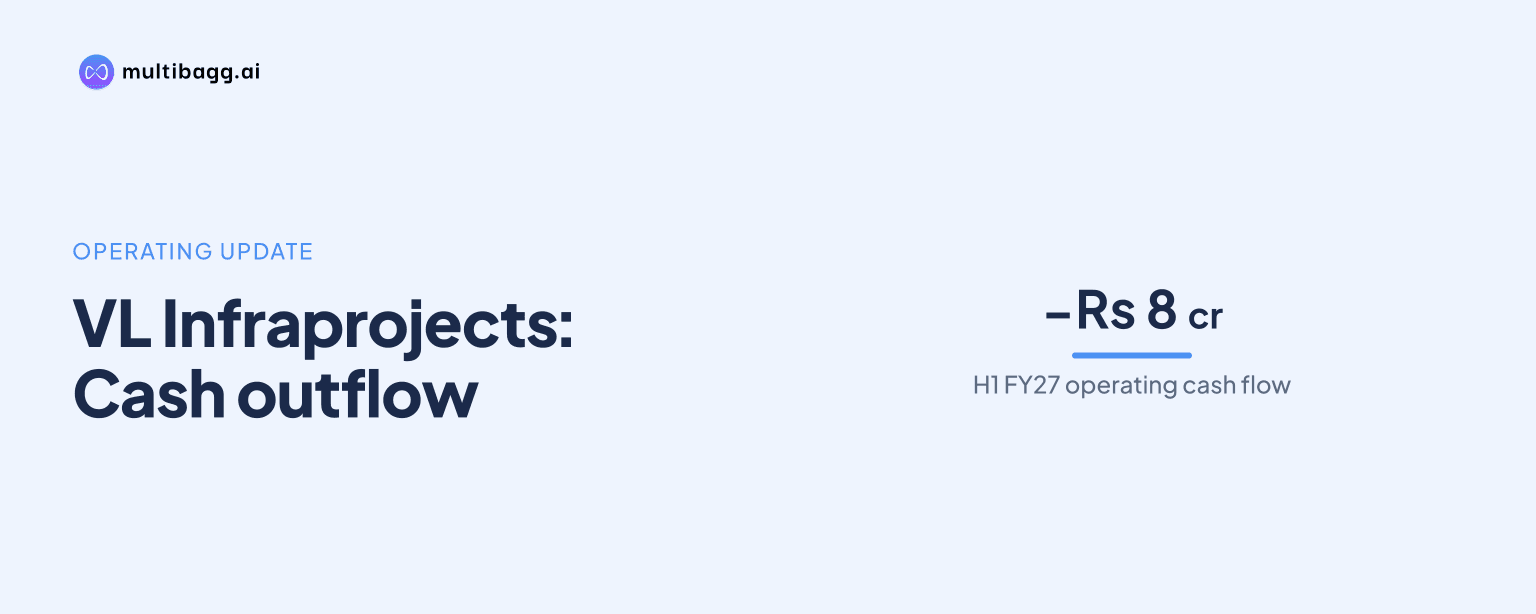
VL Infraprojects Limited said H1 FY27 operating cash flow was negative Rs 8 crore because water-project supply work typically releases about 60% of payment initially, while the remaining 40% is received as execution progresses. Management said positive operating cash flow is not practical while turnover keeps expanding under this payment structure.
Know V.L.Infraprojects inside out
Results, valuation, peers and who's buying, in one view.
Why does VL Infraprojects expect cash outflow during growth?
VL Infraprojects expects cash requirements to continue during growth because it procures pipes and other supply materials before receiving the full project payment. Management said roughly 60% of a supply component is released initially, while the remaining 40% stays pending until the execution portion is completed.
The company described this as a repeating cycle rather than a one-off cash event. Each new supply activity requires procurement, partial payment and later execution, creating further inventory, unbilled revenue and outstanding balances even when earlier projects begin releasing cash.
Management said positive cash flow would arise if the company stopped business, but said that is not consistent with continuing operations. This was its response to an investor who cited negative operating cash flow of Rs 8 crore in H1 FY27 and asked whether cash flow could turn positive in H2.
How have VL Infraprojects receivables and inventory changed?
VL Infraprojects had trade receivables of about Rs 27 crore after an almost 17% increase over six months, according to an investor’s question. Management said payments that were already in process were received by the end of October after the September 2026 half-year period.
Management gave May-to-October as an example of payment timing, saying a bill raised in May was paid in October. It also said Jal Jeevan Mission, or JJM, delayed payments were almost released during October and that the government had indicated payments would be regularised monthly or at least once every two months.
Inventory increased from about Rs 3 crore to nearly Rs 10 crore over 18 months, based on the investor’s comparison. Management said it buys steel and other materials for supply work, after which on-site execution takes time and part of the supply value remains tied up in inventory or project balances.
Management said inventory, unbilled revenue and retained supply payments are continuous features of water-project execution. It expects their absolute values to rise as the business grows, while saying their percentage of activity should remain almost the same; it did not disclose an inventory-ageing schedule or unbilled-revenue value.
What did VL Infraprojects say about JJM payment delays?
VL Infraprojects said JJM-related delayed payments were almost released in October 2026, including payments that had been in process before the September half-year close. The company did not identify a specific state or client responsible for the delay when asked about payment patterns.
The May bill paid in October illustrates a roughly five-month lag between billing and receipt in at least one instance. Management’s indication that payments could be regularised monthly, or at least every two months, was an account of what it said the government had communicated, not a disclosed contractual payment timetable.
The water-project structure can also affect payment timing because work is spread across numerous locations. Management said a project may require 25 to 30 underground sumps and five or six overhead tanks, while rights-of-way, or ROW, and land-acquisition issues can delay scattered construction activities.
Got a follow-up? Ask IRIS
How is VL Infraprojects funding working capital?
VL Infraprojects said its average borrowing cost is around 12%. Management confirmed that rate when asked about financing costs and said it would use 10% funding if available, gradually closing 12% borrowings in that circumstance.
Management did not give a FY27 debt target, a refinancing date or a schedule for moving from financial-institution borrowing to lower-cost bank facilities. It said borrowing would vary from time to time, making the amount of debt dependent on operating needs and funding availability.
An investor referred to about Rs 12 crore of unsecured financial-institution loans, but management did not separately confirm that amount in its answer. The confirmed disclosure was the average 12% borrowing cost, rather than a detailed debt mix or maturity profile.
Other expenses rose from Rs 3.55 crore in H1 of the prior year to Rs 5.18 crore in the current H1, an increase of Rs 1.63 crore. Management attributed the rise mainly to bank-limit and working-capital-limit renewal charges, while noting that professional expenses, initial public offering expenses and site costs also sit within other expenses.
Can VL Infraprojects grow revenue without increasing cash needs?
VL Infraprojects is targeting 20% year-on-year revenue growth for FY27 after H1 growth of 14%, according to the investor who raised the question. Management maintained the 20% target and said the final quarter is particularly important for engineering, procurement and construction, or EPC, companies.
Management did not provide an operating-cash-flow target alongside its revenue objective. Its explanation indicates that higher turnover can increase near-term cash needs, because each additional supply order can leave about 40% of its supply value awaiting execution-linked payment.
The company is participating in Rs 200 crore to Rs 250 crore of tenders and is targeting around Rs 200 crore of new orders in FY27. Management said it expected at least Rs 100 crore in the coming quarter, but these are tender and order targets rather than booked revenue or cash collections.
Competition has changed the conversion backdrop. Management said its bid-to-win rate was around 20%, compared with roughly 40% two years earlier, and attributed the decline to more competition. It also said it generally qualifies for tenders around Rs 60 crore and, in some cases, up to Rs 150 crore.
Conclusion
VL Infraprojects’ H1 FY27 negative operating cash flow of Rs 8 crore reflects the payment mechanics management described: materials are procured for supply work, around 60% of payment is released initially, and roughly 40% follows execution. Receivables of about Rs 27 crore and inventory nearing Rs 10 crore show the scale of balances associated with that operating cycle.
The next disclosures to watch are whether JJM receipts become monthly or at least every two months as management said the government indicated, and whether October 2026 releases reduce receivables. Management’s 20% FY27 revenue-growth target, around Rs 200 crore new-order target and stated willingness to replace 12% borrowing with 10% funding if available will also affect working-capital funding needs.

