








VL Infraprojects Limited expands civil work as win rate falls
MAX Plan at ₹4,999/yr

Find your next multibaggerBe a Pro Investor
Research stocks and track your picks on the go. Download the app.
Key highlights
- VL said its water-project tender strike rate had fallen from about 40% to about 20%.
- VL is targeting civil-work assignments worth Rs 50 crore to Rs 100 crore, versus Rs 10 crore to Rs 20 crore currently under way.
- Management said Gujarat water tenders currently draw five to 10 bidders, mostly local players.
- VL is bidding in Andhra Pradesh, Telangana, Odisha and Bihar and expects projects in one or two locations in the next half-yearly period.
powered by IRIS
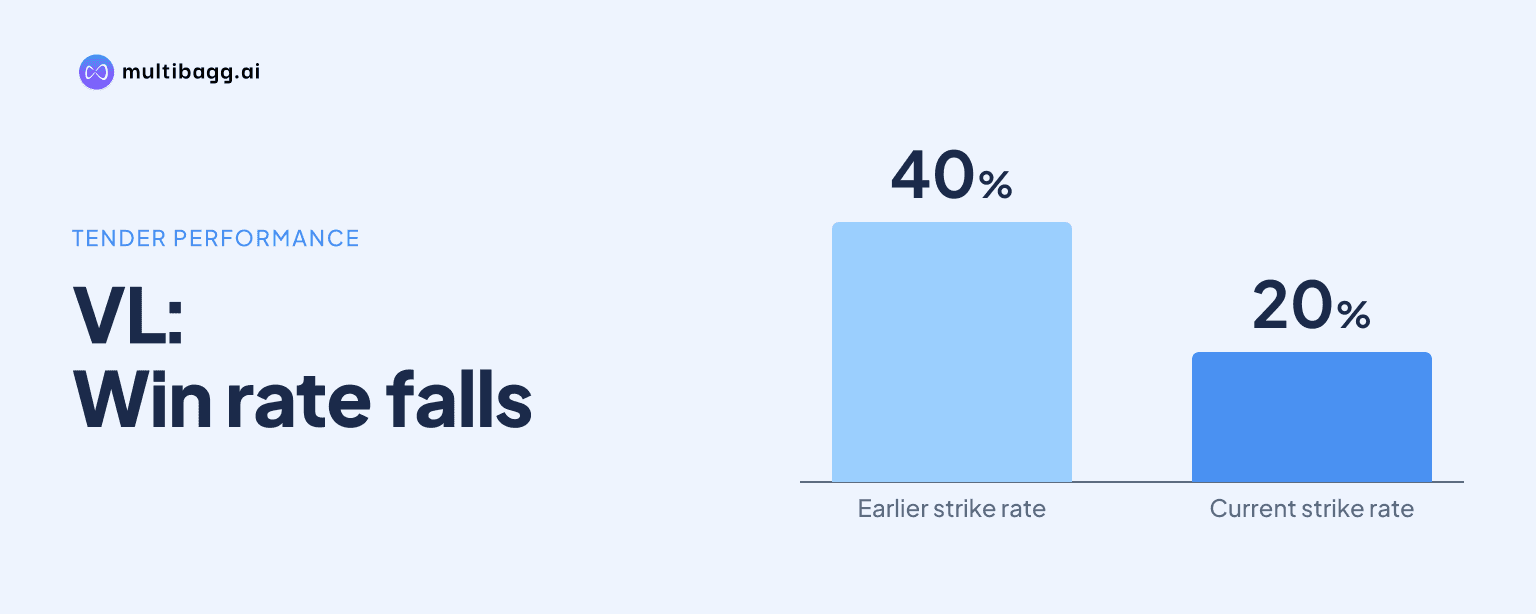
VL Infraprojects Limited is expanding private building-construction subcontracting as management said its water-project tender strike rate had fallen from about 40% to 20% amid heavier competition. VL is seeking to scale civil assignments from the Rs 10 crore to Rs 20 crore range currently under way to Rs 50 crore to Rs 100 crore.
Know V.L.Infraprojects inside out
Results, valuation, peers and who's buying, in one view.
Why is VL expanding civil work?
VL is expanding civil work because management sees more aggressive pricing in government water tenders. Management said the tender strike rate had reduced to about 20% from roughly 40% previously as competition increased. It said some bidders quote 10% below their estimate, while VL would not take a tender by quoting 12% below because its own costing would not change.
The company described the new activity as private building-construction work executed on a subcontract basis. During the call, an investor said subcontracting costs had increased to 43% of revenue from 30%, while civil works accounted for about 20% of revenue. Management clarified that VL was obtaining subcontract work for building construction, rather than subcontracting its own water-project work.
Management said it had not taken building-construction railway work under current conditions, but was still trying to secure larger building assignments. It said work worth Rs 10 crore to Rs 20 crore was under way and set a target of taking projects worth Rs 50 crore to Rs 100 crore. This was a management target, not a disclosed order win or revenue forecast.
How large could VL's civil contracts become?
VL plans to pursue civil assignments worth Rs 50 crore to Rs 100 crore, compared with Rs 10 crore to Rs 20 crore currently under way. Management also said the civil-work component discussed at 20% could potentially become 40% to 50%, while cautioning that it was only an illustration and not an exact forecast. No timetable for this mix change was disclosed.
VL said its credentials generally qualify it for tenders worth around Rs 60 crore, with qualification reaching Rs 150 crore in some locations, including Bihar. Management said joint ventures are used where the company does not qualify for one or two tender items. Such arrangements are for credentials rather than project execution, distinguishing them from the private subcontracting model.
Management did not disclose a civil-work margin figure. It said profitability varies by project and is confidential, but indicated building work could be somewhat better than water works. It also linked the civil-work expansion to lower unbilled revenue than water projects, where scattered sites and staged execution can delay billing.
How is VL responding to aggressive water bidding?
VL is continuing to bid for water projects while maintaining its internal cost discipline. Management said a 20% strike rate can still produce projects when tender volumes rise, but it would not accept work solely to increase order intake. In Gujarat, management said a project currently has five to 10 bidders, most of them local players.
Tender assessment begins with eligibility and then a physical site visit, according to management. It said pipe costs can be similar across Gujarat, Hyderabad and Karnataka, but on-site civil costs vary by local conditions. VL declined to disclose a minimum profitability threshold, saying each project carries its own required profitability.
Water pipeline remained the largest disclosed operating segment. An investor said water pipeline contributed 57% of revenue and 80% of the order book, while irrigation and sewage contributed 12% of revenue against 5% of the order book. Management did not directly state that water-pipeline execution was slowing, instead saying it was trying to increase work in civil construction and other areas.
VL said government water contracts provide price variation for pipes: contract values decline if pipe prices fall and rise if they increase. Management did not specify equivalent protection for steel, cement, fuel or transport. It cited a previous period when steel rose from Rs 50,000 per tonne to about Rs 80,000 to Rs 85,000 per tonne as an example of a disruption that cannot be assessed in advance.
Got a follow-up? Ask IRIS
Where is VL seeking work beyond Gujarat?
VL is participating in water-supply tenders in Andhra Pradesh, Telangana, Odisha and Bihar. Management said it expected new projects in at least one or two places during the next half-yearly period. It also said it had already bid in Odisha and Bihar without securing work, and that one or two unsuccessful tenders were insufficient to draw a conclusion.
Gujarat will remain VL's principal market, management said, while the company seeks to establish a second location. An investor said Gujarat represented 72% of the order book, compared with 62% of FY26 revenue, and Andhra Pradesh represented 6% of the order book. Management described the Andhra Pradesh work as building-construction subcontracting and distinguished it from planned government water bids in Andhra Pradesh and Telangana.
The strategy also operates alongside working-capital demands in water projects. Management said supply activity can release 60% of payment while the remaining 40% is held until execution progress, making sustained positive cash flow impractical while turnover grows. It said Jal Jeevan Mission payments were largely released in October, including payment for a bill raised in May, after an investor cited trade receivables of about Rs 27 crore.
What sectors is VL considering next?
VL is considering building construction, power, solar, railway and water opportunities, though management said water would continue while newer segments are tested. It said it was working on power engineering, procurement and construction, or EPC, opportunities and would pursue solar projects depending on competition. Management said it could consider 5% or 10% in its calculations, but would proceed only if the offered rate met its assessment.
Management had previously discussed a Rs 500 crore revenue ambition by 2030, but said it could not currently assign a rupee contribution to power or other new sectors. It said operating in two or three sectors for six to 12 months would provide a clearer basis for expansion. On funding, management said no immediate financing was required, though it expected funding would be needed in the future depending on requirements.
Conclusion
VL's stated response to water-sector pricing pressure is to retain bidding discipline while increasing private subcontracted civil work. The fall in its reported tender strike rate to about 20% from roughly 40%, alongside five to 10 bidders in Gujarat tenders, explains management's plan to move from Rs 10 crore to Rs 20 crore civil assignments toward Rs 50 crore to Rs 100 crore projects.
The next indicators are management's expectation of one or two project wins across Andhra Pradesh, Telangana, Odisha and Bihar in the next half-yearly period. Investors can also watch completion of Jalundra by January and Telangana and Shela by March, as well as whether the stated two-month payment regularisation for government water work improves working-capital timing.

