










Waa Solar targets 300 MW by 2030 through four business avenues
Key highlights
- Waa Solar targets a 300 MW portfolio by 2030 across standalone solar, solar plus BESS, standalone BESS and C&I offtake.
- Waa Solar’s 48.15 MW Madhya Pradesh feeder-solarisation project had achieved financial closure in principle and begun on-ground execution by 30 September 2026.
- Waa Solar commissioned its 1.5 MW Mitana project in Gujarat by 30 September 2026; its separate 4 MW Paddhari project has no disclosed construction status.
- Waa Solar’s H1 FY2026-27 consolidated revenue rose 93.9% to Rs 17.09 crore, while EBITDA increased 58.6% to Rs 12.54 crore.
powered by IRIS
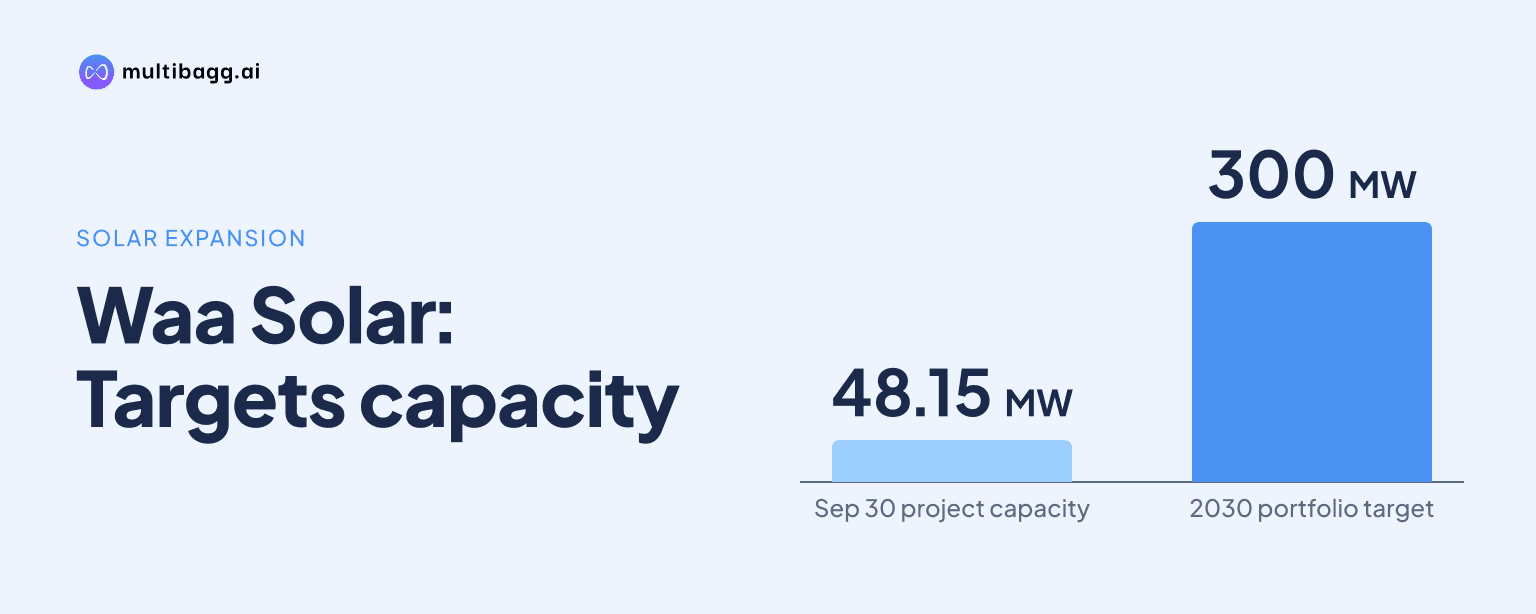
Waa Solar Limited targets a 300 MW portfolio by 2030 across standalone solar, solar plus battery energy storage systems, standalone storage and commercial and industrial offtake. Its principal capacity-disclosed project is a 48.15 MW Madhya Pradesh feeder-solarisation plant, where financial closure was achieved in principle and on-ground execution had started by 30 September 2026.
Know Waa Solar inside out
Results, valuation, peers and who's buying, in one view.
How will Waa Solar reach 300 MW by 2030?
Waa Solar plans to reach 300 MW by 2030 through four avenues: standalone solar, solar plus battery energy storage systems (BESS), standalone BESS, and commercial and industrial (C&I) offtake. The company describes the plan as an integrated renewable-platform strategy, extending its project base beyond standalone solar development.
Waa Solar identifies feeder-level solarisation under PM-KUSUM C as the scheme supporting its disclosed Madhya Pradesh and Gujarat projects. The 300 MW target is more than six times the 48.15 MW Madhya Pradesh project under execution, but the presentation does not provide annual capacity additions or allocate the target between its four stated avenues.
Waa Solar’s proposed firm and dispatchable renewable energy (FDRE) model combines solar and BESS to provide guaranteed capacity through long-term contracts. Management says payments would be structured as recurring Rs lakh per megawatt-hour per month over power purchase agreements lasting 20 to 25 years; no awarded FDRE capacity, tariff or commissioning timetable is disclosed.
What projects is Waa Solar implementing?
Waa Solar’s 48.15 MW Madhya Pradesh project is a feeder-level solarisation plant for Madhya Pradesh Urja Vikas Nigam Ltd. Awarded under PM-KUSUM C in FY2025-26, it had achieved financial closure in principle, completed land acquisition, secured major long-lead components and begun on-ground execution as of 30 September 2026.
In Gujarat, Waa Solar lists 5.5 MW across Mitana, with 1.5 MW, and Paddhari, with 4 MW, for Paschim Gujarat Vij Company Ltd. The projects are part of 47.5 MW of PM-KUSUM C projects for that client, and the presentation states that Mitana’s 1.5 MW project was commissioned by 30 September 2026. It gives no separate construction status for Paddhari.
Waa Solar also lists seven special-purpose vehicles under the Surya Mitra Krishi Feeder Scheme in Madhya Pradesh. They are intended to develop grid-connected solar plants selling power to MPPMCL at Satipura, Tawlai, Awalda, Kalibawadi, Talanpur, Narayanpura and Utawad, although the presentation gives no capacity, award date or operating schedule for these entities.
Got a follow-up? Ask IRIS
How is Waa Solar positioning its funding for growth?
Waa Solar says long-tenor FDRE power purchase agreements are intended to support project finance, while retained earnings and green capital pools would fund the 300 MW build-out to 2030. This is the company’s stated funding approach, rather than disclosed committed financing, as the presentation provides no capital requirement, equity-raising schedule or green-capital amount.
Consolidated borrowings and net debt rose between 31 March 2026 and 30 September 2026, while cash and bank balances fell. Property, plant and equipment increased by Rs 11.91 crore to Rs 193.21 crore over the same period, but the presentation does not attribute the movement to the 48.15 MW project or another specific asset.
The consolidated net debt-to-equity ratio increased to 0.90 times at 30 September 2026 from 0.73 times at 31 March 2026. In H1 FY2026-27, consolidated revenue from operations was Rs 17.09 crore, up 93.9%, while earnings before interest, tax, depreciation and amortisation were Rs 12.54 crore, up 58.6%; the presentation does not connect this growth to the Madhya Pradesh project.
What new markets is Waa Solar pursuing?
Waa Solar plans a 2 GW cell-to-container BESS manufacturing line. Management says the line would provide a vertical cost advantage and support project internal rates of return across the proposed 300 MW portfolio, but the presentation does not disclose its location, investment, production date or existing manufacturing capacity.
In C&I offtake, Waa Solar proposes open-access and group-captive structures with credit-worthy corporate counterparties. Management says these structures can generate tariffs above distribution-company rates, but the presentation names no counterparty, signed capacity, tariff or operating C&I project.
Waa Solar also identifies maritime decarbonisation using a methane-and-BESS hybrid intended to replace diesel in shipping. Technology tie-ups with marine original equipment manufacturers are under evaluation, and management targets a pilot vessel in FY28, without naming a vessel owner, supplier, pilot capacity or commercial agreement.
Conclusion
Waa Solar’s 2030 strategy combines a 300 MW target with a current project base led by the 48.15 MW Madhya Pradesh feeder-solarisation plant. The 1.5 MW Mitana project was commissioned by 30 September 2026, while FDRE, BESS, C&I offtake and manufacturing are presented as routes to expand beyond the company’s solar-project base.
The next disclosed milestones are execution progress at the 48.15 MW project, further definition of the seven Madhya Pradesh special-purpose vehicles and financing detail for the 300 MW build-out. Management’s FY28 pilot-vessel target is the only dated milestone stated for the maritime initiative.