










Wardwizard contests Rs 19.94 crore claims without provisions
Key highlights
- Wardwizard disclosed customs and income-tax claims with stated base demands totalling Rs 19.94 crore.
- Wardwizard appealed the Rs 12.36 crore customs order on 28 April 2026.
- Wardwizard received a Rs 7.58 crore income-tax demand during the quarter ended 30 September 2026 and preferred an appeal.
- Wardwizard reported a standalone loss after tax of Rs 5.82 crore for the quarter ended 30 September 2026.
powered by IRIS
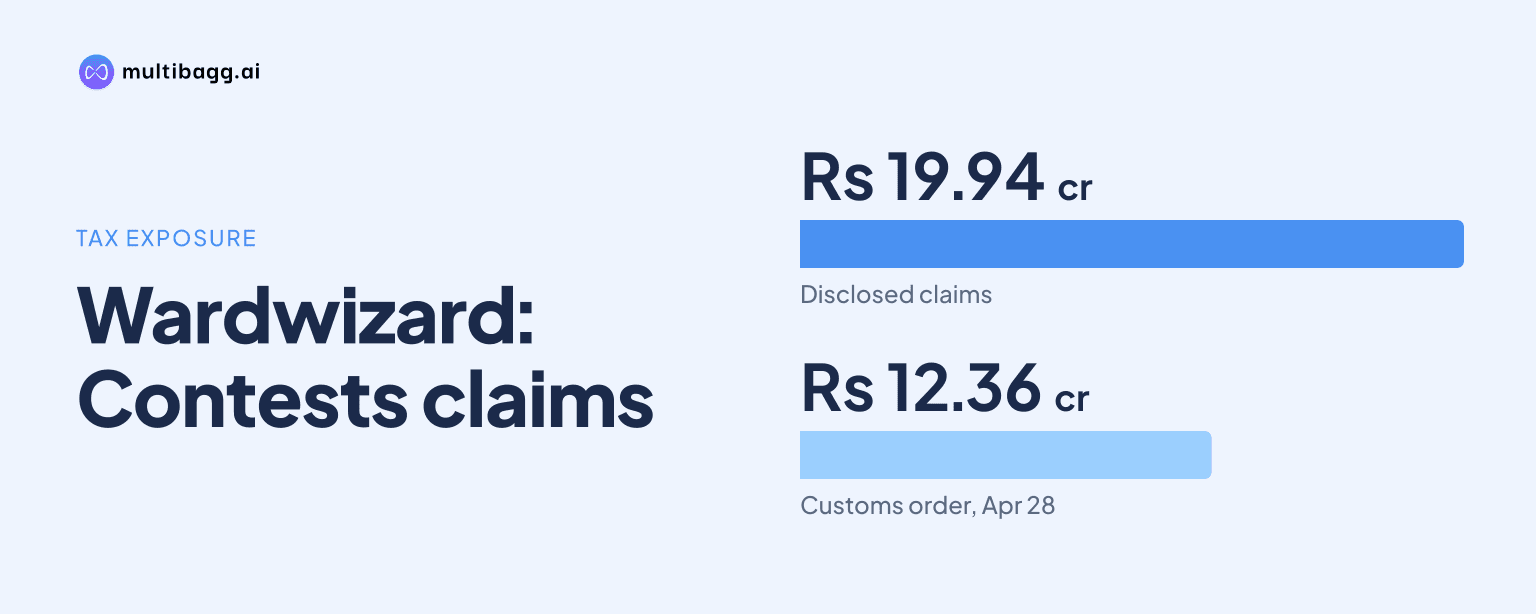
Wardwizard Innovations & Mobility Limited has disclosed appealed customs and income-tax demands with stated base amounts totalling Rs 19.94 crore, without recording provisions in its 30 September 2026 financial statements. Wardwizard cited legal advice for the customs case and the merits of its income-tax case, while reporting a Rs 5.82 crore quarterly loss.
Know Wardwizard Innovations & Mobility inside out
Results, valuation, peers and who's buying, in one view.
What claims is Wardwizard contesting?
Wardwizard is contesting a Rs 12.36 crore differential customs-duty demand and a Rs 7.58 crore income-tax demand, producing stated base claims of Rs 19.94 crore. The customs demand also includes applicable interest and penalties, but Wardwizard did not quantify those components, so the combined figure does not represent a disclosed maximum cash outflow.
The customs matter originated in a show-cause notice dated 18 March 2023 from the Commissioner of Customs, Nhava Sheva, following an inquiry by the Directorate of Revenue Intelligence, Ahmedabad, on 25 and 26 March 2022. The adjudicating authority passed an order on 2 February 2026, which Wardwizard said was communicated on 16 February 2026.
Wardwizard said it received the Rs 7.58 crore income-tax demand during the quarter ended 30 September 2026. The filing linked that matter to search activity conducted by the income-tax authority at Wardwizard's corporate office and manufacturing unit in February 2024, when the company said it provided requested details, clarifications and documents.
Why did Wardwizard make no provisions for the demands?
Wardwizard made no provision because it said it expects favourable outcomes in both appeals. For the Rs 12.36 crore customs matter, Wardwizard said its view was based on legal advice and that it does not expect a material financial outflow, leading it to classify the matter as a contingent liability.
For the Rs 7.58 crore income-tax demand, Wardwizard said it is confident of a favourable outcome based on the merits of the case. It therefore described the demand as contingent in nature and said no provision was considered necessary in the financial statements for the quarter and half year ended 30 September 2026.
The two cases are at different disclosed stages. Wardwizard filed the customs appeal before the appropriate appellate authority on 28 April 2026, after the 2 February 2026 order, whereas it said only that the income-tax demand was received and appealed during the quarter ended 30 September 2026. The filing gives neither the income-tax appeal date nor a decision timetable for either case.
Got a follow-up? Ask IRIS
What did Wardwizard's auditor say about the customs matter?
Wardwizard's statutory auditor, VCA & Associates, drew attention to the customs contingent liability in its limited review report dated 7 November 2026. The auditor referred specifically to Note 6, covering the Nhava Sheva customs show-cause notice, the subsequent order and Wardwizard's appeal.
VCA & Associates said its conclusion was not modified in respect of the customs matter. For the unaudited standalone results for the quarter and half year ended 30 September 2026, it said nothing had come to its attention to indicate that the results were not disclosed as required or contained a material misstatement; it also stated that a limited review provides less assurance than an audit.
The auditor additionally highlighted Note 9, which addresses disruption in Wardwizard's electric-mobility business and ancillary ecosystem. Wardwizard attributed the pressure to supply constraints largely arising from global disruptions, saying they had dampened market demand, while the auditor did not modify its conclusion in relation to that emphasis-of-matter disclosure.
How did Wardwizard's September 2026 results compare with last year?
Wardwizard reported a standalone loss after tax of Rs 5.82 crore for the quarter ended 30 September 2026, compared with a profit after tax of Rs 17.45 lakh for the quarter ended 30 September 2025. Loss before tax was Rs 5.81 crore in the latest quarter, against profit before tax of Rs 9.50 crore a year earlier.
For the half year ended 30 September 2026, Wardwizard recorded a loss after tax of Rs 5.63 crore, compared with profit after tax of Rs 1.29 crore in the corresponding half year of 2025. The company reported one operating segment, Electric Mobility Vehicles, through its dealership network, so the filing does not provide segment-level figures separating the impact of the supply constraints.
Wardwizard said it is diversifying its supplier base for critical components, renegotiating arrangements and arranging additional working-capital facilities. Management said it hopes business sentiment will improve and disruptions will reduce in the ensuing quarter, but those statements describe its plan and expectation rather than reported outcomes as of 7 November 2026.
Conclusion
Wardwizard has left the Rs 19.94 crore of stated customs and income-tax base demands outside provisions because management expects favourable outcomes from its appeals. The customs claim is larger at Rs 12.36 crore, carries unquantified interest and penalties, and was specifically highlighted in the limited review report, while the income-tax claim was Rs 7.58 crore.
The next disclosures to watch are decisions or other developments in the customs appeal filed on 28 April 2026 and the income-tax appeal preferred during the September 2026 quarter. Wardwizard's disclosed supplier-diversification, renegotiation and additional working-capital plans are also relevant because the company said supply disruptions affected its Electric Mobility Vehicles business.