










Welspun Enterprises Limited Sees $300m-$400m Mumbai Gas Savings
Key highlights
- Welspun Enterprises expects ONGC infrastructure sharing to cut Mumbai block capital costs by about $300 million-$400 million.
- Welspun Enterprises targets early Mumbai block revenue in FY29, subject to revised EDP approval and project execution.
- The Mumbai block has about 0.6 Tcf of producible gas and about 20 lakh barrels of oil or condensate.
- Welspun Enterprises reported Rs 1,432 crore of cash and cash equivalents as of September 30, 2026.
powered by IRIS
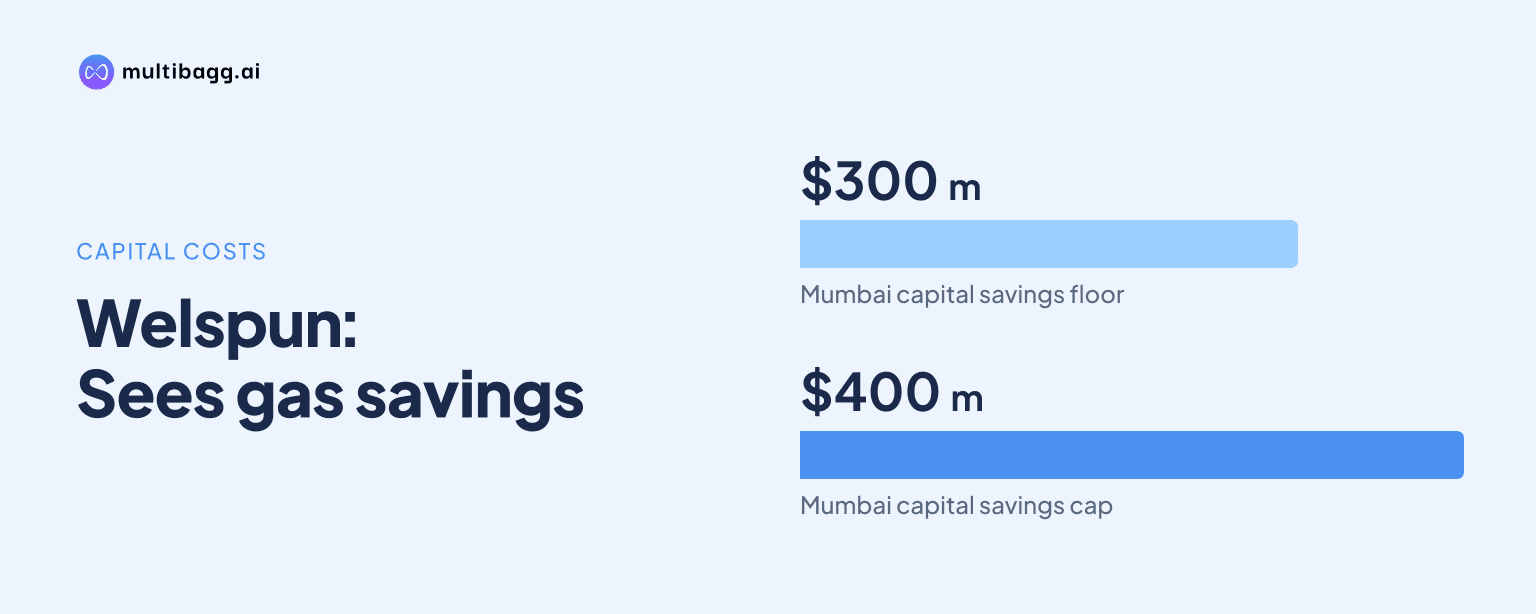
Welspun Enterprises said on November 6, 2026, that its Mumbai gas block development could avoid about $300 million-$400 million of capital expenditure by using Oil and Natural Gas Corporation infrastructure, with early revenue targeted in FY29 subject to approval of a revised development plan. The arrangement replaces a longer standalone pipeline route with toll-based access to existing offshore and Hazira facilities.
Know Welspun Enterprises inside out
Results, valuation, peers and who's buying, in one view.
How will Welspun Enterprises lower Mumbai block capital costs?
Welspun Enterprises expects to reduce the Mumbai block's capital cost by about $300 million-$400 million by using existing Oil and Natural Gas Corporation, or ONGC, assets rather than building a full independent gas evacuation and processing system. Management said the original development concept involved a substantially longer pipeline to shore, while the revised plan avoids a significant part of that construction cost.
The planned arrangement changes part of the spending from upfront capital investment to toll-based operating expense. Management said this should lower overall development risk because the project would rely on operating facilities rather than requiring construction of all-new evacuation, transport and processing infrastructure. The company did not disclose its final project capital budget because the revised plan remains before the regulator.
What ONGC facilities will Welspun Enterprises use for Mumbai gas?
Welspun Enterprises plans to use a chain of ONGC facilities beginning with the unmanned B-12-11P platform, which management said is about 30 kilometres from the platform planned for the Mumbai block. Gas and condensate from the block would be transported to B-12-11P before moving to ONGC's TCPP offshore processing platform.
After offshore processing, the gas would travel through the SBHT pipeline to Hazira for further processing. Management said the processed gas could then be injected into the grid at Hazira at medium and high pressure. This access to established facilities is the operational mechanism behind the expected $300 million-$400 million reduction in capital cost and the shorter route to first revenue.
What has the Directorate General of Hydrocarbons approved?
The Directorate General of Hydrocarbons, or DGH, has approved Adani Welspun Exploration Limited, or AWEL, to use ONGC's existing facilities on a toll basis to evacuate and process gas from the Mumbai block. Management said the DGH order identifies the facilities AWEL can use under the Ministry of Petroleum and Natural Gas infrastructure-sharing policy issued in June 2025.
Welspun Enterprises has revised its early development plan, or EDP, to reflect the approved infrastructure-sharing route and has submitted it to DGH. Management said it expects approval soon, but did not give a date. It also said final investment, production, revenue and profitability figures will be fixed only after the revised EDP receives approval.
When could Welspun Enterprises earn Mumbai block revenue?
Welspun Enterprises targets early revenue from the Mumbai block in FY29, conditional on revised EDP approval and successful development and production. Management said the use of ONGC infrastructure reduces the amount of physical work needed compared with the earlier pipeline-led concept, which supports the timing target.
The company disclosed about 0.6 trillion cubic feet, or Tcf, of producible gas and about 20 lakh barrels of oil or condensate for the block. Management did not estimate revenue because it depends on production volumes and the gas and condensate prices used in the eventual calculation. It also did not provide a first-gas date or a profitability target during the November 6 call.
Got a follow-up? Ask IRIS
How does the Mumbai gas plan fit Welspun Enterprises' capital strategy?
Welspun Enterprises is developing the gas block alongside an infrastructure strategy that includes recycling capital from operational road assets. In Q2 FY27, the company completed the sale of a 51% stake in the Mukarba Chowk-Panipat Road Project and recorded a gain of Rs 194 crore. Management described such monetisation as part of its asset-light model.
The company reported Rs 1,432 crore of cash and cash equivalents, Rs 450 crore of net debt and Rs 3,581 crore of net worth as of September 30, 2026. Its net debt-to-equity ratio was 0.2 times. The ONGC arrangement is separate from road-asset sales, but both reflect management's stated aim of limiting the capital committed to individual projects.
What remains unresolved in Welspun Enterprises' Mumbai block plan?
Welspun Enterprises still requires DGH approval of the revised EDP before it can disclose the final capital commitment, expected revenue or profitability for the Mumbai block. Management cited confidentiality constraints and said the reported $300 million-$400 million reduction is an expected saving against the original development concept, rather than a final total project-cost estimate.
The call also did not disclose toll rates, capacity allocation, operating terms or the schedule between revised EDP approval and the FY29 revenue target. The development depends on the practical use of B-12-11P, TCPP, the SBHT pipeline and Hazira. Management's stated case is that existing infrastructure lowers risk by reducing new construction work and bringing potential revenue forward.
Conclusion
The DGH-approved framework changes the Mumbai block from a development centred on a longer independent pipeline into one that uses ONGC's offshore processing, transport and Hazira facilities. Welspun Enterprises expects the shift to avoid about $300 million-$400 million of capital expenditure, replace part of that outlay with toll-based costs and support early revenue in FY29. The disclosed resource base is about 0.6 Tcf of producible gas and 20 lakh barrels of oil or condensate.
The next milestone is DGH approval of the revised EDP, which management said it expects soon. Investors should watch for the company's disclosure after that decision of final capital investment, production assumptions, revenue and profitability, as well as progress toward the FY29 early-revenue target.